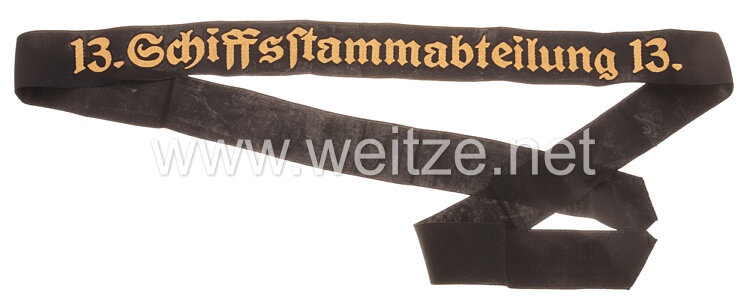
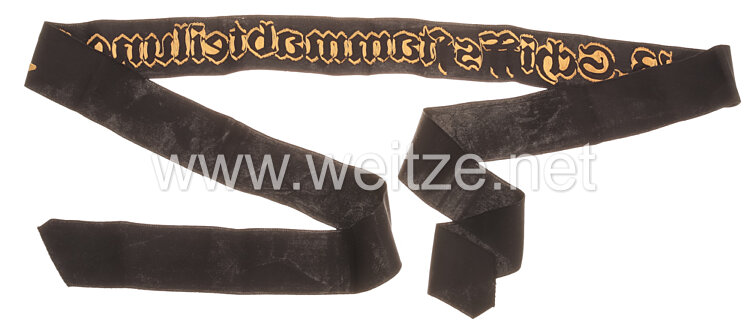
Kriegsmarine Cap Tally “13. Schiffsstammabteilung 13.”
The cap tally of the 13. Schiffsstammabteilung (13th Ship Crew Division) represents an important aspect of the organizational and training structure of the Kriegsmarine during World War II. Ship crew divisions were central institutions for the training, administration, and assignment of naval personnel, playing an indispensable role in the personnel management of the German Navy.
Historical Context of Ship Crew Divisions
The Schiffsstammabteilungen were established as administrative and training units to manage the constantly growing personnel requirements of the expanding Kriegsmarine. After the seizure of power in 1933 and open rearmament from 1935, the Navy required an efficient system for training and assigning crew members. The 13th Schiffsstammabteilung was one of several such units distributed across various naval bases throughout the German Reich.
These divisions served multiple purposes: they were assembly points for newly conscripted recruits, training facilities for basic maritime skills, and administrative centers for assigning personnel to active ships and units. Sailors assigned to a Schiffsstammabteilung underwent their basic training there before being transferred to warships, U-boats, or coastal installations.
The Cap Tally as Identification Feature
The cap tally (Mützenband) was an essential component of the Kriegsmarine uniform for enlisted ranks. Worn on the characteristic sailor's cap (Tellermütze), it served to identify a sailor's affiliation with a specific ship or unit. The tradition of cap tallies dates back to the Prussian and Imperial German Navy and was continued in the Kriegsmarine.
Cap tallies were woven from black cotton thread and bore the name of the ship or unit in golden-yellow script. The standardized length was approximately 110-115 cm, which allowed for a bow at the back of the head. According to Kriegsmarine uniform regulations, wearing the correct cap tally was mandatory and part of military discipline.
Production and Procurement
The production of cap tallies was carried out by specialized textile companies that received contracts from the Kriegsmarine. The weaving technique allowed the integration of the golden-yellow lettering directly into the black base fabric. Quality standards were strictly monitored, although toward the end of the war, particularly from 1943/44 onwards, material and quality deterioration became noticeable.
For ship crew divisions, cap tallies were ordered in larger quantities and issued to assigned personnel. Each sailor typically received several cap tallies, as they wore out with intensive use and frequent washing.
Organization of the 13th Schiffsstammabteilung
Although specific details about the exact location and operational area of the 13th Schiffsstammabteilung may vary in different sources, it followed the general organizational principle of these units. A Schiffsstammabteilung was typically commanded by a Corvette Captain or Frigate Captain and comprised several hundred to over a thousand men, depending on the war phase and requirements.
Training in the ship crew divisions included military drill, theoretical instruction in navigation and seamanship, practical exercises on guns and technical equipment, and physical conditioning. The duration of training varied depending on personnel specialization.
Collector and Documentation Value
Kriegsmarine cap tallies are today important historical documents and sought-after collector's items. They enable the reconstruction of the Kriegsmarine's organizational structure and help identify units and their history. For military historians, they are valuable primary sources for researching personnel structure and organization.
The present specimen in condition 2 (lightly worn) shows typical signs of use from service deployment. The preserved length of 112 cm corresponds to standard measurements. Such authentic, worn pieces are historically more valuable than unused warehouse stocks, as they were actually used in service and thus represent direct witnesses to naval history.
Historical Classification
The Schiffsstammabteilungen existed throughout the entire duration of the Kriegsmarine from 1935 to 1945. As the war progressed and losses in personnel and material increased, their importance as training and replacement units became ever more critical. Toward the end of the war, many members of ship crew divisions were also deployed for land-based defense tasks.
Today, these cap tallies remind us of the complex organization of a navy that had hundreds of thousands of men in its ranks between 1939 and 1945, and whose history is inseparably linked with the events of World War II.