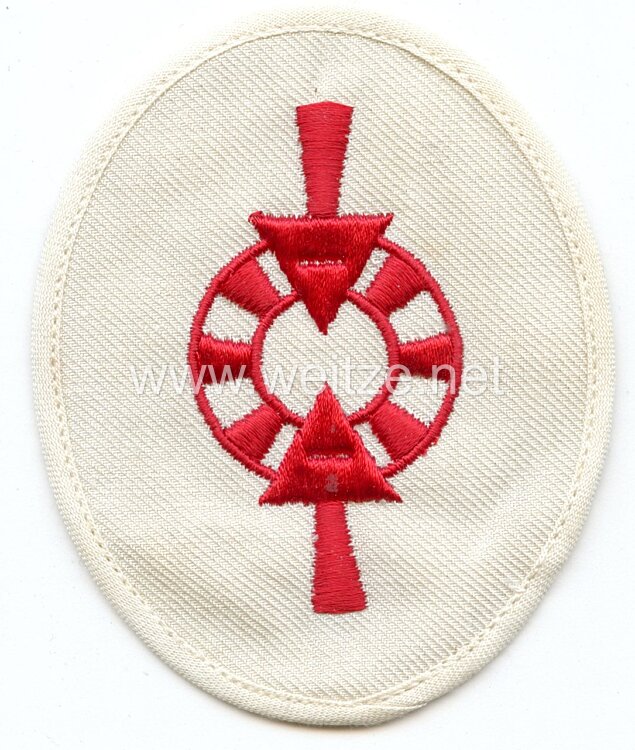
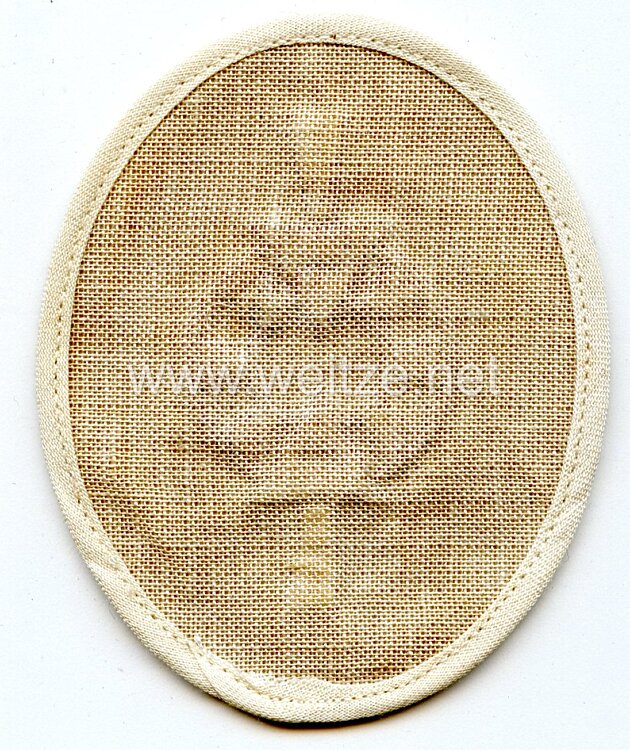
Kriegsmarine Sleeve Insignia Special Training Fire Control Petty Officer (Troop Training)
The Kriegsmarine Sleeve Badge for Special Training Fire Control Petty Officer represents a fascinating example of the differentiated badge system of the German Kriegsmarine during World War II. These specialized sleeve badges were introduced to visibly identify the special skills and technical qualifications of non-commissioned officers and enlisted personnel.
The Kriegsmarine, as the naval force of National Socialist Germany from 1935 to 1945, developed a complex system of uniform insignia and rank markings. Particularly significant were the career badges and special training badges worn on the sleeves of various uniform types. The badge described here was intended for wear on the white blouse, the summer service uniform of the Kriegsmarine.
The Waffenleitvormann (Fire Control Petty Officer) designated a specially trained non-commissioned officer in the field of fire control technology. This position was crucial to a warship's combat effectiveness, as it encompassed the precise control and coordination of naval artillery. Fire control in 20th-century modern naval warfare was a highly complex technical task requiring extensive mathematical calculations, technical understanding, and precise operation of optical and electronic equipment.
Training to become a Fire Control Petty Officer took place in specialized naval schools and included theoretical instruction as well as practical exercises. Graduates had to be familiar with ballistic calculations, operation of rangefinders, fire control devices, and later also with radar systems. This technical specialization was characteristic of the increasing mechanization of naval warfare.
Kriegsmarine sleeve badges were worn in accordance with dress regulations and uniform directives, which precisely specified which badges were to be worn on which uniform and at which position. The white blouse, also called the white service blouse, was worn during summer months or in warmer climates. Badges on this uniform were usually in dark blue to provide necessary contrast against the light background.
The production of these badges was carried out by various manufacturers and insignia factories that produced for the Wehrmacht. Quality could vary from machine-made standard versions to hand-embroidered examples of higher quality. Badges were either factory-sewn onto uniforms or attached by the wearers themselves or by tailors.
Within the Kriegsmarine hierarchy, the position of Fire Control Petty Officer was part of the technical career track. This differed from other career paths such as deck officers, engineers, or medical officers. Technical specialists were indispensable for operating the increasingly complex weapons systems on warships, from small fast attack craft to large battleships and cruisers.
The historical significance of such badges today lies in their function as material evidence of the military organization and hierarchy of the Kriegsmarine. They document the specialization and professionalization of the naval forces and are important sources for military historical research. For collectors and museums, they represent important objects for documenting uniform history.
After the war ended in 1945, the Kriegsmarine was dissolved, and its uniforms and badges lost their official function. Many pieces were destroyed, others ended up in private collections as war souvenirs or were kept by former members. Today, such badges are the subject of historical collections and serve the scholarly examination of this epoch in German naval history.