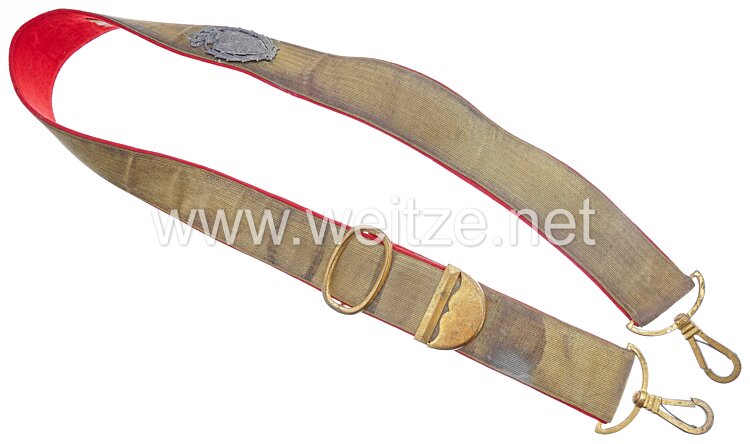
Kingdom of Saxony Bandolier for Cartridge Box, Officers Artillery/Train

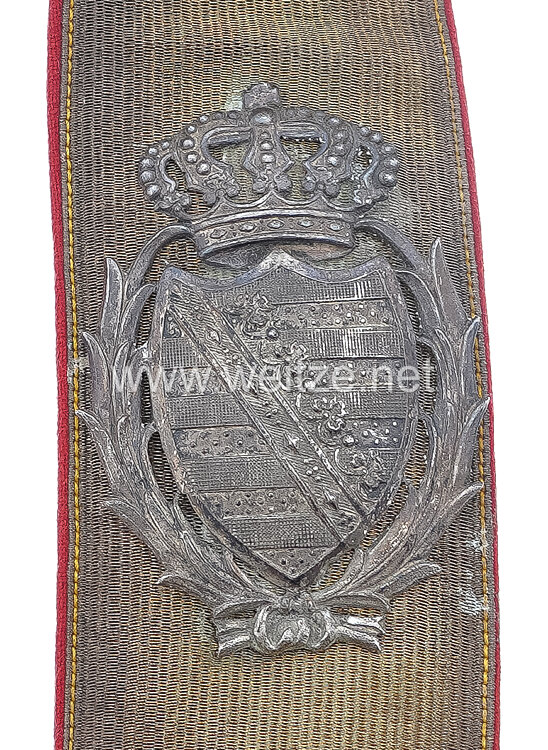
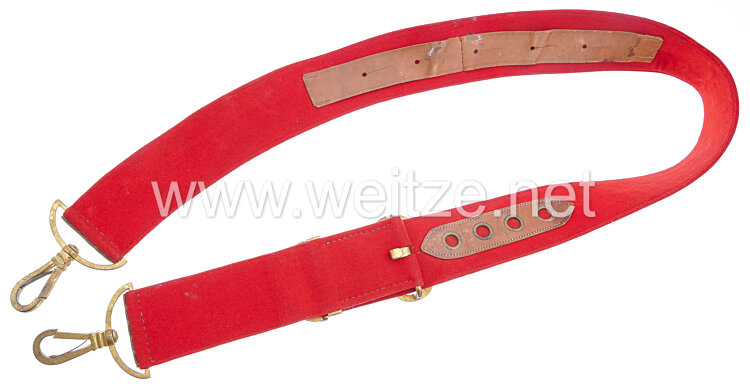
Circa 1910. Gold-colored braid with ponceau red cloth backing, with the Saxon state coat of arms applied in silver on the front. Condition 2.
465612
450,00

Kingdom of Saxony Bandolier for Cartridge Box, Officers Artillery/Train

The present object represents a bandolier for the cartridge box of an officer in the Saxon Artillery or Train from around 1910, as worn in the Kingdom of Saxony during the late Imperial era. This piece of military equipment embodies the high craftsmanship quality and representative character of officer equipment from that epoch.

The Kingdom of Saxony had been a federal state of the German Empire since 1871 and maintained its own royal army as the XII. (Royal Saxon) Army Corps. The Saxon army had a proud tradition and possessed its own uniform regulations that differed in details from those of other German federal states. The artillery and train played an important role in the organizational structure.

The bandolier, also referred to as a cartridge box strap or ammunition pouch suspension, served to attach and carry the cartridge box, a leather pouch for storing ammunition. For officers, however, this element increasingly had a representative character, as officers no longer typically fought with firearms in combat but performed command functions.

The gold-colored braid of this piece clearly indicates membership in the officer class. Gold was traditionally reserved for officers in the uniform regulations of the German Imperial armies, while non-commissioned officers and enlisted men wore silver-colored or simpler equipment. The braid was applied to a ponceau red cloth backing, a color characteristic of various branches of service.

The central element of this bandolier is the Saxon state coat of arms, applied in silver. The coat of arms of the Kingdom of Saxony traditionally displayed the crossed electoral swords on a golden field, sometimes supplemented by the characteristic rue crown of the Wettin dynasty. These heraldic elements were an integral part of Saxon military identity and appeared on numerous uniform parts and equipment items.

The dating to around 1910 places the piece in the late phase of the Saxon monarchy. King Friedrich August III had ruled since 1904 and would remain on the throne until his abdication in 1918. This period was characterized by increasing military tensions in Europe and an accelerated armament of the German armies. Army reforms under General von Heeringen and the continuous modernization of equipment characterized this era.

The Artillery of the Kingdom of Saxony comprised several field artillery regiments, foot artillery battalions, and was equipped with modern guns such as the Feldkanone 96 n.A. The Train, meaning the supply and transport troops, was also essential for the army's operational capability and became increasingly professionalized.

The craftsmanship of such bandoliers was the responsibility of specialized military effects manufacturers who had to maintain strict quality standards. Companies such as C.G. Haenel in Suhl or Saxon court suppliers manufactured these representative equipment pieces according to precise specifications from the royal clothing offices.

The indicated condition 2 suggests good to very good preservation, which is remarkable for a textile piece over 110 years old. This speaks to careful storage and possibly limited wear, which was not uncommon for officer equipment, as they often owned multiple sets.

With the end of World War I and the November Revolution of 1918, the German monarchies disappeared, including the Kingdom of Saxony. Traditional uniforms and equipment items with monarchical symbols became obsolete and were replaced by the standard equipment of the Reichswehr. Such historical pieces thereby acquired their character as witnesses to a vanished era.

Today, such objects are important collector's items and museum pieces that provide insight into military history, craft culture, and the social order of the German Empire. They document the significance of rank, tradition, and regional identity in the military sphere of the pre-war period.