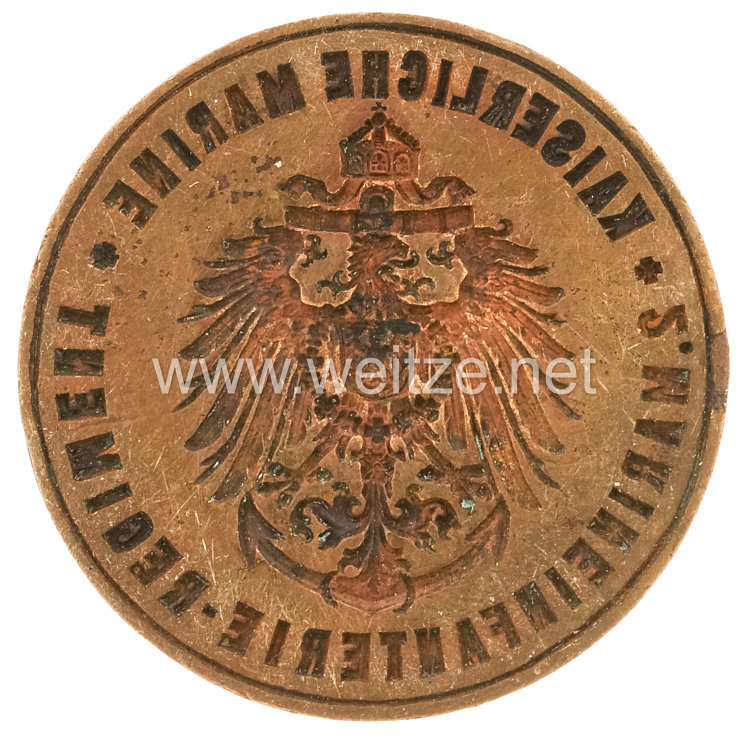
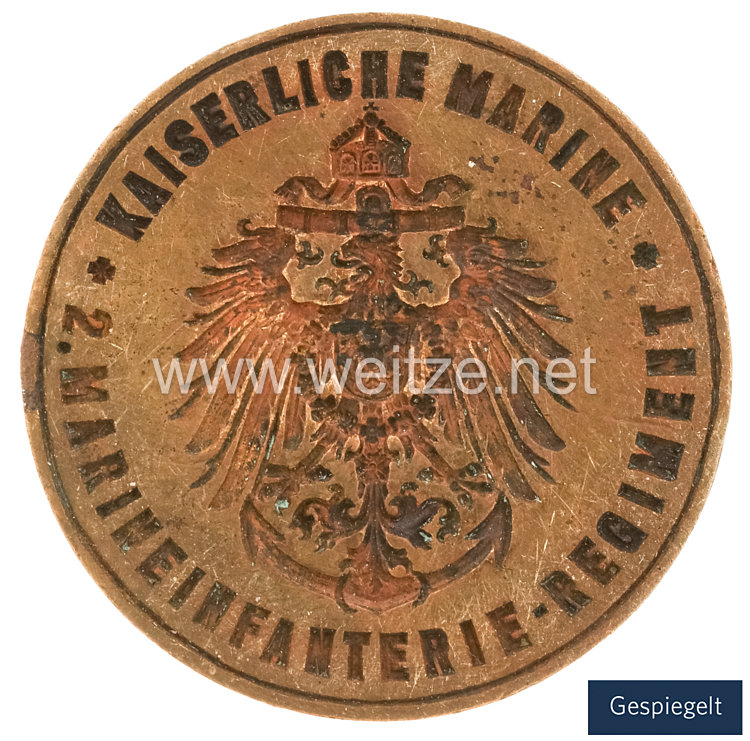
Imperial German Navy Seal/Signet "2. Marineinfanterie-Regiment"
Remaining stock from the former Reichsmarineamt (Imperial Naval Office), circa 1919.
The 2. Marine-Infanterie-Regiment belonged to the 3rd Division of the Marinekorps Flandern.
This seal of the 2nd Marine Infantry Regiment of the Imperial German Navy represents an extraordinary testimony to German naval history during World War I. This seal with a lead core and brass casing originates from the former Imperial Naval Office (Reichsmarineamt) and dates to around 1919, when the dissolution of imperial military structures occurred following the end of the war and the November Revolution.
The 2nd Marine Infantry Regiment belonged to the 3rd Division of the Marine Corps Flanders, a formation that played a distinctive role in German warfare on the Western Front. The Marine Corps Flanders was established in the summer of 1914 and was primarily responsible for defending the Belgian coast and German-occupied naval bases in Flanders. These units differed from regular army formations through their affiliation with the Imperial Navy and their specific training.
Marine infantry had a long tradition in the Imperial German Navy. Originally conceived as ship's soldiers, these troops developed into versatile deployable units. In World War I, marine infantrymen were employed not only for defending naval bases but also in land operations, particularly in Flanders, where they occupied trenches and participated in combat similar to that of army units.
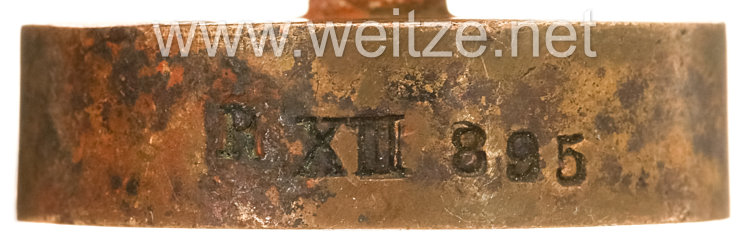
The marking "R XIII 895" on the rim of the seal refers to the systematic inventory system of the Imperial Naval Office. Such markings were part of the Prussian-German military bureaucracy, known for its thoroughness and order. Every official seal was registered and administered to ensure the authenticity of documents and prevent misuse.
Seals of this type served to authenticate official military documents, orders, directives, and administrative correspondence. In an era before electronic communication, such seal impressions were indispensable for legitimizing orders and maintaining the chain of command. The combination of lead core and brass casing was typical for contemporary manufacture: the lead core provided the necessary weight and stability, while the brass casing guaranteed durability and a representative appearance.
Following the armistice of November 1918 and the end of the monarchy, the Imperial Naval Office was dissolved. The provisions of the Treaty of Versailles of 1919 drastically restricted the German Navy and led to the dissolution of numerous naval units, including the marine infantry regiments. The Marine Corps Flanders was demobilized, and many of its members returned to civilian life or were absorbed into the greatly reduced Reichsmarine.
The "remnant stock from the former Imperial Naval Office" indicates that this seal was part of those materials that were no longer needed upon the dissolution of the authority. Such objects found their way into private or institutional collections through various channels. Today they represent important historical artifacts that provide insight into the administrative practices and organization of the Imperial Navy.
The preservation as condition 2 indicates a well-preserved specimen that, despite its age of over a century, shows only minor signs of use. This is remarkable, as many such objects were lost, destroyed, or melted down during the turbulent post-war period.
For collectors and historians, such seals offer not only aesthetic and material value but also documentary significance. They are testimonies to a vanished epoch of German military history and serve as reminders of the organizational complexity and reach of the imperial armed forces. The 2nd Marine Infantry Regiment and its history in the Marine Corps Flanders represent a lesser-known chapter of World War I that is nonetheless significant for understanding German warfare and military organization.