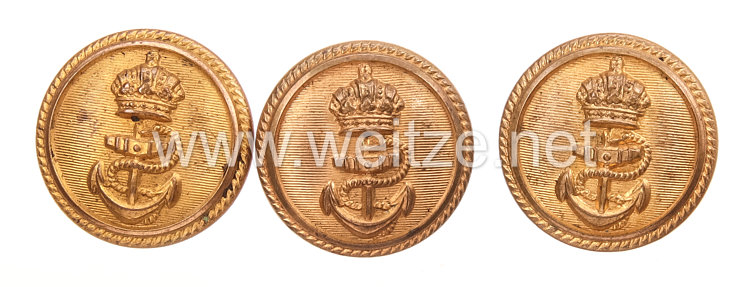
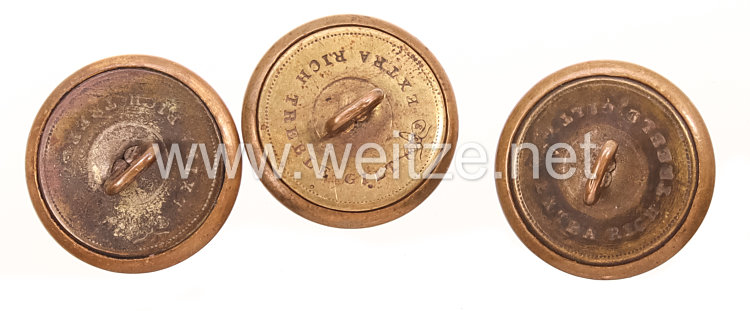
Austria/K.u.K. Monarchy - Imperial and Royal Navy 3 Buttons for Officer's Uniform

Circa 1914. Worn condition, Condition Grade 2.
431911
75,00

Austria/K.u.K. Monarchy - Imperial and Royal Navy 3 Buttons for Officer's Uniform

The k. u. k. Kriegsmarine (Imperial and Royal Navy) of the Austro-Hungarian Monarchy represented a significant naval power in the Adriatic Sea and Mediterranean from the early 19th century until the end of World War I in 1918. These three officer uniform buttons from around 1914 are authentic relics of this vanished navy and bear witness to the strict uniform regulations and representative character of the k. u. k. naval forces.

Historical Context of the k. u. k. Kriegsmarine

The k. u. k. Kriegsmarine developed throughout the 19th century into a respectable fleet stationed in the Habsburg coastal territories of the Adriatic. With main naval bases at Pola (today Pula, Croatia), Trieste, and Cattaro (today Kotor, Montenegro), the fleet controlled important strategic positions in the Mediterranean region. By the outbreak of World War I in 1914, the navy had undergone impressive modernization, including the construction of dreadnought battleships and modern torpedo boats.

Uniform Regulations and Rank Insignia

The uniforms of the k. u. k. Kriegsmarine followed precise regulations laid down in the Adjustierungsreglement (Uniform Regulations). These were regularly updated, with the last significant changes before World War I occurring in 1911 and 1913. Officers' uniforms differed significantly from enlisted ranks' uniforms through higher-quality materials, specific cuts, and special insignia. Buttons were not merely functional elements but also important identifying marks of the wearer's status and branch of service.

Design and Manufacture of Officer Buttons

Officer buttons of the k. u. k. Kriegsmarine were typically manufactured from gilt metal or brass and bore characteristic insignia. The most common motif was the double-headed eagle of the Habsburg Monarchy, often combined with maritime symbols such as anchors. Buttons were produced in various sizes depending on their use on uniform coats, vests, or overcoats. The quality of officer buttons was significantly higher than those for enlisted ranks, as officers had to procure their uniforms at their own expense and placed great value on representative appearance.

Production was carried out by specialized military equipment factories within the Monarchy, primarily in Vienna, Prague, and Budapest. These establishments had to meet strict quality standards and have their products approved by the k. u. k. War Ministry.

The Period Around 1914

The year 1914 marks a dramatic turning point in the history of Austria-Hungary and its navy. The assassination of Archduke Franz Ferdinand in Sarajevo on June 28, 1914, triggered a chain reaction that led to World War I. The k. u. k. Kriegsmarine played an important, though geographically limited, role during the war due to the confines of the Adriatic. Under the command of Admiral Anton Haus and later Admiral Miklós Horthy, the fleet conducted operations against Italian and French forces.

The navy achieved notable successes through its submarine force and torpedo boat flotillas. The famous Battle of Otranto in 1917 and various submarine operations in the Mediterranean demonstrated the striking power of the Austro-Hungarian naval forces.

Wear and Significance

The officer uniform of the k. u. k. Kriegsmarine around 1914 consisted of several variants: the parade uniform (gala), the service uniform, and various working and sea-going uniforms. Buttons were found on all these uniform variants, with their number and arrangement precisely specified by regulations. The dark blue base color of the naval uniform with gold buttons and rank insignia corresponded to international naval tradition and gave officers a distinguished appearance.

The End of an Era

With the collapse of the Austro-Hungarian Monarchy in October/November 1918, the history of the k. u. k. Kriegsmarine also came to an end. The fleet was divided among the successor states, with the largest portion going to Italy and the Kingdom of Serbs, Croats and Slovenes (later Yugoslavia). Many ships were scrapped or scuttled.

Collector Value and Historical Significance

Today, uniform parts and insignia of the k. u. k. Kriegsmarine are sought-after collector's items. Officer buttons in good condition (condition 2, as with the present pieces, indicates light signs of wear with generally good preservation) are authentic witnesses to a vanished era. They document not only the military organization of the Danubian Monarchy but also the craftsmanship of military equipment manufacture and the strict hierarchical order of the Imperial and Royal armed forces. For military historians and collectors, such objects represent important sources for researching uniform history and the everyday culture of the k. u. k. armed forces.