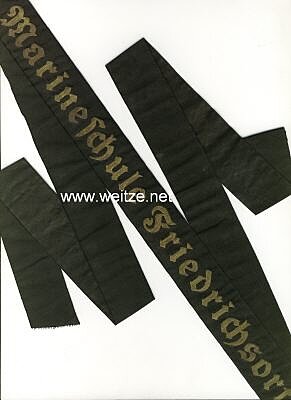
Kriegsmarine Cap Tally "Marineschule Friedrichsort"
The cap tally of the Naval School Friedrichsort represents a significant chapter in German naval history and military training tradition. The Marineschule Friedrichsort, located on the Kiel Fjord near Kiel in Schleswig-Holstein, served as a central institution for officer training in the German Navy during the period of the Kriegsmarine between 1933 and 1945.
The facility at Friedrichsort possessed a long military tradition that extended far beyond the Nazi era. Even during the Imperial Navy, this location played an important role in naval training. After rearmament and the establishment of the Kriegsmarine in the 1930s, the naval school became one of the most important training centers for prospective officers.
The present cap tally displays a metal-thread woven construction, characteristic of high-quality Kriegsmarine naval uniforms. This technique, in which metal threads were incorporated into the fabric, gave the cap tallies not only a special optical quality but also increased durability. The gold or silver metal threads were traditionally woven into dark blue or black base fabric, creating the characteristic shine and elegance of these uniform items.
Cap tallies of the Kriegsmarine served not merely as decorative elements but fulfilled an important identification function. They marked affiliation with a specific unit, ship, or training facility. The inscription “Marineschule Friedrichsort” clearly identified the wearer as a member or graduate of this prestigious training institution.
The length of 145 cm corresponds to the standard measurements for Kriegsmarine cap tallies, which were sized so they could be wrapped twice around the cap, with both ends bearing the inscription hanging down at the back. This manner of wearing had been established in the German Navy since Imperial times and was continued in the Kriegsmarine.
Training at the Naval School Friedrichsort encompassed both theoretical instruction and practical seamanship training. Cadets received instruction in navigation, tactics, weapons technology, shipbuilding, and other disciplines relevant to naval service. The school trained officers for various deployments, from surface forces to the submarine service.
During World War II, training at the naval school gained particular significance as the Kriegsmarine had a constant need for qualified officers. Training courses were partially shortened to meet urgent personnel requirements. Nevertheless, efforts were made to maintain high training standards.
The worn condition of the present cap tally indicates that it was actually used in service by a member of the naval school. Such authentic pieces are today important historical documents that provide insight into the everyday reality of military training during this period.
After the end of World War II, the Naval School Friedrichsort was dissolved. The facilities were taken over by the Allies, and German naval training was initially completely discontinued. Only with the founding of the Bundesmarine in the 1950s did institutionalized naval officer training resume in Germany, though at different locations and under completely different political and military conditions.
From today's military-historical perspective, cap tallies like this represent important collectible objects that help document the organizational structure and training tradition of the Kriegsmarine. They are testimonies to a historical epoch that must be scientifically examined and presented in a museum context to enable a differentiated understanding of German military history.
The metal-thread weaving technique used in this cap tally exemplifies the high standards of German military textile production during this period. Specialized manufacturers produced these items according to precise regulations that specified everything from thread composition to lettering style. The craftsmanship involved in creating such items reflected the emphasis placed on military tradition and unit identity within the naval service.