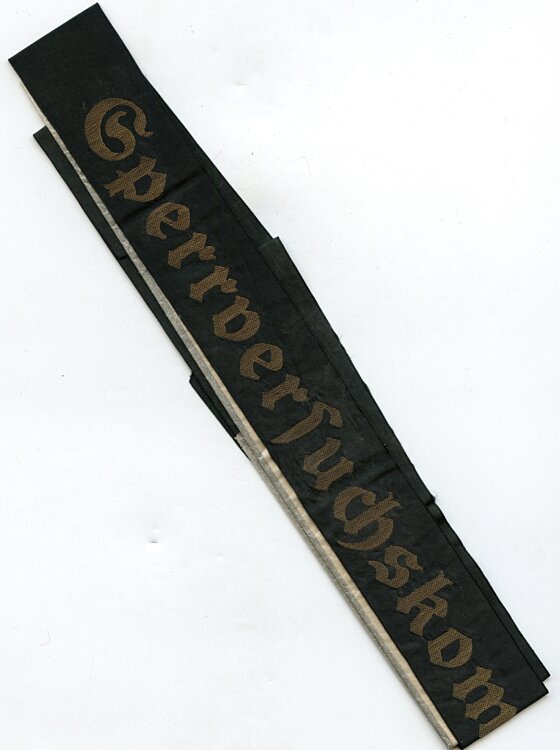
Kriegsmarine Cap Tally "Sperrversuchskommando"

mint condition, partially with original wrapping paper, script slightly faded, 150 cm long. Condition 2
133510
150,00

Kriegsmarine Cap Tally "Sperrversuchskommando"

The Kriegsmarine cap tally "Sperrversuchskommando" represents an extremely rare and specialized piece of equipment from the German Kriegsmarine during World War II. These cap tallies, worn on the naval cap, served not only to identify the unit but also reflected the complex organization of the German naval forces.

The Sperrversuchskommando was a highly specialized unit of the Kriegsmarine dedicated to the development, testing, and evaluation of naval barriers. These included mine barriers, net barriers, and other defensive installations used to control sea routes and protect home waters. The work of these commands was of enormous strategic importance, as sea mines and barrier installations served both offensive and defensive functions.

The production of Kriegsmarine cap tallies followed strict regulations laid down in the Kriegsmarine dress regulations. Standardly, these ribbons were made of black wool fabric with gold-colored lettering showing the name of the ship, unit, or command. The typical length of 150 cm corresponded to official specifications and allowed for the characteristic tying at the back of the head with two hanging ends.

The inscription was executed in Gothic script, which was traditional for the German Navy and was officially used until 1940. The inscription "Sperrversuchskommando" clearly identified the wearer as a member of this special technical unit, which was of great importance within the strictly hierarchical Kriegsmarine organization.

The barrier system of the Kriegsmarine developed continuously during World War II. Germany employed various mine types, including ground mines, moored mines, and the revolutionary magnetic mines. The experimental commands played a central role in the further development of these weapons and in researching countermeasures against Allied mine barriers.

The organizational structure of the Kriegsmarine comprised numerous specialized commands and units. Besides front-line units on warships, there were training facilities, shipyard commands, naval arsenals, and technical experimental commands. Members of these units wore corresponding cap tallies for identification, making their affiliation clearly recognizable.

The condition described as "mint with partial original packaging" suggests that this specimen may never have been worn or only very limitedly used. This could have various reasons: it might have been a spare tally kept in case of loss or damage, or it comes from warehouse stocks that were no longer issued after the war's end.

The slight fading of the script is a typical aging characteristic of textiles from this period. The gold-colored lettering was applied through printing or embroidery and could lose intensity due to light exposure, moisture, or simply the passage of time. Despite this slight impairment, the historical significance of the object remains unchanged.

Kriegsmarine cap tallies are today sought-after collector's items that provide important insights into the organizational structure of the German Navy. Particularly rare are tallies from specialized units like the Sperrversuchskommando, as these had only a few members compared to large warships and correspondingly fewer tallies were produced.

Historical research uses such objects to reconstruct naval history. Through the analysis of cap tallies, historians can trace the existence and organization of various units, especially when written records have been lost. The Sperrversuchskommando itself is only limitedly documented in military historical literature, making such material evidence all the more valuable.

In conclusion, this cap tally represents an authentic testimony to the technical-scientific work within the Kriegsmarine and documents a specialized area of German naval warfare during World War II.

r