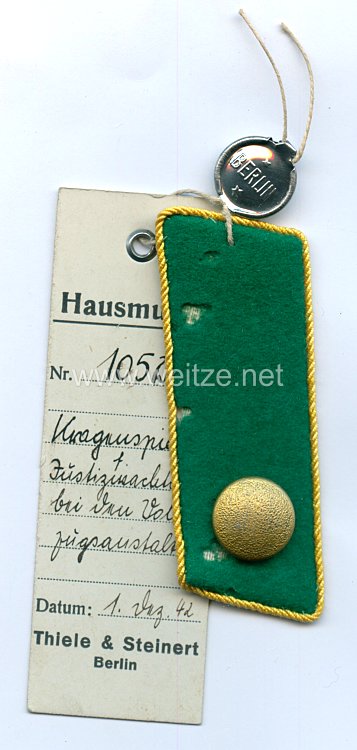
Third Reich Single Collar Tab for a Justice Guard at Correctional Facilities

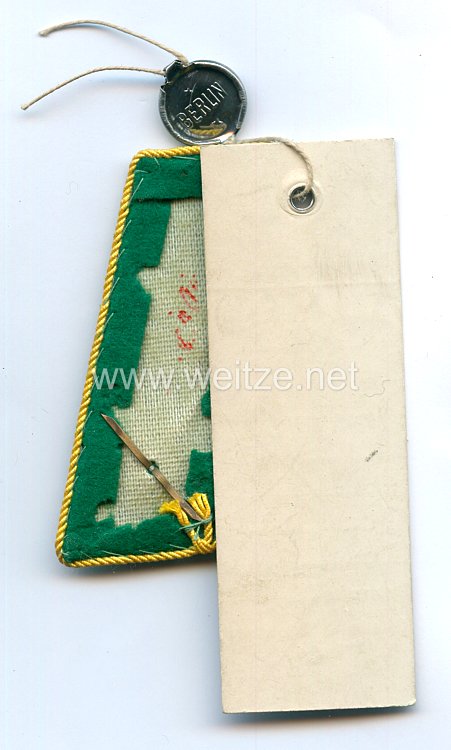
Sample piece by the firm “Thiele & Steinert”, sealed as house sample, inscribed and dated 9.3.1937. With moth damage, condition 2-
356310
150,00

Third Reich Single Collar Tab for a Justice Guard at Correctional Facilities

This object represents an exceptional artifact of National Socialist uniform administration: a single collar tab for a Justice Guard (Justizwachtmeister) in correctional facilities from the Third Reich era. Particularly noteworthy is that this is a sample piece from the firm “Thiele & Steinert,” sealed, labeled, and dated March 9, 1937 as a house sample.

The firm Thiele & Steinert of Dresden was among the significant manufacturers of uniform insignia during the NS period. Such sample pieces were produced by manufacturing companies for submission to the relevant authorities to obtain approval for series production. They document the bureaucratic process of uniform standardization in National Socialist Germany and are today of considerable historical collecting value, as they often represent the only surviving examples of certain uniform variations.

The Justizwachtmeister (Justice Guards) formed an independent professional group within the correctional system in the Third Reich. They were responsible for supervision and administration in prisons, jails, and other correctional institutions. Their uniforms differed distinctly from regular police and other security organs, reflecting their specific position in the administrative apparatus.

The collar tabs of the correctional service were typically executed in dark green base color and bore specific rank insignia or symbols identifying rank and affiliation. The year 1937, when this sample was produced, falls within a phase of intensive reorganization and standardization of the German justice and correctional administration. After the seizure of power in 1933, the entire justice system was gradually centralized and subordinated to National Socialist principles.

The Reich Minister of Justice issued numerous ordinances during the 1930s regarding the uniforming of justice personnel. The standardization of service clothing was part of a comprehensive program for the militarization and hierarchization of state administration. Every rank and function was to be recognizable at first glance—a principle that the National Socialists adopted from military traditions and extended to all areas of administration.

This sample piece displays typical characteristics of the period: precise craftsmanship, the use of high-quality materials, and careful documentation through seals and dating. The mentioned moth damage is not unusual for textiles of this age and only marginally affects the historical value of the piece.

The existence of such house samples is invaluable for uniform research. They enable researchers to trace the development and changes in uniform regulations and demonstrate the diversity of uniformed services in the National Socialist state. Many of these sample pieces were destroyed or lost after 1945, making surviving specimens all the more significant.

The Justice Guard service was part of a system that increasingly became an instrument of political oppression during the NS period. Correctional facilities served not only to house ordinary criminals but also to detain political opponents, forming an intermediate stage in a system ranging from regular prisons to concentration camps. This historical contextualization is essential for understanding such uniform pieces.

For collectors and museums, such documented sample pieces represent important reference objects. They enable authentication of other uniform parts and contribute to understanding the complex uniform landscape of the Third Reich. The precise dating to March 9, 1937, makes this piece a valuable historical document of the pre-war period.

r