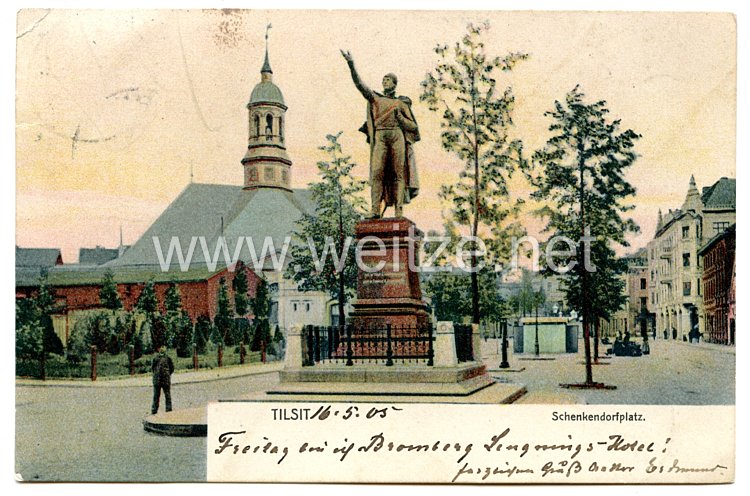
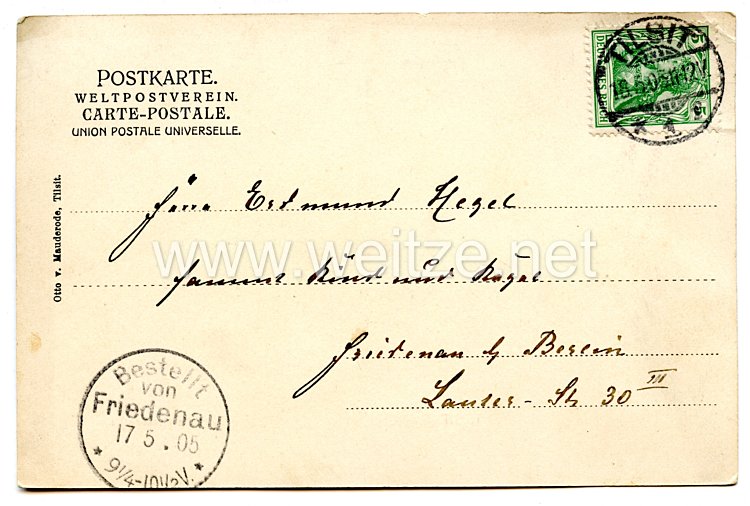
German Empire 1871-1918 Postcard “Tilsit”

Postmarked Tilsit 1905. 14 x 9.1 cm. Condition 2.


429310
15,00

German Empire 1871-1918 Postcard “Tilsit”

This postcard from Tilsit, postmarked in 1905, represents a fascinating testament to German postal history during the era of the German Empire (1871-1918). Tilsit, today known as Sovetsk in the Russian Kaliningrad Oblast, was then a significant East Prussian city with a rich military and cultural tradition.

The German Empire established after the founding of the Reich in 1871 one of the most modern and efficient postal systems in Europe. The Reichspost, founded under the leadership of Postmaster General Heinrich von Stephan, revolutionized communication throughout the Empire. Postcards, which became increasingly popular in the 1870s, served both private correspondence and military purposes.

Tilsit itself was a city of considerable strategic importance. Here in 1807, the famous Peace of Tilsit was concluded between Napoleon Bonaparte, Tsar Alexander I of Russia, and King Frederick William III of Prussia. The city maintained its military relevance throughout the 19th and early 20th centuries. As a garrison town, Tilsit housed various troop units of the Prussian Army and later the Imperial Army.

Around 1905, the year of the postmark on this card, the German Empire was in a phase of intensive military rearmament and strategic reorientation. The Weltpolitik (World Policy) under Kaiser Wilhelm II led to increased tensions with European neighbors. In East Prussia, on the border with the Russian Empire, the military presence was particularly pronounced. The Russo-Japanese crisis of 1904-1905 also influenced strategic considerations in Berlin regarding the eastern border.

Postcards from this era frequently served as a means of spreading patriotic and military motifs. Soldier postcards, regimental pictures, and depictions of military parades were extremely popular. The postcard industry experienced its Golden Age during this time, with millions of cards sent annually throughout the Reich. The Reichspostordnung (Imperial Postal Regulations) regulated the format, postage, and use of these correspondence pieces.

The standard dimensions of a postcard from that period largely correspond to the measurements given here of 14 x 9.1 cm. The Reichspost had specific requirements for postcard formats to facilitate mechanical processing. The postmark itself is an important historical document, as it contains not only place and date but also administrative details about the local post office.

From a military-historical perspective, postcards from garrison towns like Tilsit are particularly valuable. They document not only civilian communication but often also military events, troop movements, or local celebrations. The years before World War I were characterized by an intense military culture that was reflected in all areas of public life.

The preservation of such postcards in condition 2 (according to common numismatic and collector grading scales) signifies good to very good condition with possibly slight signs of use. This is remarkable for an object over 115 years old and indicates careful storage over several generations.

East Prussia as the easternmost province of the German Empire had a special role in military strategy. The region was traditionally heavily militarized and served as a staging area for potential conflicts with Russia. The Battle of Tannenberg in 1914, only a few years after this postcard, would demonstrate the strategic importance of the region.

Today, such postcards are important sources for historical research. They offer insights into everyday life, communication habits, and the visual culture of the Wilhelmine era. For collectors of military antiques, they represent authentic contemporary witnesses of a bygone epoch that definitively ended with the conclusion of World War I in 1918 and the collapse of the German Empire.