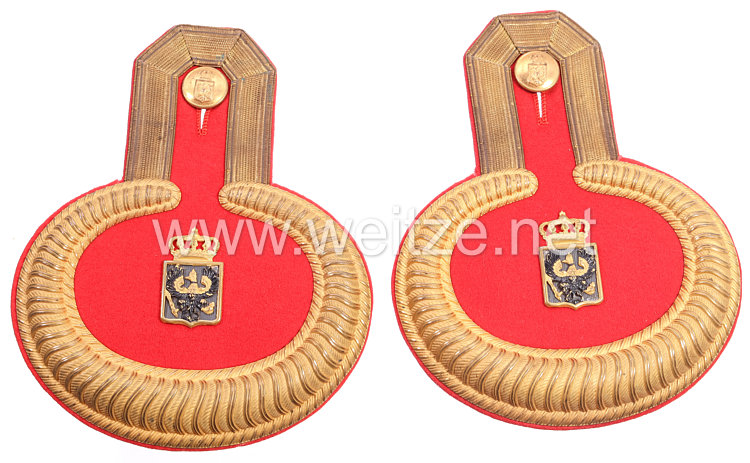
Prussia Royal Prussian Railway Administration KPEV Pair of Epaulettes for a Station Master II. Class

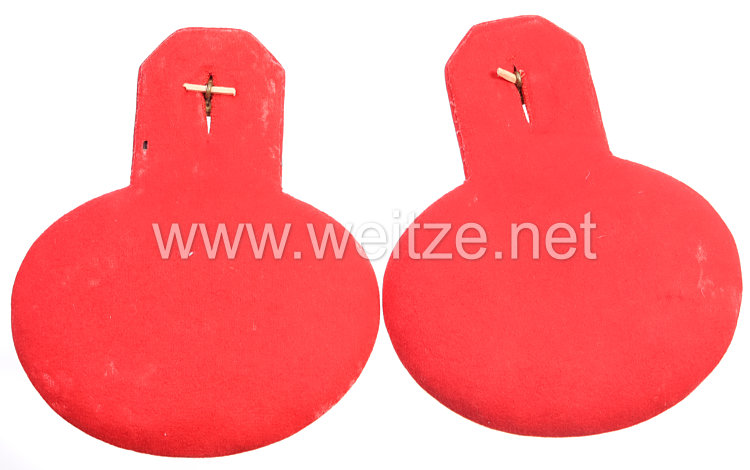
Circa 1880. Red fields with applied Prussian coat of arms, pressed gold crescents, surrounding gold braid without pull-throughs, the cloth backing in red. Complete with shoulder buttons. Lightly worn, condition 2.
The epaulettes were only worn until 1889, then abolished.
395409
450,00

Prussia Royal Prussian Railway Administration KPEV Pair of Epaulettes for a Station Master II. Class

These epaulettes for a Station Master Second Class of the Royal Prussian Railway Administration (KPEV) represent a fascinating chapter in Prussian railway history and uniform studies from around 1880. These rank insignia document the strict hierarchical organization and military-influenced spirit that characterized the Prussian state administration in the 19th century.

The Royal Prussian Railway Administration emerged as a state institution to manage the rapidly developing railway infrastructure in Prussia. After initial experiments with private railway companies, the Prussian state recognized the strategic importance of railways for military purposes, economic development, and national unity. From the 1850s onwards, a systematic nationalization of railway lines began, leading to the establishment of the KPEV.

The uniforming of railway personnel deliberately followed military models. This was no coincidence but reflected Prussian state philosophy, which regarded discipline, hierarchy, and duty fulfillment as central values. Epaulettes, originally purely military rank insignia, were also introduced for civil servants to make their authority and rank visible.

The epaulettes described here show characteristic features of Prussian uniform regulations: The red fields with applied Prussian coat of arms identified the wearer as an official in the service of the Prussian state. The pressed golden crescents were typical elements of epaulettes and gave the rank insignia its characteristic shape. The surrounding golden braid without through-passages designated the specific rank of a Station Master Second Class within the KPEV hierarchy.

The position of a Station Master was of considerable importance in railway operations. He bore responsibility for the entire operational procedure of a station, passenger safety, train dispatch, and coordination with other departments. Classification into different classes was based on the size and importance of the station. A Station Master Second Class managed a medium-sized station with corresponding personnel and traffic volume.

Particularly noteworthy is the temporal classification of these epaulettes. The dating “around 1880” falls into a phase of consolidation of the German Empire after its founding in 1871. The Prussian railway administration expanded considerably and developed standardized uniform regulations for its growing personnel. The epaulettes served not only for rank identification but were also intended to convey respect and authority toward passengers.

A crucial historical detail is the fact that epaulettes were only worn until 1889. In that year, a comprehensive reform of the KPEV uniform regulations took place. The epaulettes, perceived as impractical and excessively militaristic, were replaced by more modern rank insignia. This reform reflected a general trend toward modernization and simplification of uniforms that also affected other European railway administrations.

The shoulder buttons, mentioned as being completely preserved, were functional elements for attaching the epaulettes to the uniform. Their preservation makes this pair particularly valuable for collectors and historians, as complete ensembles are considerably rarer than individual epaulettes.

The stated condition “lightly worn” indicates that these epaulettes were actually used in service. This gives them additional historical authenticity, as they are not merely uniform pieces but witnesses to lived professional history. A station master wore these rank insignia at official occasions, during train dispatch, and in all service actions where his authority needed to be visible.

The Prussian railway administration was famous for its precision and organization. Detailed service regulations governed not only technical operations but also the appearance and behavior of officials. Correct uniforming was mandatory and strictly controlled. Violations could have disciplinary consequences.

Today, such epaulettes are important collectors' items and museum objects that provide insight into the history of railways, Prussian state administration, and uniform studies of the 19th century. They document an era when railways were not only a means of transport but a symbol of technical progress and state modernization.

r