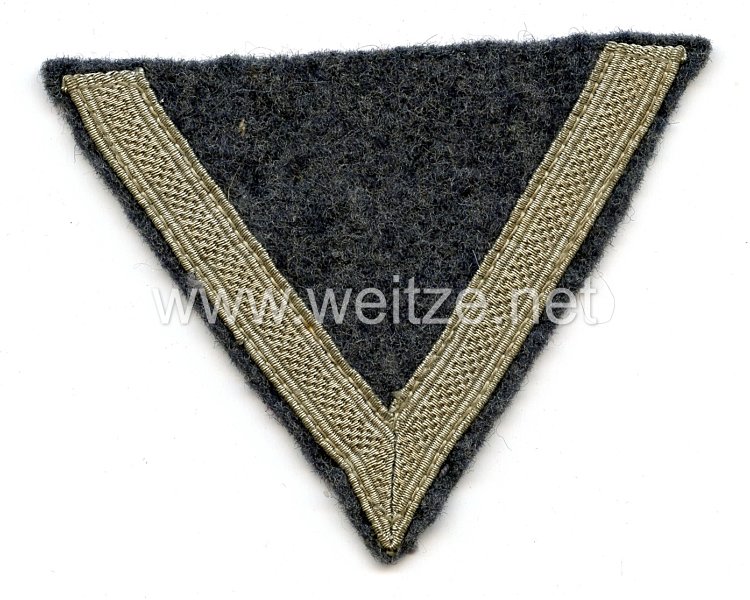
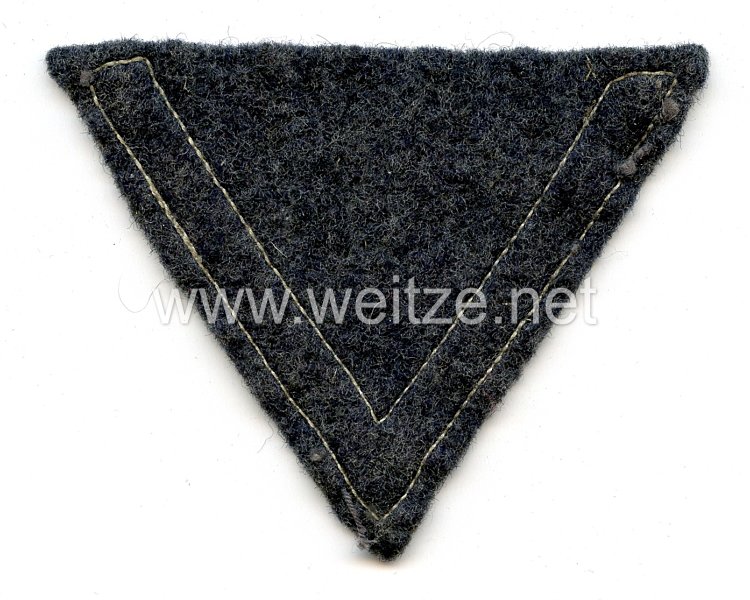
Luftwaffe Sleeve Insignia Lance Corporal
The Luftwaffe sleeve badge for Gefreiter (Lance Corporal) represents a fascinating testament to the rank system of the German Air Force during World War II. These textile rank insignia were an essential component of uniforming and enabled immediate identification of a soldier's rank within the military hierarchy.
The Luftwaffe, officially founded on February 26, 1935, developed an independent system of rank insignia that differed from those of the Army (Heer) and Navy (Kriegsmarine). The rank of Gefreiter was the first enlisted rank above the simple Flieger (Airman) and was typically awarded after six months of service, provided the soldier had proven himself and received no disciplinary punishments.
The sleeve badge for Gefreiter was worn on the left upper arm in accordance with Heeresdienstvorschrift (H.Dv.) 471/1 and corresponding Luftwaffe regulations. It typically consisted of a single upward-pointing chevron made from aluminum braid. This braid was applied to a dark blue-gray or bottle-green background, depending on the type of uniform - dress uniform, service dress, or field tunic.
These badges were manufactured by various authorized producers throughout the German Reich. Quality could vary, with early wartime productions often exhibiting higher manufacturing quality than later examples from the period of material shortage from 1943/44 onwards. The badges were either sewn directly onto the uniform or attached to a cloth-covered cardboard backing, which was then sewn on to ensure a more stable form.
The Gefreiter represented an important transition in the Wehrmacht hierarchy. While a simple Flieger was still considered a completely subordinate soldier, the Gefreiter already received certain privileges and could be entrusted with leading small groups or special tasks. In the Luftwaffe, Gefreiter could be employed in various roles: as aircraft crew, ground personnel, in anti-aircraft units, or in administrative functions.
The rank structure of the Luftwaffe was strictly hierarchically organized. Above the Gefreiter followed the ranks of Obergefreiter (two chevrons), Hauptgefreiter (two chevrons with star), and then the non-commissioned officer ranks. This clear structure was essential for military order and chain of command, especially in the complex organization of the Luftwaffe with its technically demanding tasks.
From a collector's perspective, such sleeve badges are important military-historical objects today. The stated condition 2 indicates a well-preserved specimen with minimal signs of wear. Collectors typically rate condition on a scale from 1 (mint) to 5 (heavily damaged). A condition 2 usually means that the badge was worn but shows no significant damage, moth damage, or heavy soiling.
The historical significance of such badges lies not only in their military function but also in their testimonial value for the everyday reality of millions of soldiers. Every Gefreiter of the Luftwaffe wore this badge with a certain pride, as it marked the first advancement in a military career. At the same time, these objects today serve as memorials of a dark epoch in German history and are preserved in serious collections exclusively for documentation and educational purposes.
The research and documentation of such uniform items contributes to understanding the military organization of the Third Reich and helps to scientifically process the historical contexts of this period.