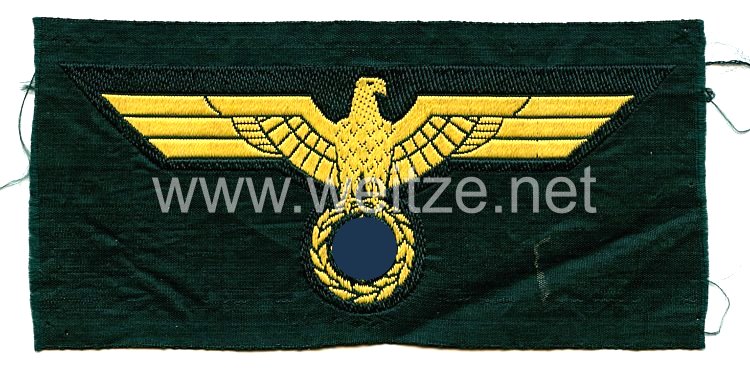
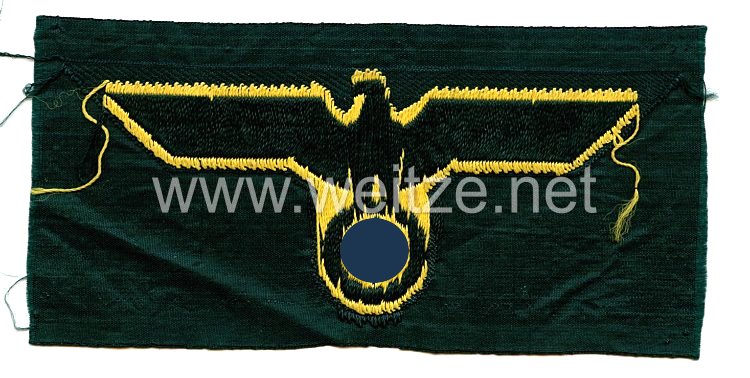
Kriegsmarine Breast Eagle for Enlisted Men Coastal Artillery - Ground Units

Bevo woven version on green, condition 2.
423809
75,00

Kriegsmarine Breast Eagle for Enlisted Men Coastal Artillery - Ground Units

The Kriegsmarine Breast Eagle for Enlisted Personnel of Coastal Artillery represents a characteristic insignia of the German naval forces during World War II. This particular example in BeVo-woven execution on green background was worn by members of coastal artillery units, which held a special position within the Kriegsmarine.

The Coastal Artillery of the Kriegsmarine was responsible for defending German coastal areas, strategic harbors, and naval bases. These units were equipped with heavy guns and played an important role in the Third Reich's defensive strategy. Unlike ship crews who served aboard warships, members of the coastal artillery were predominantly stationed on land, which was reflected in their uniforms.

The BeVo weaving technique (Bandweberei Ewald Vorsteher) was a characteristic manufacturing process for Wehrmacht insignia and emblems. The BeVo company in Wuppertal-Barmen developed a special weaving process that allowed complex patterns and details to be woven directly into the fabric. This technique offered several advantages: the insignia were more durable than embroidered variants, more cost-effective in mass production, and better retained their shape. BeVo insignia were increasingly used from the mid-1930s and remained standard throughout the war.

The green background of this breast eagle is of particular significance. While regular naval units wore blue uniforms, ground units of the Kriegsmarine, including coastal artillery, naval landing troops, and other land-based formations, wore uniforms in various shades of green. This served better camouflage in terrestrial operational areas and visually distinguished these units from shipboard crews.

The eagle itself followed the standardized Kriegsmarine design: a right-facing eagle with spread wings, holding a swastika in its talons. This symbol, the so-called Hoheitsadler (national eagle), was prescribed on all German military uniforms and was worn on the right breast according to Kriegsmarine uniform regulations. The exact positioning and execution were detailed in clothing regulations.

For enlisted personnel (soldiers up to the rank of Obergefreiter), special execution specifications applied. Unlike officers, who often wore hand-embroidered or silver-wire eagles, enlisted ranks received standardized, machine-woven BeVo versions. This was both a matter of economy and rank distinction.

The coastal artillery became increasingly important during the war, especially after the beginning of Allied air offensives and the growing threat of amphibious operations. Along the entire European coast, from the North Cape to the French Atlantic coast, extensive defensive positions were established. The most famous were the fortifications of the Atlantic Wall, where coastal artillery batteries with guns up to calibers of 406mm were stationed.

The equipment and uniforms of these units underwent several changes during the course of the war. Particularly from 1943 onward, as resource scarcity increased, simplified manufacturing processes were introduced. Nevertheless, the BeVo weaving technique remained the preferred method for enlisted insignia until the end of the war due to its efficiency and economy.

Today, these coastal artillery breast eagles are sought-after collector's items for militaria enthusiasts and historians. They document the organizational complexity of the Kriegsmarine and the differentiation between various service branches. Condition is of great importance in historical evaluation, as many of these textile insignia have not survived the decades undamaged. A condition grade 2 indicates a well-preserved example with minor signs of wear, which is remarkable for a textile piece over 75 years old.

The scholarly study of such military-historical objects provides important insights into uniforming practices, production techniques, and organizational structures of the Wehrmacht. They serve as material witnesses to a historical era and contribute to understanding the military history of the 20th century.