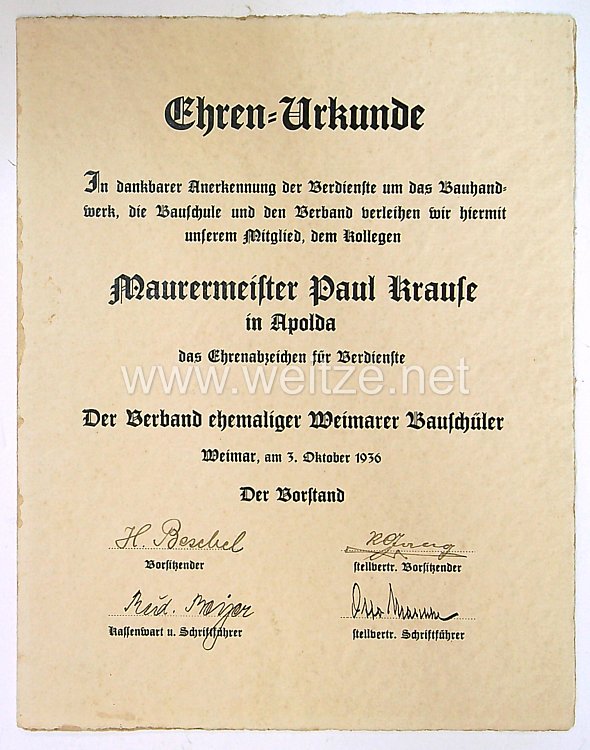
Third Reich - Association of Former Weimar Bauschule Students - Certificate of Honor for the Badge of Honor for Meritorious Service
This Certificate of Honor for the Badge of Merit issued by the Association of Former Weimar Building School Students represents a fascinating testimony to the complex associational culture of the Third Reich. Issued on October 3, 1936 in Weimar to a master mason in Apolda, this document chronicles the continuity of professional and regional connections during a time of profound political upheaval.
The Association of Former Weimar Building School Students was an organization of graduates from the prestigious building trade school in Weimar, which had a long history of vocational and technical education in the construction sector. Since the 19th century, Weimar had maintained an important building trade school that trained masons, carpenters, stonemasons, and other construction professionals. These institutions were essential for the professionalization of building trades and the development of modern construction techniques in Germany.
After the Nazi seizure of power in 1933, German associational life underwent fundamental transformation. Many traditional professional and occupational organizations were either dissolved, incorporated into National Socialist organizations, or forced to adapt to the new political realities. The Association of Former Building School Students appears to have been among those organizations that could continue their existence under certain conditions, often having to adapt their statutes and objectives to National Socialist ideology.
The awarding of badges of honor and certificates was a widespread means of recognizing merit and integrating various social groups into the National Socialist system during the Third Reich. While state decorations were strictly regulated, many private clubs and associations retained the right to award their own badges of honor, as long as these could not be confused with official state decorations.
The recipient, a master mason in Apolda, represents the typical addressee of such honors. Apolda, a town in Thuringia located between Weimar and Jena, was known in the 19th and 20th centuries for its textile industry but also had active construction activity. A master mason held a respected position in the local trades during this period and was frequently organized in guilds and professional associations.
The year 1936 was a year of self-presentation for National Socialist Germany. The Olympic Games in Berlin were intended to present a positive image of the “new Germany” to foreign audiences, while domestically, rearmament and preparation for war were already in full swing. In this context, honors such as the present one also served to integrate professional classes and demonstrate normalcy and continuity.
The design of such certificates of honor often followed traditional patterns that were already common in the Imperial era and the Weimar Republic. They typically contained calligraphic elements, coats of arms or symbols of the issuing association, and a ceremonial formulation of the honor conferred. After 1933, these traditional elements were often combined with National Socialist symbolism such as swastikas or Reich eagles.
The place of issue, Weimar, held special significance for such awards. The city was not only a traditional center of German culture and education but was instrumentalized by the National Socialists as a symbol of the connection between German tradition and National Socialist renewal. At the same time, Buchenwald concentration camp was being established in the immediate vicinity, a stark contrast to the official self-representation.
For historical research, such documents are valuable because they provide insight into everyday history and the continuity of local and professional networks during National Socialism. They demonstrate how traditional structures of associational life and professional organization persisted under the conditions of dictatorship and how individuals received recognition within this system.
The document's current “used condition” speaks to its authenticity and history. Many such certificates were destroyed after 1945, as their owners feared association with the Nazi regime. Surviving examples are therefore important contemporary historical sources that help document the complex reality of everyday life in the Third Reich beyond propaganda and crimes.