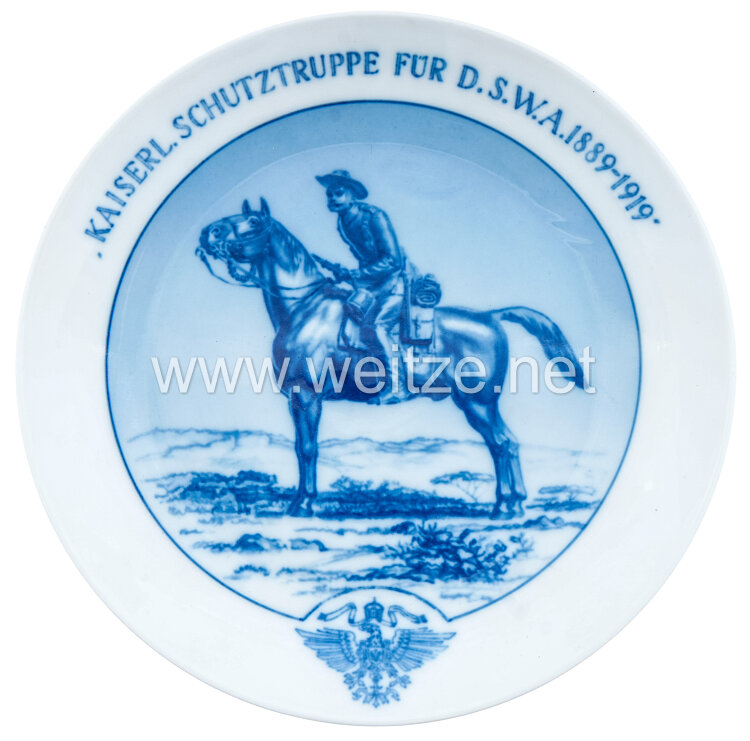
This commemorative plate from the Staatliche Porzellan-Manufaktur Meißen (Meissen State Porcelain Manufactory) documents the continued culture of remembrance surrounding Germany's colonial military history during the Third Reich period. Created circa 1938, the piece belongs to a series of honor plates that Meissen produced during this era to commemorate various military units and historical themes.
The plate honors the Kaiserliche Schutztruppe für Deutsch-Südwestafrika (Imperial Protection Force for German South West Africa), the official colonial military force that maintained German Imperial rule in the colony of German South West Africa (modern-day Namibia). The Schutztruppe was established on May 1, 1889, and formally constituted by Reich Law on June 9, 1895. This force is held responsible for numerous atrocities during the Herero and Nama uprisings in 1904. During World War I, the Schutztruppe was defeated by Union of South Africa forces in 1915. In October 1919, all Schutztruppen were officially dissolved in Germany.
The central artistic motif of the plate is based on the sculpture "Schutztruppler auf Patrouille" (Patrol Trooper) by the Berlin sculptor Karl Möbius. Möbius created this work after witnessing troops departing for South West Africa in 1904. The sculpture received a silver medal at the 1907 Berlin Art Exhibition. The patrol rider on horseback in a steppe landscape, depicted in the plate's center, conveys the romanticized image of colonial service that persisted long in German collective memory.
The dating of this Meissen design can be established with precision: the design was not present in the 1937 catalog but appeared for the first time in July 1938. This clear temporal placement allows the piece to be understood within the context of National Socialist historical policy, which deliberately connected to the German Empire and its military traditions. The production of colonial commemorative items by Meissen continued into the Nazi era (1933-1945) as part of broader themes of German military history and imperial nostalgia.
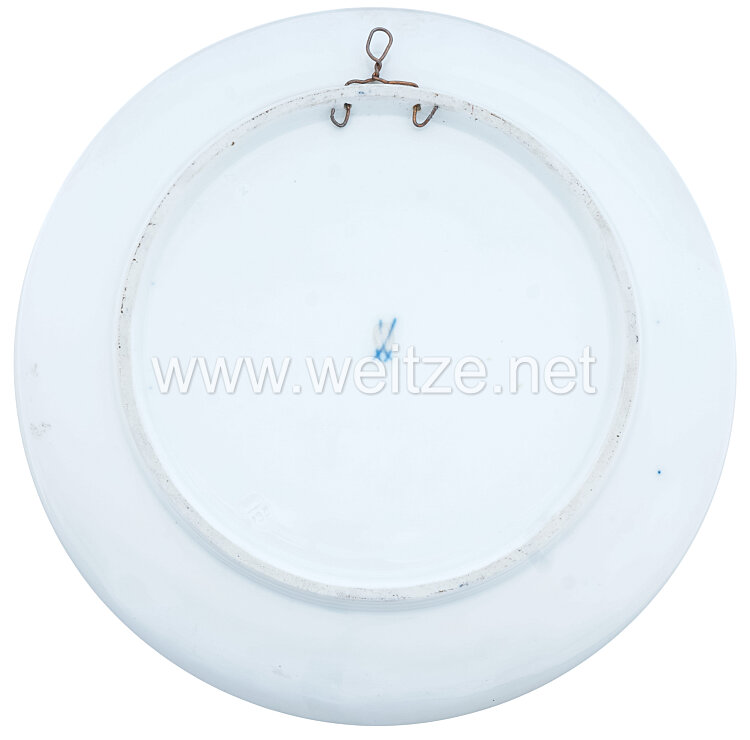
The white glazed porcelain bears a rim inscription reading "Kaiserliche Schutztruppe für Deutsch-Südwestafrika 1889-1919," encompassing the entire period from establishment to dissolution. Alongside the patrol rider, the center also displays the eagle emblem of the Schutztruppe. The base contains the ground underglaze crossed swords mark of Meissen (Schwertermarke) and model number 135. With a diameter of 25.5 centimeters, the plate represents a substantial collector's piece.
After World War II, Karl Möbius's original sculptures and monuments related to colonial themes were largely destroyed or removed, making items like this plate among the surviving representations of his colonial-themed work. The plate served as historical memorabilia honoring the units of the Imperial Schutztruppe after their dissolution in 1919. Such plates were typically acquired by veterans of colonial service, military collectors, or those with connections to the former Schutztruppen.
Today, this commemorative plate documents not only the craftsmanship of the Meissen manufactory but also a problematic chapter of German colonial history. It testifies to the way the National Socialist regime instrumentalized colonial memories for its purposes and stands as an example of the nostalgic glorification of German colonial rule that was cultivated nearly two decades after the end of German colonial times.