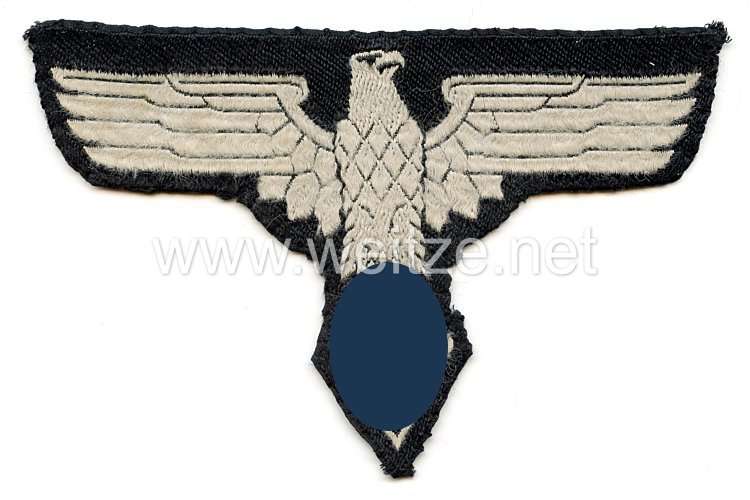
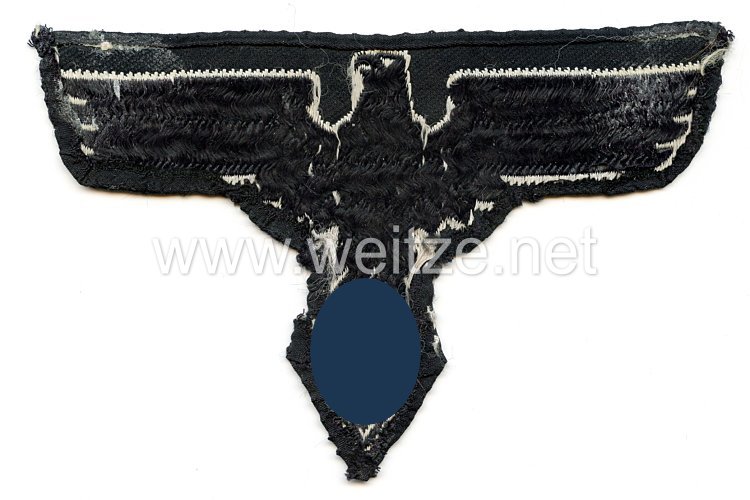
NS-Studentenbund Large Breast Eagle for Sports Shirt

Bevo-woven version. Unworn, condition 2-3
Unfortunately, numerous copies of this version exist; this is one of the few originals!
443808
285,00

NS-Studentenbund Large Breast Eagle for Sports Shirt

NS-Studentenbund Large Breast Eagle for Sports Shirt: Historical Context and Significance

The NS-Studentenbund (NSDStB), or National Socialist German Students' League, was one of the most significant affiliated organizations of the NSDAP and played a central role in bringing German universities into line during the Third Reich. The Bevo-woven version of a large breast eagle for the sports shirt described here represents a characteristic insignia of this organization, symbolizing the connection between academic youth, National Socialist ideology, and physical training.

History and Organization of the NS-Studentenbund

The NS-Studentenbund was founded as early as 1926, before the Nazi seizure of power, and developed into one of the most successful NS organizations during the Weimar Republic. Under the leadership of Baldur von Schirach and later Oskar Stäbel, the NSDStB managed to gain dominant influence at German universities in the early 1930s. In the 1931 student government elections, the organization had already achieved absolute majorities in many university cities.

After 1933, the NS-Studentenbund became the sole representation of German students. The organization at times comprised over 100,000 members and was structured into Gau student leaderships and university groups. The NSDStB was not only responsible for the political alignment of students but also organized sports activities, paramilitary exercises, and ideological training.

The Bevo Weaving Technique and Its Significance

The designation “Bevo” derives from the Barmer Bandweberei Vohwinkel, a leading manufacturer of woven badges and emblems during the NS era. The Bevo weaving technique enabled the production of highly detailed, colorfast badges in large quantities. Unlike embroidered versions, Bevo-woven badges were more robust, cheaper to produce, and better retained their shape.

This manufacturing method was employed for numerous NS organizations, from the Wehrmacht to the SS and various party affiliates. The consistent quality and characteristic flat structure make Bevo-woven pieces easily identifiable today for collectors and historians.

The Eagle as Symbol

The eagle was the central sovereign emblem of the German Reich and was systematically integrated into National Socialist symbolism. The breast eagle of the NS-Studentenbund typically displayed the characteristic eagle with outstretched wings above the swastika. The placement on the sports shirt emphasized the importance of physical training in the National Socialist worldview.

The distinction between different sizes and versions had practical reasons: the large breast eagle for the sports shirt was particularly visible due to the lighter fabric color and sporting activities, and was meant to demonstrate membership in the NS student body during competitions and public events.

Sports and Military Education in the NS-Studentenbund

Sports occupied a central position in the NS-Studentenbund. The organization conducted regular Reich competitions and particularly promoted paramilitary disciplines. The sports shirt with the breast eagle was worn on various occasions: during cross-country sports exercises, marches, camps, and athletic competitions. The uniform clothing was intended to strengthen camaraderie and solidarity while simultaneously emphasizing the military orientation of the organization.

The Problem of Forgeries

As mentioned in the object description, numerous copies of this version exist. This is a widespread problem with NS memorabilia. Since the 1950s, badges, uniform parts, and other items from the NS era have been reproduced, sometimes for film productions, but more often for the collector market. Modern forgeries can be technically very convincing, which is why expertise and precise knowledge of materials are required.

Original Bevo-woven badges show characteristic features: the specific weaving pattern, signs of aging at the edges, a typical reverse side construction, and often slight discoloration. Unworn pieces in condition 2-3 are particularly rare, as most badges were used and thereby damaged or worn out.

Collector Value and Historical Significance

From a historical perspective, such objects document the comprehensive penetration of all areas of life by National Socialist ideology. The NS-Studentenbund played an active role in the book burning of 1933, the expulsion of Jewish and politically undesirable professors, and the ideological transformation of universities. The seemingly harmless sports badges were part of a system that instrumentalized academic youth for criminal purposes.

Today, authentic objects like this breast eagle serve historical research and education. They remind us of the mechanisms of totalitarian rule and the importance of vigilance against extremist ideologies. Museums and educational institutions use such artifacts to convey the history of this dark era and warn against the dangers of political indoctrination.

r