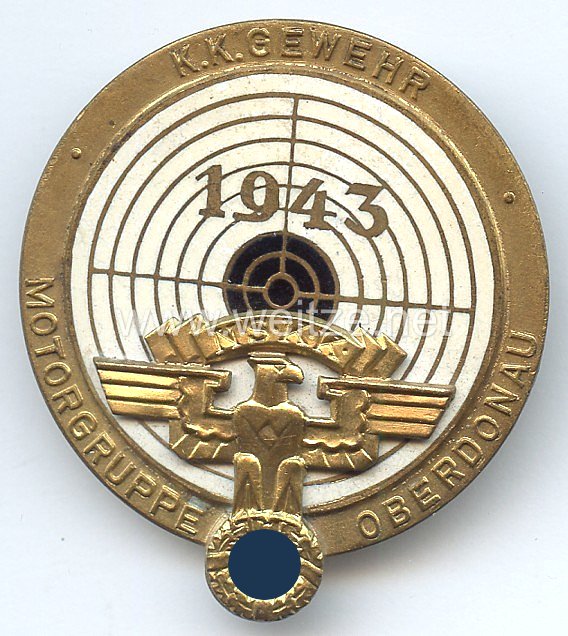
NSKK - Motorgruppe Oberdonau - Marksmanship Award in Gold for "K.K.Gewehr" from 1943

Fine zinc, partially enameled with applied NSKK eagle, 45 mm, on pin, condition 2.
316208
380,00

NSKK - Motorgruppe Oberdonau - Marksmanship Award in Gold for "K.K.Gewehr" from 1943

The NSKK Gold Shooting Award for K.K. Rifle from Motorgruppe Oberdonau dated 1943 represents a significant artifact documenting the military training and honors culture of the National Socialist Motor Corps (NSKK) during World War II. This award illustrates the intensive paramilitary training and the growing importance of marksmanship skills within Nazi organizations during the late war years.

The NSKK was initially founded in 1931 as a sub-organization of the SA and developed after 1933 into an independent formation of the NSDAP. Under the leadership of Korpsführer Adolf Hühnlein, the NSKK expanded considerably and assumed central responsibilities in the motor vehicle technical training of the German population. The organization was divided into various Motorgruppen (Motor Groups) that corresponded to geographical areas.

Motorgruppe Oberdonau was established after the annexation of Austria in 1938 and encompassed the territory of the Reichsgau of the same name with its capital in Linz. Gau Oberdonau was one of seven administrative districts into which former Austria was divided after the Anschluss. Motorgruppe Oberdonau played an important role in integrating Austrian motor vehicle operators into Nazi structures and in preparing drivers for military purposes.

The K.K. rifle refers to the small-caliber rifle in .22 caliber (5.6 mm), which was used for training and sporting purposes. The use of small-caliber weapons for training offered several advantages: lower ammunition costs, reduced recoil for beginners, and the ability to practice on shorter shooting ranges. In the context of war preparations and during the war itself, training with K.K. rifles gained considerable importance as it provided fundamental preparation for handling military weapons.

This Gold Shooting Award represented the highest level of NSKK shooting badges. Typically, three grades existed: Bronze, Silver, and Gold, with Gold honoring the highest achievements. To earn this award, participants had to achieve exceptional hit rates at official shooting competitions or examinations. The exact requirements were defined in the NSKK service regulations and usually included a specific number of shots at defined distances with minimum point scores.

The technical execution of the badge corresponds to typical manufacturing standards of the period. The object was made from fine zinc, a material increasingly used for awards during the war as strategically important metals such as bronze or tombac were needed for armaments production. The partial enameling gave the badge color accents and enhanced its visual impact. The applied NSKK eagle – the sovereign emblem of the organization – was a characteristic feature of nearly all NSKK awards and badges.

The year 1943 marks a significant point in World War II history. After the catastrophe at Stalingrad and increasing Allied successes, Germany found itself in a phase of total mobilization. The training of reservists and the preparation of the civilian population for military tasks intensified. The NSKK played an important role in this, not only training drivers but also teaching basic military skills such as shooting.

The awarding of such decorations served multiple purposes: it motivated members to higher performance, created a sense of camaraderie and belonging, and demonstrated the military readiness of the organization. In the hierarchical structure of Nazi organizations, such visible insignia also had an important social function, as they marked the wearer's status within the community.

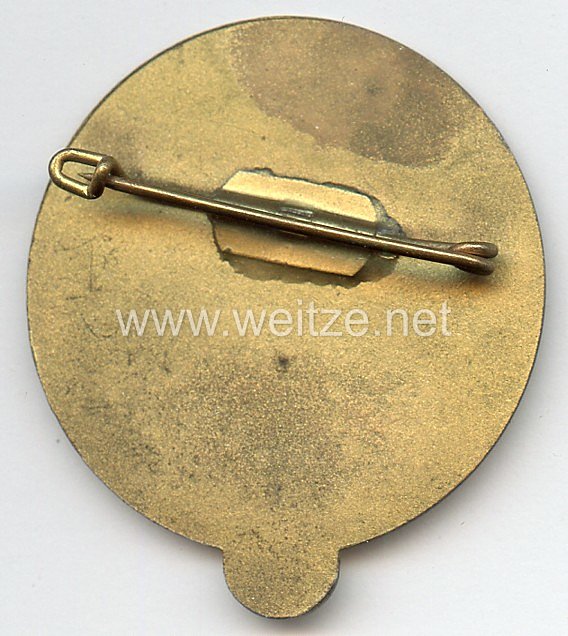
The pin construction on the reverse allowed the badge to be worn on uniforms. NSKK members typically wore their awards on the left breast of their service uniforms. The size of 45 mm corresponded to standardized dimensions for such organizational badges and ensured good visibility.

After the end of World War II, the NSKK and all its subdivisions were dissolved by the Allies and classified as a criminal organization. The organization's awards became historical documents of a dark epoch in German history. Today, such objects serve in collections and museums for historical research and documentation of the structures and practices of the Nazi regime.