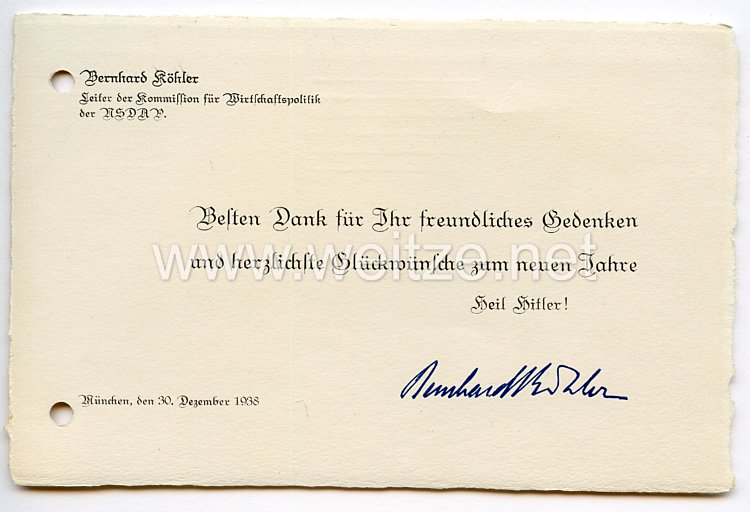
Third Reich - Bernhard Köhler - Director of the Commission for Economic Policy of the NSDAP - New Year's Greeting Card
This New Year's greeting card, dated December 30, 1938, and issued in Munich, originates from Bernhard Köhler, who served as head of the Commission for Economic Policy of the NSDAP (National Socialist German Workers' Party) and played a significant role in shaping the economic policy direction of the Nazi regime. Such documents provide fascinating insights into the administrative culture and networking practices of NS functionaries during the pre-war period.
Bernhard Köhler belonged to the extended circle of NSDAP functionaries who dealt with economic policy matters. The Commission for Economic Policy was part of the complex party apparatus that existed parallel to state administration and often competed with it. Munich, designated as the “Capital of the Movement,” was the symbolic and administrative center of the NSDAP and housed numerous party offices and institutions.
The year 1938 marked a turning point in the history of the Third Reich. It was the year of the Anschluss of Austria in March, the Sudeten Crisis in autumn, and the Munich Agreement in September. In November 1938, the November Pogroms took place, representing a dramatic escalation point in the persecution of the Jewish population. Economic policy during this period was increasingly oriented toward war preparation, with the Four-Year Plan under Hermann Göring serving as the central control instrument.
Greeting cards and congratulatory letters from NS functionaries were common instruments for maintaining relationships within the party apparatus and with important business partners. The use of facsimile signatures was widespread among high-ranking functionaries, as the large number of documents to be sent made personal signatures impractical. This suggests that such cards were produced in larger quantities and sent to an extended circle of recipients.
The NSDAP's Commission for Economic Policy dealt with the ideological orientation of economic questions and coordination between party and economy. It was part of efforts to restructure the German economy in accordance with National Socialist ideology and to align it with the regime's autarkic goals. The defense economy (Wehrwirtschaft), the integration of the economy into military planning, was intensified during this period.
Munich as the card's place of issue underscores the city's central importance for the NSDAP. It housed the Brown House, the party headquarters, as well as numerous other important institutions of the movement. The city was the site of the failed putsch attempt of 1923 and later became a pilgrimage destination for party members.
The document's perforation indicates that it was kept in a binder or collection, which was typical for administrative documents and correspondence of this era. The condition described as “lightly used” is remarkable for a paper document over 80 years old and indicates careful preservation.
Such ephemera from the NS period are important historical sources for researching the everyday culture and administrative practices of the regime. They document the routines and rituals of exercising power and maintaining relationships within the system. For collectors and historians, they provide insights into the functioning of the NS state beyond major political events.
The NSDAP's economic policy work during this period focused on several core areas: preparing the economy for war, displacing Jewish entrepreneurs, and coordinating economic associations. The Aryanization of Jewish property reached a new peak in 1938 following the November Pogroms and became a central economic policy instrument of the regime.
Today, such documents serve as memorials and objects of study, reminding us of the mechanisms of totalitarian rule and emphasizing the importance of democratic values.