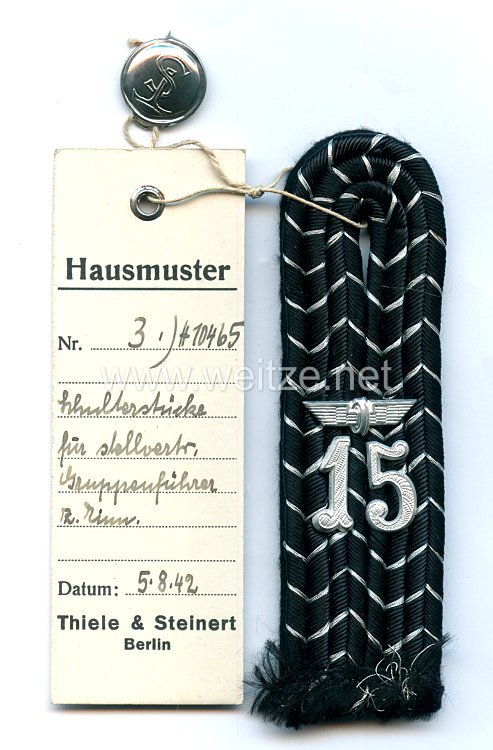
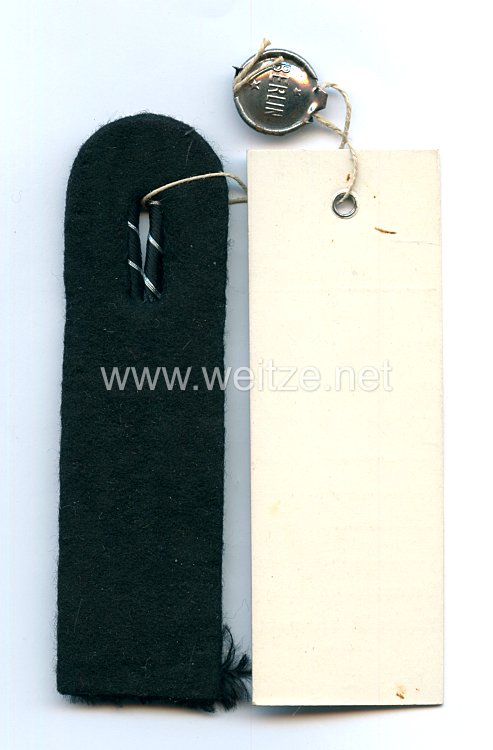
Railway Protection Single Shoulder Strap for a Deputy Group Leader

Shoulder board with aluminum insignia and stone-gray wool base as reserve pattern. Sample piece by the firm “Thiele & Steinert”, sealed, labeled and dated as house pattern 5.8.1942. In mint condition.
356308
300,00

Railway Protection Single Shoulder Strap for a Deputy Group Leader

This shoulder board represents an extraordinary testament to the German railway protection organization during World War II. It is a single shoulder piece for a deputy group leader of the Bahnschutz, manufactured as a sample piece by the renowned firm Thiele & Steinert and dated August 5, 1942.

The Bahnschutz (Railway Protection) was a paramilitary organization responsible for securing the railway infrastructure of the German Reich during World War II. With the expanding war effort and the associated acts of sabotage, partisan attacks, and air raids on strategically important transportation hubs, the need for a specialized protection force became increasingly urgent. The railways formed the backbone of military logistics and were crucial for transporting troops, supplies, and war-essential materials.

The rank structure of the Bahnschutz was modeled on military hierarchies, with the deputy group leader (stellvertretender Gruppenführer) representing a middle leadership position. This position was comparable to a non-commissioned officer rank and included both operational and administrative duties in organizing railway surveillance and security.

The shoulder board itself displays characteristic features of the uniform equipment of that era. The stone-gray cloth base was typical for reserve and auxiliary units and differed markedly from the dark green or field gray bases of regular Wehrmacht units. The aluminum overlays were the standard material for enlisted men and non-commissioned officers, while officers wore silver or gold braids. This material differentiation enabled quick identification of rank even at greater distances.

Particularly noteworthy is the provenance of this piece as a house sample (Hausmuster) from the firm Thiele & Steinert. This company was among the established manufacturers of uniform effects and military insignia during the Nazi era. House samples were reference pieces maintained by manufacturers for documentation and quality assurance purposes. They served as templates for series production and were often provided with seals, inscriptions, and dates to document their authenticity and conformity with official regulations.

The dating to August 5, 1942 places this object in a phase of the war when the German Wehrmacht reached its maximum territorial expansion, but was simultaneously confronted with increasing logistical challenges. The demand for uniform effects and equipment items was enormous, and production had to be standardized and rationalized. House samples like this were therefore an essential component of quality control in the armaments industry.

The mint condition of this sample piece is explained by its function as an archive item. Since it was never worn but served exclusively as a reference, it remained free from normal wear and tear. This makes such objects particularly valuable historical documents today, as they perfectly preserve the original manufacturing condition.

The shoulder board is also testimony to the meticulous bureaucracy and regimentation that characterized the National Socialist system. Every detail of uniforming was precisely prescribed, from the dimensions of shoulder pieces to the materials used, to the colors and patterns. This standardization was intended not only to symbolize military discipline and order but also to visually manifest the hierarchical structure of society.

From today's perspective, such objects are important primary sources for researching the everyday and military history of World War II. They enable historians to reconstruct the material culture of the period and understand how hierarchies, affiliations, and functions were expressed through uniforming. At the same time, they are memorials to a dark period of German history and must be viewed in the context of the criminal character of the Nazi regime.

The fact that this piece was manufactured by a specialized firm and carefully documented reflects the industrial organization of the German war economy. Companies like Thiele & Steinert were integrated into a complex system of military contracts and specifications, contributing to the war effort through the mass production of uniform accessories. The preservation of house samples also indicates the systematic approach to military supply and the importance placed on maintaining consistent standards across vast production runs.

r