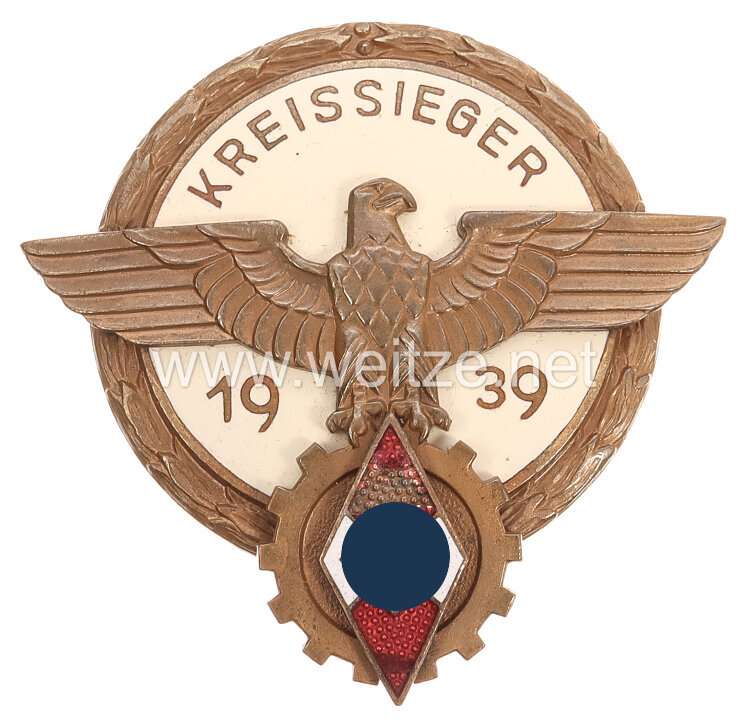
District Winner in the Reich Vocational Competition 1939

Non-ferrous metal, partially enameled. Clearly worn, the enamel of the HJ emblem damaged. Reverse with maker “A.G. Tham Gablonz”.
455707
350,00

District Winner in the Reich Vocational Competition 1939

The District Winner Badge in the Reich Vocational Competition 1939 represents a significant testament to the National Socialist youth organization and its efforts to combine vocational training with ideological education. This badge was awarded to young people who had distinguished themselves as winners at the district level in the Reich Vocational Competition (Reichsberufswettkampf, RBW).

The Reich Vocational Competition was established in 1934 by the German Labor Front (Deutsche Arbeitsfront, DAF) in cooperation with the Hitler Youth (Hitlerjugend, HJ). This annual event was designed to promote the vocational competence of German youth while emphasizing the National Socialist concept of achievement. The competition included theoretical and practical examinations in various professional fields, ranging from crafts and industry to commercial occupations.

The present example from 1939 marks a particularly significant moment in the history of the Third Reich. In the year war began, the Reich Vocational Competition had already established a five-year tradition and had become an integral part of National Socialist youth education. Participation numbers had steadily grown, and in 1939, several million young people participated at various levels of the competition.

The hierarchy of the Reich Vocational Competition was structured in several stages: beginning with factory competitions, through local group winners, district winners, regional winners, up to the Reich winners. The badge described here honors a victory at the district level, which represented a considerable achievement, as significant pre-selection had already taken place at this level.

The material design of the badge is characteristic of the period: it was manufactured from non-ferrous metal and partially enameled. This manufacturing technique was typical for NS-era awards, which on one hand were meant to appear representative, but on the other hand could not be made from precious materials due to large production numbers. The enameling gave the badges their characteristic colored design, particularly on the HJ emblem, which typically featured the organization's characteristic colors – red, white, and black.

The manufacturer noted on the reverse, “A.G. Tham Gablonz,” provides insight into the production site. Gablonz an der Neiße (today Jablonec nad Nisou in the Czech Republic) was a traditional center of the jewelry and bijouterie industry. After the annexation of the Sudetenland in 1938, the local manufactories were increasingly utilized for the production of orders, decorations, and badges of the German Reich. The Tham company was among the established manufacturers of such awards.

The condition of the present piece – “clearly worn” with damaged enamel on the HJ emblem – is historically significant. It demonstrates that the badge was actually worn by its bearer over an extended period, indicating the importance attached to the award. Many young people considered winning such a badge an honor and wore it with pride on their HJ uniform or civilian clothing.

The historical context of 1939 is of particular significance: it was the last year in which the Reich Vocational Competition could still take place under largely normal conditions. With the beginning of World War II on September 1, 1939, the framework conditions changed fundamentally. Many of the older participants were soon drafted into the Wehrmacht, and vocational training was increasingly concentrated on war-essential sectors.

The ideological dimension of the Reich Vocational Competition must not be overlooked. The event served not only to promote vocational skills but was firmly embedded in the National Socialist worldview. In addition to professional examinations, “ideological schooling” and physical fitness were also evaluated. The competition was intended to strengthen the “spirit of community” and prepare youth for their future tasks in economy and society – and ultimately also in war.

The propaganda value of such competitions was considerable. The regime used the Reichsberufswettkampf to demonstrate the supposed superiority of the German vocational training system and to mobilize youth enthusiasm for the National Socialist state. Ceremonies, press coverage, and the awarding of badges like the one described here were carefully staged to maximize their impact.

Today, such badges are important historical sources that provide insight into the everyday history of National Socialism. They document the comprehensive efforts of the regime to penetrate all areas of life – including vocational training – and instrumentalize them for its purposes. At the same time, they reveal the reality of youthful life-worlds during this period, in which many young people participated with genuine enthusiasm in such competitions, without necessarily grasping the full extent of the ideological appropriation.

For collectors and historians, such pieces serve as tangible reminders of how totalitarian systems sought to control and shape every aspect of youth development, using seemingly benign mechanisms like vocational competitions to advance their broader ideological agenda.