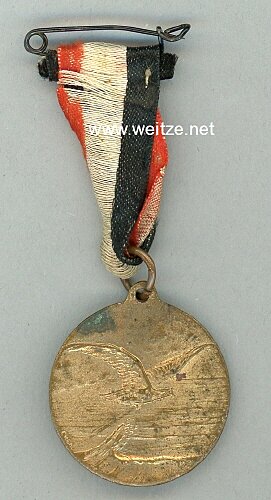
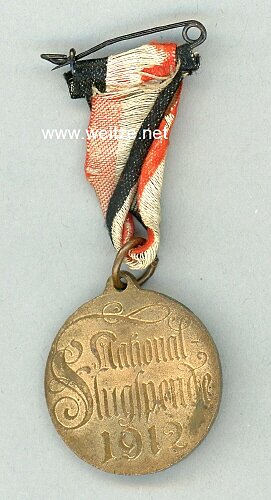
Wearable Donation Medal “National-Flugspende 1912”

Bronze-toned, on ribbon with pin bar, condition 2
The National-Flugspende was a national fundraising campaign initiated by Prince Heinrich von Preussen to advance the development of the German aviation industry.
222106
45,00

Wearable Donation Medal “National-Flugspende 1912”

The portable donation medal “National-Flugspende 1912” (National Aviation Donation 1912) represents a significant testimony to early German aviation history and documents an unprecedented patriotic fundraising campaign on the eve of World War I. This award was conferred upon donors who contributed to the national fundraising initiative designed to promote the development of the German aircraft industry.

Prince Heinrich of Prussia, the younger brother of Kaiser Wilhelm II, initiated the Nationalflugspende in 1912. As an enthusiastic promoter of technical innovations and particularly aviation, the Prince recognized the strategic importance of a capable aircraft industry for the German Reich. At this time, Germany lagged significantly behind France in the international comparison of military aviation, which was increasingly perceived as alarming in military and political circles.

The fundraising campaign was organized with great propagandistic effort and found broad resonance among the German population. Newspapers, associations, and local committees mobilized citizens to donate for the “national cause.” The donation campaign appealed to national sentiment and concerns about Germany's technological competitiveness. Within a short period, considerable sums were raised, which were used for building military aircraft, establishing flight schools, and promoting aviation research.

As a token of gratitude and visible sign of participation, donors received the donation medal, typically executed in toned bronze. The medal was worn on a ribbon with a pin and could thus be publicly displayed. This corresponded to the zeitgeist of the era, in which the wearing of orders and decorations documented not only military merit but also civic engagement for national purposes. The medal thus served both as recognition and as an advertising tool to motivate additional citizens to participate in the donation campaign.

The National-Flugspende 1912 must be understood in the context of the contemporary armament policy and the increasing arms race between the European great powers. Military aviation was still in its infancy, but its potential significance for future conflicts was already recognizable. France had systematically invested in its air forces following the first flight attempts by the Wright brothers and possessed a significantly larger fleet of military aircraft than Germany in 1912.

German military authorities recognized this deficit and demanded accelerated armament. However, since regular military budgets were already heavily strained, the civil society donation campaign offered a welcome additional source of financing. The Nationalflugspende generated millions of marks that flowed directly into the expansion of German air forces. Numerous aircraft were procured, pilots trained, and airfields established.

The design of the medal itself followed the usual conventions of contemporary awards. Typically, such medals displayed patriotic symbols, inscriptions with the name of the donation campaign and the date, as well as frequently stylized representations of aircraft or eagles. The use of bronze as material corresponded to the standard for civilian awards and commemorative medals of this period.

The historical significance of the National-Flugspende and its medal lies not only in its immediate contribution to German armament but also in its function as testimony to the mobilization of the civilian population for military purposes. It documents how German society on the eve of World War I willingly supported national armament projects and how skillfully propaganda and patriotism were employed to finance military objectives.

Today, these medals are sought-after collectibles that represent an important aspect of German military and aviation history. They recall a time of technological upheaval and the growing importance of the third dimension in warfare. The condition of such historical objects is usually evaluated according to a standardized system, whereby various degrees of preservation are considered, from strike quality to signs of wear.

The National-Flugspende of 1912 stands as a remarkable example of how public enthusiasm and national pride could be channeled into concrete support for military development, foreshadowing the total mobilization of society that would characterize the coming world war.

r