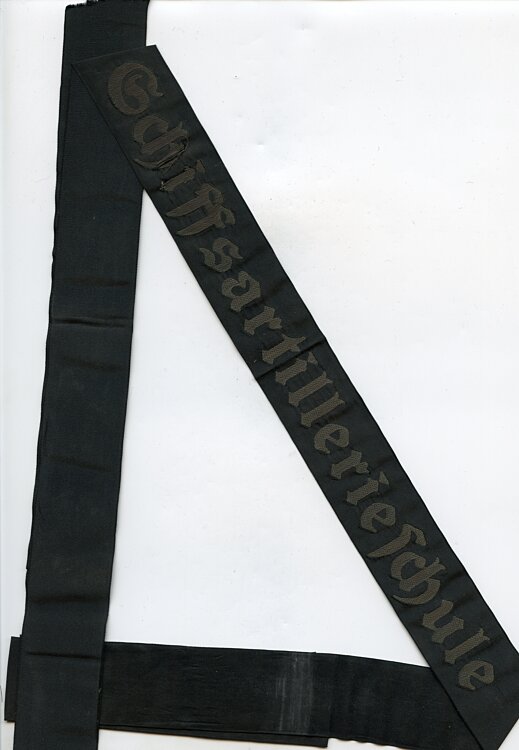
Cap Tally "Schiffsartillerieschule"

Metal thread woven construction, clearly worn. Condition 2-
108006
35,00

Cap Tally "Schiffsartillerieschule"

Cap Tally of the Naval Artillery School (Schiffsartillerieschule) of the Imperial German Navy

This cap tally bears the inscription "Schiffsartillerieschule" (Naval Artillery School) and represents an important institution of German naval training that existed from the late 19th century until the end of World War I. Such cap tallies were an integral part of the Imperial German Navy uniform and served to identify the respective unit or ship of the wearer.

Historical Background of the Naval Artillery School

The Schiffsartillerieschule was established during the massive naval expansion under Grand Admiral Alfred von Tirpitz. With the increasing importance of modern naval artillery and the development of ever more powerful gun systems, specialized training for artillerymen of the Imperial Navy became essential. The school was located in Sonderburg (today Sønderborg in Denmark) on the island of Als, and later also in Kiel-Wik.

The institution's mission was to train officers and enlisted men in the operation of increasingly complex naval guns. This included not only the practical handling of weapons, but also theoretical knowledge in ballistics, fire control systems, and range finding. The training was particularly important for crews of the modern dreadnought battleships of the High Seas Fleet, which were equipped with guns of 28 cm, 30.5 cm, and later 38 cm caliber.

The Cap Tally as Uniform Component

Cap tallies of the Imperial German Navy were available in various designs. The highest quality variant was the metal-thread woven version, as present in this specimen. These bands were made from black fabric, with the lettering woven in gold-colored metal thread. The quality of workmanship and the use of metal threads made these tallies a recognizable status symbol within the Navy.

According to the uniform regulations of the Imperial Navy, cap tallies were worn on the Bordmütze (working cap), which was part of the daily service uniform. The inscription on the band identified the wearer's affiliation with a particular ship or shore establishment. Unlike ship names, which could change frequently, assignment to training facilities remained constant throughout the training period.

Technical and Material Aspects

Metal-thread woven cap tallies were characterized by particular durability, but showed signs of wear with intensive use. The worn condition of the present specimen indicates actual service use. Typical wear patterns include oxidation of the metal threads, fraying of fabric edges, and general patina. Such authentic signs of use significantly increase the historical value of such an object, as they bear witness to actual military daily life.

Temporal Classification

Cap tallies of this type were mainly worn between 1890 and 1918. The Naval Artillery School existed throughout the entire fleet expansion phase of the German Empire and played a central role in preparation for World War I. After the Battle of Jutland in 1916, the largest naval battle of the war, the importance of well-trained artillerymen was emphasized once again.

With the end of World War I and the provisions of the Treaty of Versailles in 1919, the Imperial Navy was dissolved and replaced by the severely limited Reichsmarine. The Naval Artillery School as an institution of the old Navy ceased to exist.

Collector Value and Historical Significance

Today, cap tallies of the Imperial German Navy are sought-after collectibles representing important testimonies of German naval history. Tallies from training establishments such as the Naval Artillery School are rarer than those from famous battleships, which adds to their special value. The worn condition underscores the authenticity and historical relevance of the object as a personal equipment item of a naval serviceman from the Wilhelmine era.