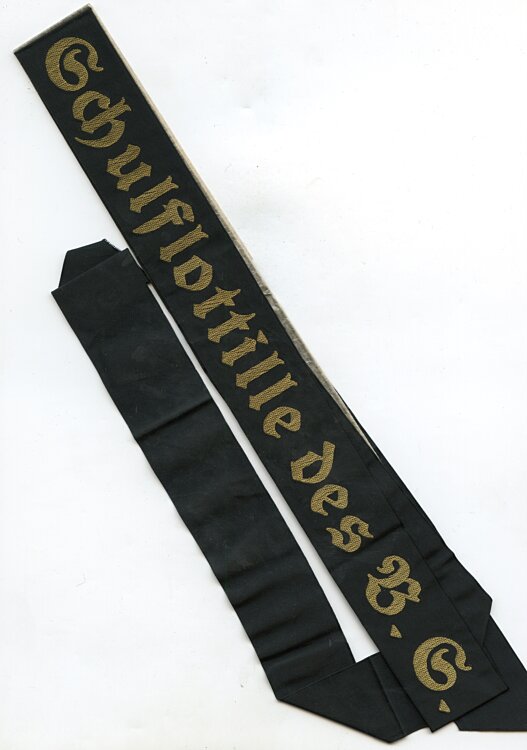
Kriegsmarine Cap Tally "Schulflottille des B.S.N."

mint condition with original paper packaging, 150 cm long. Condition 1 (B.S.N. = Befehlshaber der Schulschiffe der Nordsee - Commander of Training Ships North Sea).
134406
140,00

Kriegsmarine Cap Tally "Schulflottille des B.S.N."

Kriegsmarine Cap Tally "Schulflottille des B.S.N."

This Kriegsmarine cap tally bears the inscription “Schulflottille des B.S.N.”, where B.S.N. stands for Befehlshaber der Schulschiffe der Nordsee (Commander of Training Ships of the North Sea). These cap tallies were an essential component of German naval personnel uniforms and served to identify affiliation with specific units, ships, or organizations.

The Schulflottillen (training flotillas) of the Kriegsmarine held central importance for training recruits. Following the rearmament of the German Navy in the 1930s, an extensive training system was established that encompassed various training ships and educational units. The Commander of Training Ships of the North Sea was responsible for coordinating and supervising training on ships under his command.

Cap tallies (also called Mützenbänder) had been a characteristic feature of German naval uniforms since the Imperial Navy era. They were worn around the peaked cap or sailor's cap and typically consisted of black ribbon with gold-yellow lettering. The standard length was approximately 150 cm, as is the case with this specimen. The ends of the ribbon hung down from the back of the cap and featured two parallel black stripes along with the inscription.

These cap tallies were manufactured by specialized producers who had to meet strict quality standards. The inscriptions were either embroidered or woven, with lettering in Fraktur or Sütterlin script. The quality and execution were subject to the Kriegsmarine's uniform regulations, which detailed precisely how various uniform components should appear.

Training in the Schulflottillen included both theoretical instruction and practical exercises at sea. Recruits and officer candidates learned navigation, seamanship, weapons training, and other skills relevant to naval service. Training ships were frequently older cruisers or units specially converted for training purposes. The North Sea as a training area offered ideal conditions for maritime education with its challenging weather and sea conditions.

The presence of the original paper packaging with this specimen is particularly noteworthy, as such packaging rarely survived. This indicates that the cap tally was either never issued or never worn. The paper packaging often contained manufacturer information, size designations, or other administrative details.

The organization of naval training fell under various command posts. Besides the Commander of Training Ships of the North Sea, there were corresponding commands for the Baltic Sea and other training facilities. This decentralized structure enabled efficient training of large numbers of recruits needed for building and maintaining the expanding Kriegsmarine.

After World War II, such uniform items became collector's objects. Cap tallies are now sought-after pieces in military-historical collections, as they provide insights into the organization and structure of the historical navy. Condition is a significant factor for historical and museum value. Unworn specimens with original packaging like this one are particularly rare.

Research into such militaria contributes to understanding organizational structure, daily life, and material culture of the military. They enable historians and museums to paint a more comprehensive picture of military history that extends beyond mere combat operations and includes aspects such as training, uniforming, and maritime traditions.