Third Reich Flute with Leather Case for Members of a Music Corps

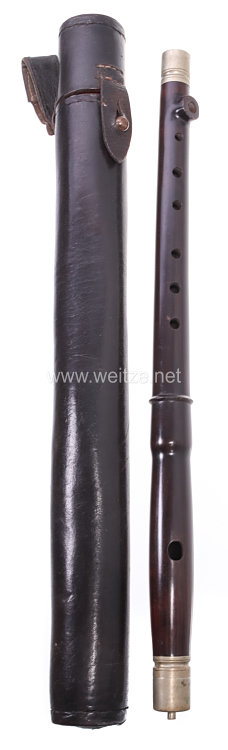
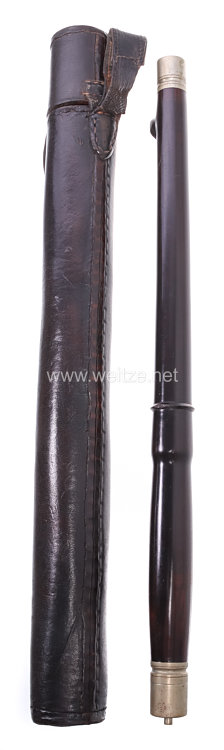
The flute made of black ebony with nickel silver fittings. Complete in black leather case with belt carrying loop. The bottom of the case has a hole, condition 2.
397106
320,00

Third Reich Flute with Leather Case for Members of a Music Corps

The ebony transverse flute with its characteristic black leather case represents a fascinating example of the musical equipment used by military bands during the era of the Third Reich (1933-1945). These instruments played a significant role in the military and paramilitary organizations of the National Socialist regime.

The military music tradition had a long history in Germany that extended far beyond the Nazi era. Already in the Prussian Army of the 18th and 19th centuries, military bands and music corps were integral parts of troop organization. With the Nazi seizure of power, this tradition was intensively cultivated and instrumentalized for propaganda purposes.

This transverse flute was crafted from ebony, a high-quality dark wood valued for its acoustic properties. The nickel silver fittings – an alloy of copper, nickel, and zinc – were characteristic of instruments from this period. Nickel silver was corrosion-resistant and allowed for precisely manufactured keys and mechanisms that were crucial for the instrument's playability.

The music corps were present in various organizations of the Third Reich: in the Wehrmacht, the SS, the Hitler Youth, the Reich Labor Service (RAD), and other paramilitary formations. Each of these organizations maintained its own musical units that performed at parades, marches, roll calls, and other official events.

The black leather case with belt carrying loop was specifically designed for military use. The carrying loop allowed the musician to attach the instrument to the belt, making it readily accessible during marches or formations. This practical solution was typical of military equipment, where functionality and quick deployment were paramount.

The training of musicians in military bands was strictly regulated. In the Wehrmacht, there were special Army Music Schools where young soldiers were trained as military musicians. The repertoire included march music, patriotic songs, and classical pieces that were performed at various occasions.

The transverse flute itself had an important function in military wind music. Together with piccolo flutes, it formed the highest register in the woodwind section and contributed significantly to the tonal color and brilliance of military bands. A typical Wehrmacht music corps usually included two to four transverse flutes.

The uniform regulations and equipment specifications of the various organizations precisely dictated how instruments were to be carried. Musicians usually wore the regular uniform of their unit, supplemented by special badges indicating their membership in the music corps. In the Wehrmacht, this was often a lyre as a sleeve insignia.

After the end of World War II in 1945, many of these instruments were kept as personal property or were lost in the chaos of the post-war period. Some specimens were taken by Allied soldiers as souvenirs. Today, such instruments with their original equipment are sought-after collectibles that provide insight into the material culture of the Third Reich.

The preservation of such objects is important from a historical perspective, as they represent authentic testimonies of a dark epoch in German history. They enable us to better understand the everyday reality and organizational structures of that time, without trivializing or glorifying the crimes of the Nazi regime.

The described instrument with its leather case shows the typical craftsmanship quality of the 1930s and 1940s. Despite the hole in the bottom of the case – presumably a sign of aging or wear – the ensemble is in good condition, indicating proper storage over the decades.

These musical instruments serve as tangible reminders of how music was employed in the service of a totalitarian state, used not only for entertainment but as a tool for indoctrination, military morale, and the projection of power during one of history's darkest periods.