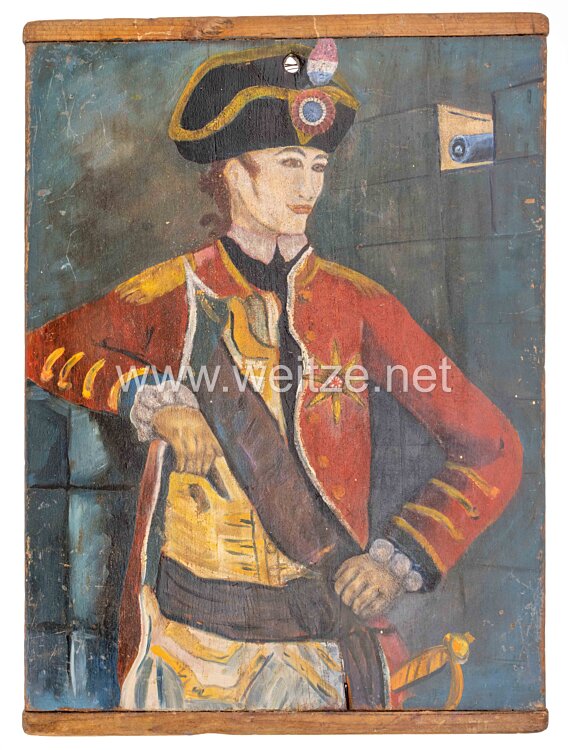
France Polychrome Painted Wooden Panel "French Soldier of the Ancien Régime"
Very decorative!
This painted wooden panel from around 1900 depicting a French soldier of the Ancien Régime represents a fascinating tradition of military folk art that experienced a particular golden age in Europe at the turn of the 20th century. Such decorative panels were typical fixtures in French taverns, bistros, and restaurants, creating an atmosphere of national identity and historical pride through their patriotic iconography.
The Ancien Régime, the term for the French monarchy before the Revolution of 1789, represents an era when France was one of Europe's leading military powers. The French army of this period was distinguished by its colorful, magnificent uniforms that served not only practical but especially representative purposes. The royal regiments wore characteristic white coats that became the hallmark of French infantry, while various units were distinguished from one another by different badges, facings, and decorations.
The creation date of this panel around 1900 is historically particularly significant. France was in the Belle Époque, a period of relative peace and economic prosperity that was simultaneously marked by growing nationalism. The humiliating defeat in the Franco-Prussian War of 1870/71 and the loss of Alsace-Lorraine had created an increased need for national self-reassurance. The return to the glorious military past of the Ancien Régime served to strengthen national self-confidence.
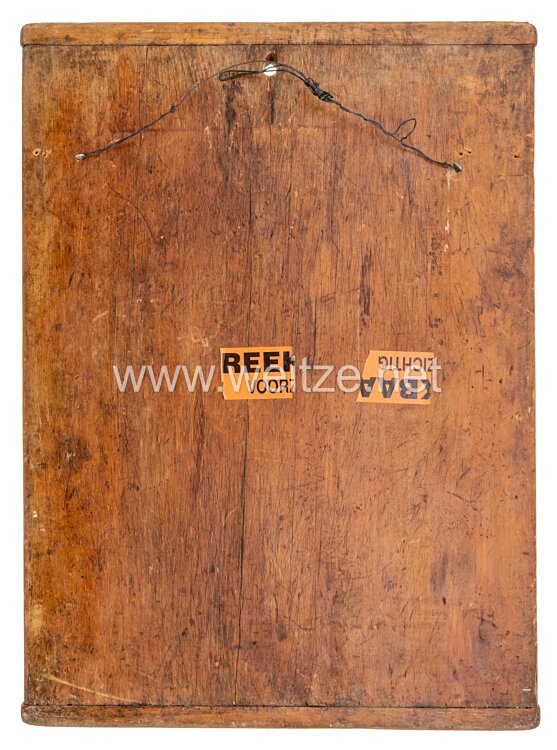
Such wooden panels were typically crafted by local artisans or specialized sign painters. The technique involved priming the approximately 2 cm thick wooden board, sketching the figure, and finally painting it with oil or enamel colors. The robust dimensions of nearly 50 x 68 cm made these panels impressive wall decorations that did not fail to make an impact even in smoky, busy taverns.
The depiction of soldiers of the Ancien Régime in art and crafts around 1900 was part of a broader movement of history painting and historical romanticism. Artists such as Édouard Detaille and Alphonse de Neuville had aroused public interest in historical uniforms and battle scenes through their detailed military paintings. This academic tradition also influenced folk art and led to a variety of decorative objects with military motifs.
In French taverns and bistros, such panels fulfilled multiple functions. They served not only as decoration but also created a specific atmosphere that conveyed tradition, masculinity, and patriotic sentiment. Many of these establishments bore names with military references such as “Au Vieux Soldat” or “Le Grenadier,” and the corresponding furnishings emphasized this thematic orientation.
The craftsmanship quality of such panels varied considerably. While some were executed by professional sign painters with considerable artistic skill, others came from the hands of talented amateurs. The authenticity of uniform depiction ranged from historically accurate reproductions based on contemporary sources and regulations to highly simplified or romanticized interpretations.
The collector value of such objects has steadily increased in recent decades. Today they are valued as important testimonies of material culture and the history of mentalities. For military historians, they offer insights into the reception and popularization of military history, while cultural historians analyze them as examples of the furnishing of public spaces and the construction of national identity.
The preservation of such wooden panels over more than a century is remarkable, as they originally served as utilitarian objects in heavily frequented public spaces. Many were lost through war damage, particularly during the two World Wars, or through simple neglect. The surviving examples are therefore all the more valuable as historical documents of a bygone era of visual and material culture.