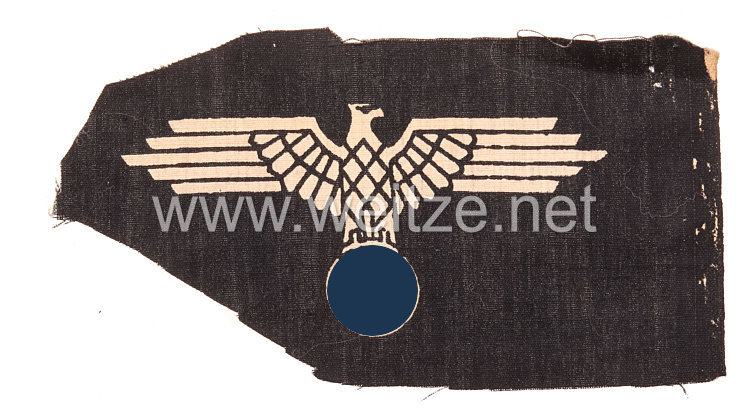
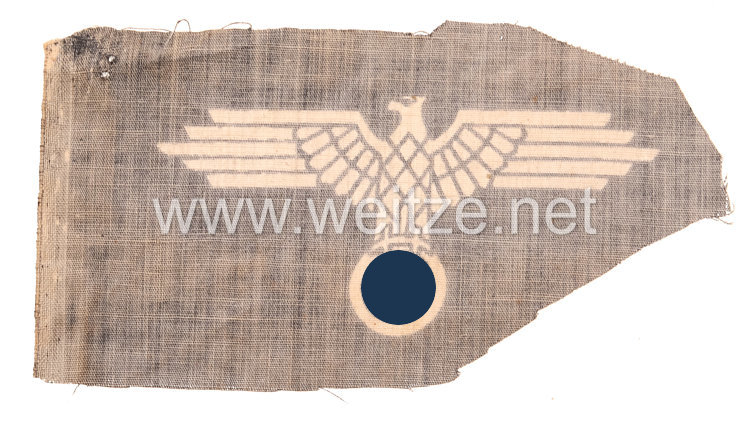
Waffen-SS Sleeve Eagle for Enlisted Men - Model 1945

Late printed version. Unissued, condition 2. Very rare.

443905
350,00

Waffen-SS Sleeve Eagle for Enlisted Men - Model 1945

The Waffen-SS sleeve eagle for enlisted personnel, Model 1945 represents one of the last standardized uniform insignia produced during the final phase of World War II for the Waffen-SS. This late printed version differs significantly from earlier, more elaborate versions and reflects the increasingly desperate material and production situation of the German Reich in the final months of the war.

The Waffen-SS, as the military arm of the Schutzstaffel, developed its own system of rank insignia and uniform markings from 1940 onwards. The sleeve eagle was traditionally worn on the left upper arm of the field tunic and served as an identifying mark of membership in the Waffen-SS. Early versions of these insignia were manufactured using elaborate hand-embroidery techniques or as woven BeVo badges, using silver-colored thread on black or field-grey backgrounds.

As the war progressed and material shortages intensified, the German armaments industry had to switch to simplified manufacturing processes. The printed versions, such as the 1945 model described here, were part of these rationalization efforts. These insignia were applied to fabric using screen-printing methods, which enabled significantly faster and more cost-effective production. However, the quality and durability of these printed versions were considerably inferior to the earlier woven or embroidered versions.

The year 1945 marked the final phase of World War II in Europe. At this point, the German Reich was already in an advanced state of collapse. The Waffen-SS had evolved from an elite formation into a mass army that, in addition to German volunteers, increasingly consisted of foreign volunteers and later also conscripts. Uniform and insignia production could barely keep pace with the rapid personnel growth, which made the introduction of such simplified production methods necessary.

The description as “unworn” is of particular historical significance for such late productions. Many of the insignia manufactured in 1945 never reached their intended wearers, as supply lines collapsed, production facilities were bombed, or the military situation was already so hopeless that distribution no longer functioned. The end of the war in May 1945 resulted in large quantities of unissued uniform parts and insignia remaining in depots or being confiscated by advancing Allied troops.

The rarity of such late printed versions can be explained by several factors: First, they were only produced for a very short period, typically between January and April 1945. Second, the chaotic conditions of the final months of the war resulted in production records being lost or destroyed. Third, after the war, many of these insignia were deliberately destroyed, as possession of SS insignia was prohibited in the occupation zones and was subject to criminal prosecution.

From a military-historical perspective, these late insignia document the complete decline of the National Socialist military machinery. The contrast between the precisely woven, high-quality insignia of the early war years and the hastily printed versions of 1945 vividly illustrates the economic and industrial exhaustion of the German Reich. The fact that even in the final weeks of the war, resources were still being expended on producing uniform insignia while basic military equipment was lacking highlights the ideological importance that the Nazi regime attached to symbolic representation.

Today, such objects are important study materials for military historians and uniform specialists researching the development and decline of German armed forces in World War II. They serve as material witnesses to one of the darkest periods in German history and help to understand the functioning and organization of National Socialist military formations.