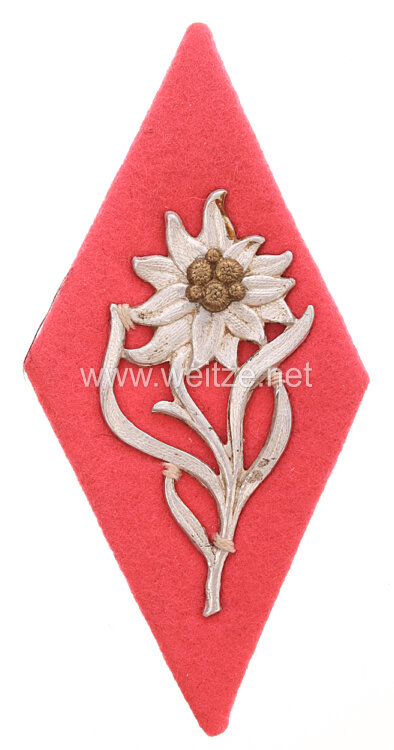
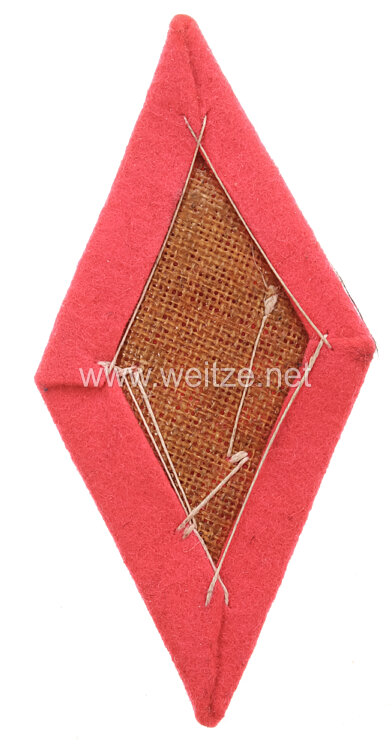
Rhombus and Edelweiss for the Mountain Cap of SA-Gruppe Südmark
The SA Mountain Cap Badge of the Südmark Group represents a significant example of paramilitary insignia used during the National Socialist period in Austria and the southeastern border regions of the German Reich. This specific badge combines an aluminum edelweiss with a pink rhombus, a combination that symbolized both regional and organizational affiliation.
The SA-Gruppe Südmark was formed after the Anschluss of Austria in March 1938 and encompassed areas of former Austria as well as southeastern border regions. The term “Südmark” referred to the historical German designation for the southeastern territories and carried strong nationalist connotations. The SA (Sturmabteilung) organized itself into various groups, each covering specific geographic regions, and each group developed its own distinctive markings and uniform variations.
The edelweiss as a symbol had a long tradition in the Alpine regions and was traditionally associated with mountaineers, mountain troops, and Alpine identity. In military contexts, the mountain troops of the Austro-Hungarian Monarchy already used the edelweiss as a distinction badge. After 1918, various Austrian defense organizations and later the Wehrmacht adopted this symbol for their mountain troops. The SA-Gruppe Südmark adapted this regionally significant symbol for their mountain cap to emphasize the connection to their Alpine homeland.
The pink rhombus served as the base for the edelweiss and represented the specific color coding of the SA-Gruppe Südmark. Different SA groups used different colors for their badges and distinguishing features, which enabled identification of regional origin. The diamond-shaped base form was typical for many SA mountain cap badges and thus differed from the circular or oval badges of other organizations.
The mountain cap itself was a characteristic component of the SA uniform in Alpine regions. It differed from the standard SA peaked cap and was specifically designated for members in mountain regions. This headgear reflected both practical considerations for the terrain and the desire to integrate regional traditions into paramilitary uniforming.
The production of such badges typically utilized aluminum, a lightweight and corrosion-resistant material well-suited for mass production. The edelweiss was crafted in a characteristic three-dimensional form, with individual petals clearly worked out. Attachment usually occurred through split pins or threaded screws on the reverse side, which were passed through the fabric of the cap.
The historical context of these badges is inseparably linked with the National Socialist seizure of power in Austria. After the Anschluss in March 1938, the Austrian SA was integrated into the German SA organization. The formation of the SA-Gruppe Südmark was part of this reorganization and was intended to symbolize the integration of Austrian territories into the German Reich. The SA played an important role during this phase in enforcing National Socialist rule and intimidating political opponents.
For collectors and historians today, such badges are important historical documents that provide insight into the organizational structure, regional peculiarities, and material culture of the SA. The condition described as “unworn” suggests that this specific specimen was probably never actually attached to a uniform, which was not uncommon with military and paramilitary equipment items, as often more badges were produced than actually issued.
The scholarly examination of such objects serves historical documentation and understanding of the structures and symbolism of totalitarian organizations. The critical historical context in which these items were created and used must always be considered. They serve as reminders of a dark period in European history and warn of the need for vigilance against extremist ideologies.