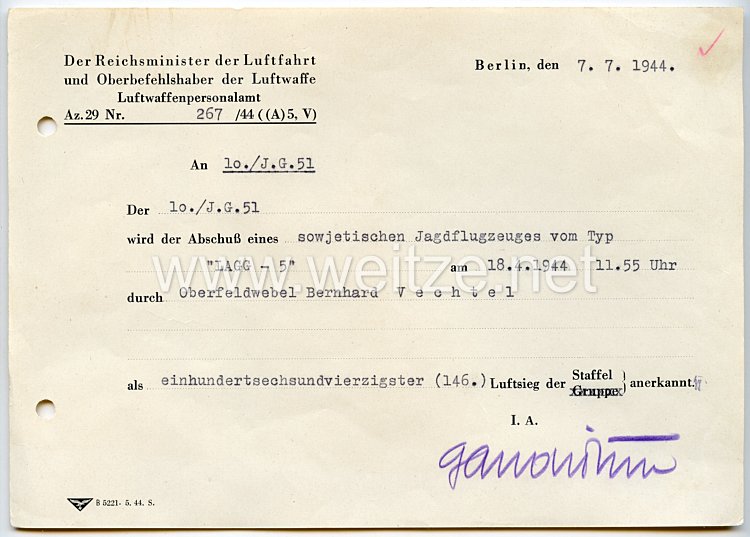
Luftwaffe - Victory Confirmation Certificate for Knight's Cross Recipient Oberfeldwebel Bernhard Vechtel of 10./Jagdgeschwader 51
The Abschussbescheinigung (victory confirmation certificate) of the German Luftwaffe represented an important military document during World War II that officially confirmed the successful downing of an enemy aircraft. These certificates were not merely administrative records but also served to recognize individual achievements and maintain precise statistics on aerial combat.
The present document certifies the shooting down of a Soviet fighter aircraft of the type LAGG-5 on April 18, 1944, by Oberfeldwebel Bernhard Vechtel, a member of the 10th Squadron of Jagdgeschwader 51 (JG 51). This aerial victory simultaneously marked the 146th confirmed kill of the entire squadron. The certificate was issued on July 27, 1944, approximately three months after the actual combat event.
Jagdgeschwader 51, also known as “Mölders” after the famous fighter pilot Werner Mölders, was one of the most successful fighter wings of the Luftwaffe. The unit fought on various fronts, with particularly intensive deployment on the Eastern Front. In the spring of 1944, at the time of the documented shoot-down, JG 51 was engaged in fierce aerial combat against Soviet air forces.
The LAGG-5 was a Soviet fighter aircraft designed as a development of the LAGG-3. The acronym LAGG stood for the names of the three designers Lavochkin, Gorbunov, and Gudkov. The LAGG-5 entered service from 1942 and proved to be a robust and combat-capable aircraft, although it was inferior to German fighters in some flight performance characteristics.
Oberfeldwebel Bernhard Vechtel was a distinguished fighter pilot who was honored for his service with the Knight's Cross of the Iron Cross (Ritterkreuz des Eisernen Kreuzes). This highest military decoration of the German Reich was awarded only to soldiers who demonstrated exceptional bravery and military success. Vechtel thus belonged to an elite group of fighter pilots who distinguished themselves through outstanding performance in aerial combat.
The procedure for confirming aerial victories was strictly regulated in the Luftwaffe. A shoot-down had to be confirmed by witnesses, either by other crew members, comrades in other aircraft, or by ground observers. Photographic evidence from gun cameras was also utilized. Squadron leadership carefully examined claims before an official victory certificate was issued. The three-month delay between the shoot-down on April 18 and the issuance of the certificate on July 27, 1944, was not unusual and reflects the bureaucratic processes involved.
Such certificates were typically issued on standard forms and contained standardized information: date and time of the shoot-down, type of enemy aircraft, location of the incident, name of the pilot, and often the sequential number of the aerial victory. The documents were hole-punched to file them in personnel records or flight logbooks.
The condition of the present document with holes and signs of use is characteristic of authentic wartime documents. These traces testify to actual use and storage during and after the war. Many such documents were lost in the chaos of the final months of the war, making surviving examples historically valuable today.
In April 1944, the war on the Eastern Front was in a critical phase. The Red Army had seized the initiative after victory at Stalingrad and the Battle of Kursk, steadily pushing back German forces. The Luftwaffe fought increasingly under difficult conditions against a numerically superior Soviet air force. Nevertheless, German fighter pilots continued to achieve notable successes due to their experience and training.
Victory certificates like this are important historical sources for aerial warfare research. They enable historians to trace the intensity of air combat, the development of air warfare tactics, and the individual achievements of pilots. At the same time, such documents must be viewed in the context of their time, as part of a comprehensive military conflict with all its human and material costs.
For collectors and museums, these certificates represent tangible connections to the experiences of individual servicemen and the broader history of aerial warfare. They provide insight into the recognition systems and documentation practices of military organizations during World War II, contributing to our understanding of how modern warfare was conducted and recorded.