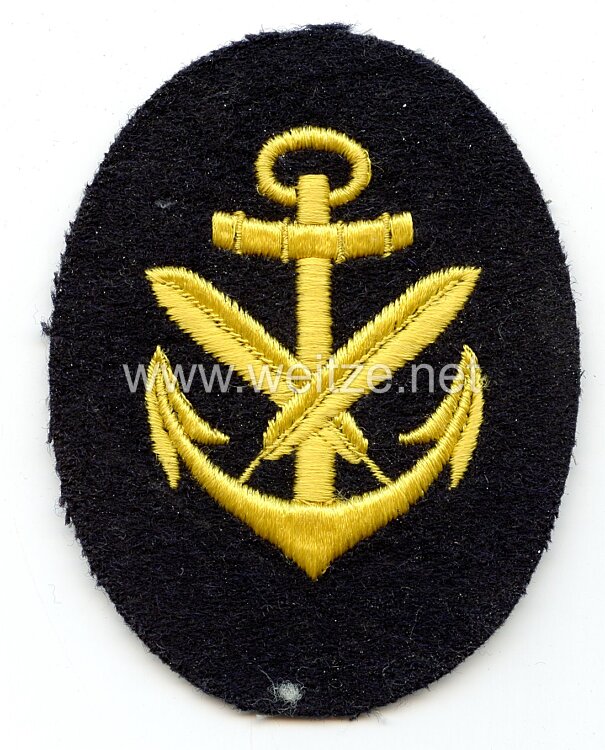
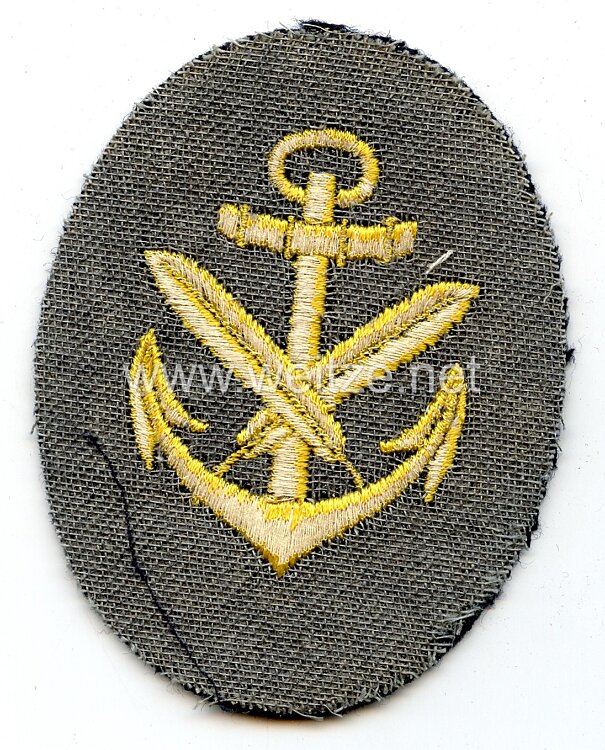
Kriegsmarine Sleeve Insignia Yeoman Petty Officer
The Kriegsmarine sleeve badge for Schreibermaat (Writer's Mate) represents a significant example of the complex rank insignia system of the German Navy during World War II. This particular machine-embroidered version was worn on the blue blouse (service uniform) and identified a non-commissioned officer in the administrative career path.
The Kriegsmarine, officially established in 1935 following the reintroduction of conscription and the repudiation of the military restrictions of the Treaty of Versailles, developed a detailed system of uniforms and insignia. Rank badges served not only to identify the rank group but also the specific career path or specialty within the Navy. This system was based on the traditions of the Imperial German Navy but adapted to the requirements and ideology of the Nazi state.
The rank of Maat corresponded roughly to that of a non-commissioned officer in other branches of the Wehrmacht and was identified by specific sleeve badges. The designation as Schreibermaat identified the wearer as a member of the administrative career path, entrusted with administrative, accounting, and clerical duties. These specialists were indispensable to the functioning of every unit, as they were responsible for personnel files, supply records, ship's logs, and other administrative documents.
The machine-embroidered execution was the standard form for Kriegsmarine sleeve badges and differed from the hand-embroidered variants, which were generally reserved for officers or special versions. Machine production enabled more cost-effective and faster manufacturing, which was necessary given the enormous personnel requirements of the rapidly expanding Navy during wartime.
The badge was worn on the blue blouse, which was part of the daily service uniform. The Kriegsmarine distinguished between different uniform types: the white summer uniform, the blue service uniform, and the dark blue walking-out uniform. The placement of sleeve badges was precisely regulated in the Kriegsmarine uniform regulations and was positioned on the left upper arm.
The structure of the Kriegsmarine encompassed various career paths, including the sea officer career path, technical paths, medical path, and the administrative path to which the writers belonged. Each career path had its own characteristic insignia, often marked by specific symbols, colors, or shapes. The writers' career path typically used stylized quill or writing pen symbols.
During the war, the Kriegsmarine grew from approximately 50,000 men in 1939 to over 800,000 by 1945. This massive expansion required a large number of administrative personnel to manage the complex logistics, personnel administration, and documentation. Schreibermaate were deployed both ashore in naval offices and aboard ships.
The production of such badges was carried out by specialized companies that had supply contracts with the Wehrmacht. Quality could vary depending on the manufacturer and the phase of the war. Towards the end of the war, material shortages and the general economic situation often led to simplified versions.
After the end of World War II and the capitulation in May 1945, the Kriegsmarine was dissolved. Its uniforms and insignia were partly destroyed, partly kept as souvenirs, or later became objects of military historical collections. Today, such badges are important testimonies to uniform studies and the organizational structure of the German Navy of this era.
From a military-historical perspective, these sleeve badges document not only the formal structure of a military organization but also the practical aspects of daily service life, the importance of specialized functions, and the development of uniform regulations during a time of total war.