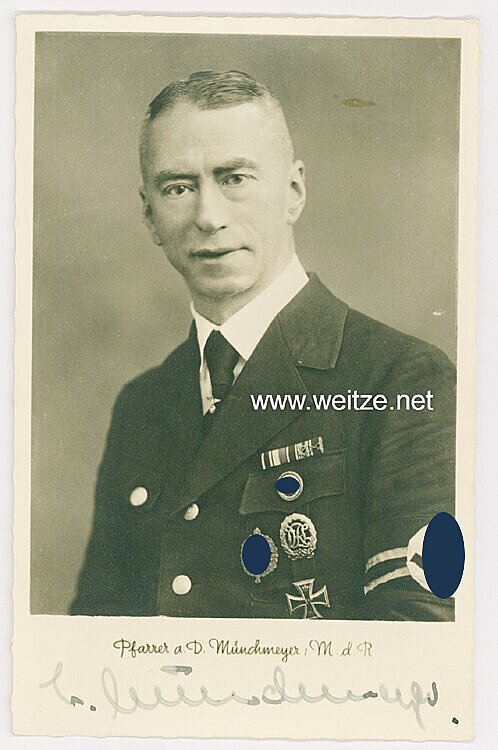
Third Reich - Original Signature of Retired Pastor Ludwig Münchmeyer, Member of the Reichstag - Holder of the Golden Party Badge -

on a portrait postcard in Party uniform, with very fine ink signature "L. Münchmeyer."; unmailed, condition 2.
(Münchmeyer was a Reich Speaker of the NSDAP)
219804
120,00

Third Reich - Original Signature of Retired Pastor Ludwig Münchmeyer, Member of the Reichstag - Holder of the Golden Party Badge -

This portrait postcard with original signature represents a typical example of political memorabilia from the era of National Socialism. Such signed postcards were widespread during the NS period and served both propaganda purposes and the personalization of the relationship between party leadership and followers.

Ludwig Münchmeyer (1870-1958) was an Evangelical pastor and member of the Reichstag (M.d.R.) for the NSDAP. Born in Oldenburg, Münchmeyer initially worked as a pastor before becoming politically active. As one of the few Protestant clergy who openly aligned with the NSDAP, he played a special role in legitimizing the party among Protestant circles.

His function as Reich Speaker of the NSDAP meant that he belonged to the officially appointed propagandists of the party who held lectures and speeches throughout the Reich. These Reich speakers were carefully selected and trained to spread National Socialist ideology. They were an important instrument of mass mobilization, especially in the years before the seizure of power in 1933 and during the early years of the regime.

The Golden Party Badge, of which Münchmeyer was a bearer, represented one of the highest honors within the NSDAP. It was only awarded to the first 100,000 party members, specifically those who had received their membership before January 1, 1934, and had remained members continuously. The badge symbolized special loyalty and early commitment to the National Socialist movement. Bearers of the Golden Party Badge enjoyed particular prestige within the party organization.

The portrait postcard itself shows Münchmeyer in party uniform, which was typical for NSDAP party functionaries. The brown uniforms of the NSDAP were a central element of National Socialist self-presentation and were meant to convey unity, discipline, and military spirit. For functionaries and Reich speakers, wearing the uniform at public appearances was customary and prescribed.

Such signed postcards fulfilled several functions in the National Socialist system. First, they served the personalization of propaganda. Followers could build a perceived closeness to party functionaries through possession of a personally signed card. Second, they were collectibles that promoted the personality cult around party leaders and functionaries. Third, they documented the hierarchy within the party, as not every party member was authorized to issue such official portrait cards.

The ink signature on the card can be assumed to be authentic, as such postcards were frequently signed at personal encounters, after speeches, or at events. The handwriting served as proof of authenticity and increased the emotional and symbolic value of the object for the recipient.

From today's perspective, such objects are significant historical sources. They document the mechanisms of National Socialist propaganda, the role of individual functionaries, and the manner in which the regime attempted to build emotional bonds with its followers. For historians, they offer insights into the everyday culture of National Socialism and the dissemination of its ideology.

The preservation of such objects in collections and museums is important for historical research and education. They serve to educate about the mechanisms of totalitarian systems and help document the history of this dark era for future generations. At the same time, handling such objects requires sensitivity and a clear pedagogical context to counteract any glorification.