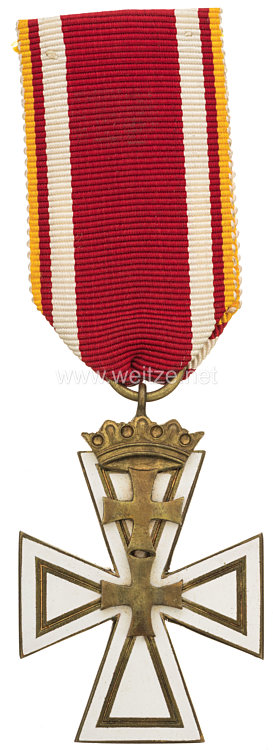
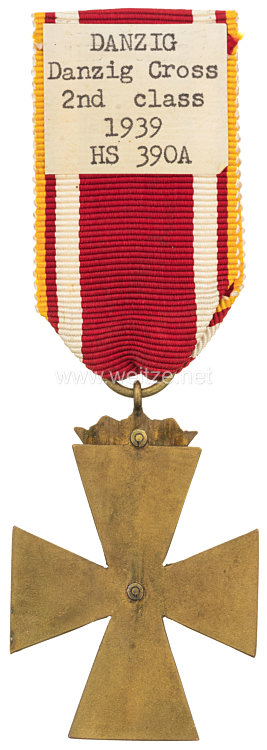
Free City of Danzig Danzig Cross 2nd Class

Cross of gilt and enameled base metal, reverse without maker mark. Complete with original ribbon. Lightly worn in good condition.
449304
1.600,00

Free City of Danzig Danzig Cross 2nd Class

The Danzig Cross 2nd Class of the Free City of Danzig represents a significant decoration from the interwar period and embodies the brief but meaningful history of this unique political entity. The Free City of Danzig existed from 1920 to 1939 as a semi-autonomous city-state under the protection of the League of Nations and developed its own system of orders and decorations during this time.

The Free City of Danzig was created by the Treaty of Versailles of June 28, 1919, and officially came into existence on November 15, 1920. This solution was intended to secure Polish access to the Baltic Sea while taking into account the predominantly German population of the city. Danzig received its own constitution, currency, postage stamps, and indeed its own orders and decorations.

The Danzig Cross was awarded in several classes and served to recognize services to the Free City. The second class was the second-highest grade of this decoration after the first class. The cross was typically made of gilt base metal and decorated with enamel, giving the decoration a special brilliance and color.

The design of the cross followed traditional heraldic principles and often displayed the coat of arms of the Free City of Danzig with its characteristic two crowns above a divided shield. The enameling was technically demanding and required specialized craftsmanship that was available in Danzig and the surrounding area. The city had a long tradition in goldsmithing and metalworking.

The awarding of the Danzig Cross 2nd Class was carried out by the Senate of the Free City of Danzig, which functioned as the government of the city-state. The decoration was worn on a ribbon, with the colors of the ribbon having symbolic significance and often reflecting Danzig's civic colors. Possessing the original ribbon with such a decoration significantly increases its historical value.

The political situation of the Free City of Danzig was marked by tensions throughout its entire existence. The city found itself in constant tension between German and Polish interests. In the 1930s, the NSDAP gained increasing influence in Danzig, and the Senate came under National Socialist control. This also influenced the practice of awarding orders and decorations.

These decorations were manufactured by various Danzig jewelers and medal producers. Not all pieces bore a manufacturer's mark on the reverse, which was quite common for military and state decorations of this period. The anonymity of the manufacturer does not diminish the authenticity or value of the piece but corresponds to the production standards of the time.

The historical context of the Danzig Cross ended abruptly with the beginning of World War II. On September 1, 1939, Germany attacked Poland, and Danzig was immediately incorporated into the German Reich. This ended the existence of the Free City of Danzig after barely 19 years. The decorations of the Free City lost their official significance but remained preserved as historical artifacts.

Today, decorations of the Free City of Danzig are sought-after collector's items that document a unique chapter of European history. They recall an attempt to find a peaceful solution for disputed territories after World War I. The Danzig Cross 2nd Class in worn condition testifies to the fact that it was actually awarded and worn, giving it additional historical authenticity.

The preservation of such objects is of great importance for historical science and memorial culture. They make it possible to make the complex history of the interwar period tangible and to understand the developments that ultimately led to World War II. The Free City of Danzig stands as an example of the challenges of the post-Versailles order and the impossibility of permanently resolving national conflicts through territorial compromises.