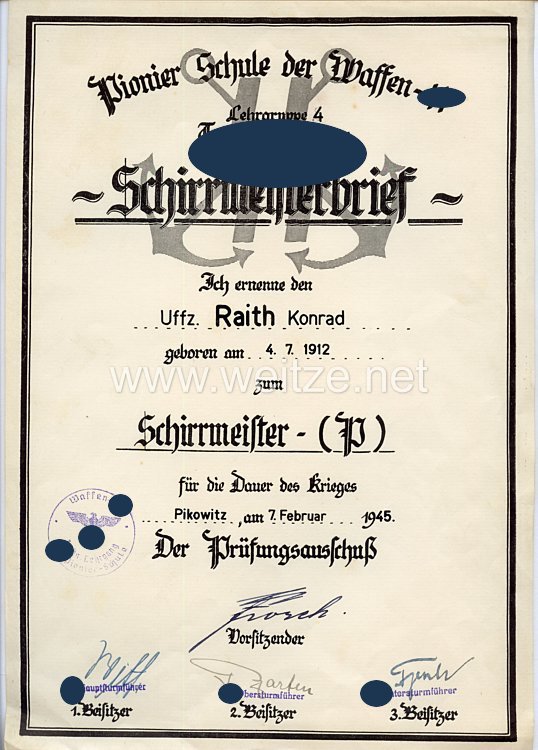
Waffen-SS - Saddler Master Certificate from the Pioneer School of the Waffen-SS Training Group 4 Technical Courses
The A4 sheet is unfolded and only lightly used.
This Schirrmeisterbrief (Equipment Master's Certificate) represents a rare document from the final months of World War II and documents the continued military training of the Waffen-SS even in the closing phase of the conflict. Issued on February 7, 1945, in Pikowitz (today Pičkovice in the Czech Republic), this certificate attests to the appointment of a non-commissioned officer to the position of Schirrmeister (P) for the duration of the war by the Pioneer School of the Waffen-SS, specifically by Training Group 4 Technical Courses.
The function of Schirrmeister in the German Wehrmacht and Waffen-SS was a specialized technical position within the military hierarchy. The Schirrmeister was responsible for the administration, maintenance, and distribution of equipment, harnesses, and technical gear. Within pioneer units, which were responsible for engineering and technical tasks, this position held particular significance as it ensured the proper functionality of specialized technical equipment.
The Pioneer School of the Waffen-SS was one of the specialized training facilities of the SS troops that trained technical and engineering personnel. Pioneer troops were responsible for a wide variety of tasks, including bridge construction, mine clearance, demolition work, fortification construction, and general technical support for combat troops. The training was correspondingly comprehensive and technically demanding.
The mention of Training Group 4 Technical Courses indicates the organizational structure of the training facility. Different training groups were responsible for various aspects of pioneer training, from basic technical skills to highly specialized knowledge. Technical courses typically included training in mechanics, electrical engineering, explosives knowledge, and the operation and maintenance of various technical devices.
The place of issue, Pikowitz (Pičkovice), is located in the region of the Protectorate of Bohemia and Moravia, which came under German control after the occupation of Czechoslovakia in 1939. Toward the end of the war, several military training facilities and administrative offices were relocated from Reich territory to these relatively rear areas to protect them from advancing Allied forces. The fact that formal training and appointments were still taking place in February 1945 is remarkable, as by this time Germany's military situation was already hopeless.
The phrase “for the duration of the war” was a common additional provision in appointments and promotions in the Wehrmacht and Waffen-SS, particularly in the later war years. It indicated that the appointment was temporary in nature and would require review after the war's end. This practice allowed military leadership to quickly appoint personnel to urgently needed positions without fully meeting normal peacetime requirements.
The document was legitimized by an examination committee consisting of a chairman and three assessors. This formal structure corresponded to military regulations for professional examinations and appointments. The examination committee was responsible for evaluating the candidate's professional qualifications and ensuring that he possessed the necessary knowledge and skills for the position.
The physical preservation of the document in unfolded condition and with only slight signs of use is remarkable. Many military documents from this period were destroyed, lost in the chaos of the war's end, or destroyed by their holders to obscure their connection to the SS. The survival of such documents is therefore relatively rare and makes them important historical primary sources.
From a historical perspective, this Schirrmeisterbrief documents several important aspects: first, the continued bureaucracy and formal structure of the German armed forces until the war's end; second, the importance of technical specialization even in a collapsing military organization; and third, the geographical relocation of military institutions to areas still under German control.
Such documents are today important sources for military historical research, as they provide insight into the everyday administrative processes of the Waffen-SS and document organizational structure as well as training practices. They complement historical understanding of the final months of the Third Reich and show how military institutions continued to function even in the face of imminent defeat.
The document also reflects the broader context of Nazi Germany's military education system, which maintained elaborate training programs and certification processes throughout the war. The formal nature of the appointment, complete with an examination committee, demonstrates the bureaucratic thoroughness that characterized German military administration, even as the Reich itself was collapsing around them.