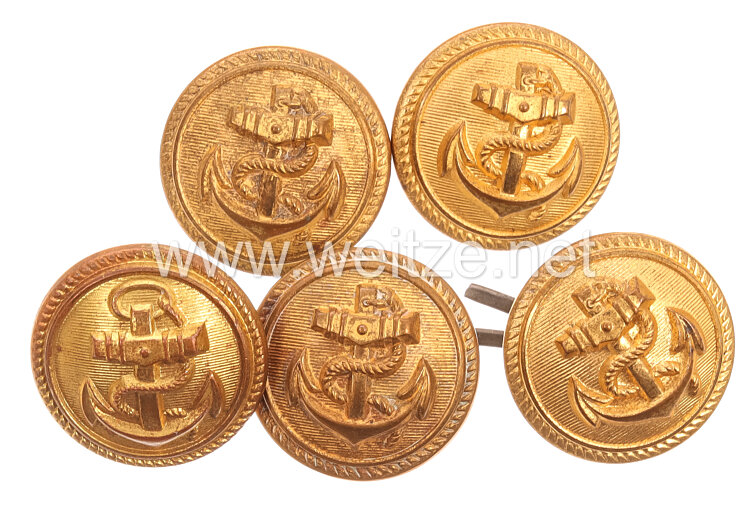
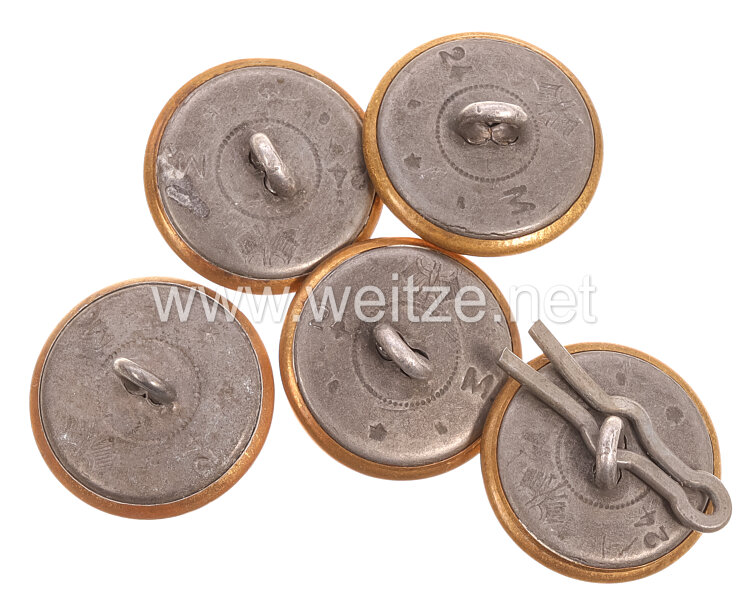
Reichsmarine / Kriegsmarine 5 Uniform Buttons
These five Reichsmarine and Kriegsmarine uniform buttons measuring 24 mm in diameter represent an important aspect of German naval history between 1921 and 1945. These buttons, bearing the characteristic Reichsmarine eagle on the reverse, served as standardized components of naval uniforms and reflect the development of German naval forces during the interwar period and World War II.
The Reichsmarine (1921-1935)
Following World War I and the Treaty of Versailles, the Imperial Navy was dissolved and replaced by the Reichsmarine. This new force operated under severe restrictions regarding tonnage, ship types, and personnel strength. The Reichsmarine was limited to only 15,000 men and restricted to smaller vessels. Despite these constraints, the Reichsmarine developed its own identity and uniform traditions.
The uniform buttons from this period display the Reichsadler (Reich Eagle) on the reverse, representing the symbol of the Weimar Republic. The eagle no longer bore the insignia of the Empire but represented the republican order. Buttons were affixed to various uniform pieces according to the dress regulations of the Reichsmarine, with the 24 mm size typically used for jackets and coats.
Transition to the Kriegsmarine (1935-1945)
On May 21, 1935, the Reichsmarine was officially renamed the Kriegsmarine as part of the general rearmament under the National Socialist regime. This renaming signaled the break with Versailles restrictions and the beginning of a massive fleet expansion program. The Kriegsmarine grew from approximately 15,000 men in 1935 to over 800,000 by 1945.
Interestingly, many uniform components, including buttons, retained their basic form. However, the eagle on the reverse was frequently modified to conform to National Socialist symbols. The continuity in the use of such buttons across both periods sometimes makes precise dating of individual specimens difficult without additional contextual information.
Manufacturing and Materials
German naval uniform buttons were produced by various manufacturers, including well-known firms such as Assmann & Söhne, Friedrich Linden, and other specialized metalware producers. The buttons typically consisted of brass alloys, gilded or coated with other metal finishes to prevent corrosion from saltwater exposure.
The 24 mm diameter corresponds to a standardized size specified in the clothing regulations. This standardization was important for mass production and maintaining a uniform appearance within the armed forces.
Use and Wearing
Buttons of this size were primarily attached to naval uniforms such as the service jacket (tunic) and coat. The exact number and positioning of buttons was detailed in uniform regulations and varied according to rank and uniform type. Officers often wore higher-quality buttons with finer workmanship, while enlisted ranks received standardized buttons.
The eagle embossed on the reverse served not only decorative purposes but also as an identification feature and quality seal. This reverse stamping helped distinguish official naval uniforms from civilian imitations.
Collector Value and Historical Significance
Today, such uniform buttons are sought-after collectibles that provide insights into material culture and everyday aspects of military life. The indicated condition 2 suggests good preservation with minimal wear, making these buttons particularly valuable for collectors and historians.
These seemingly simple objects tell the story of the German Navy through one of the most turbulent periods in German history. They connect the democratic Reichsmarine of the Weimar Republic with the Kriegsmarine of the Third Reich, documenting the continuities and ruptures in German military history of the 20th century. As artifacts, they serve as tangible reminders of the uniforms worn by tens of thousands of sailors who served in both peacetime and war, representing both the mundane administrative aspects of military organization and the broader historical transformations of their era.