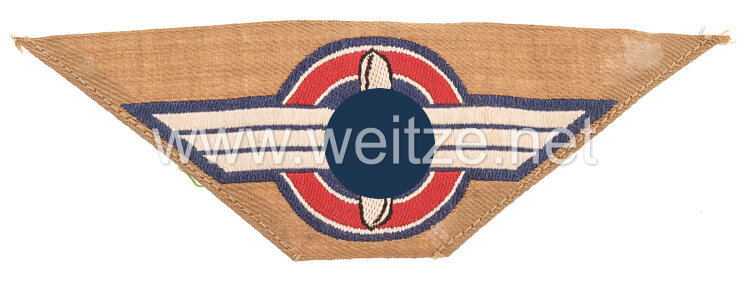
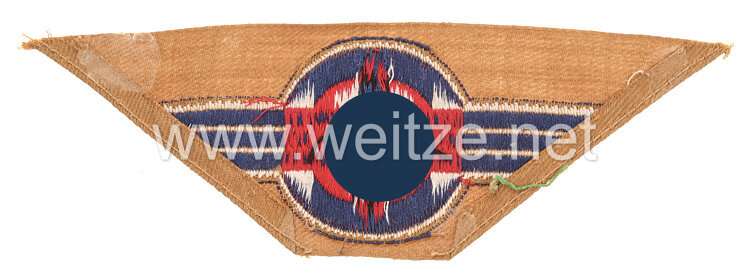
Flieger-HJ Sleeve Insignia for Members Trained by the DLV, for the Brown Shirt

Bevo-woven construction on light brown base. Unissued in very good condition, rare.

455403
220,00

Flieger-HJ Sleeve Insignia for Members Trained by the DLV, for the Brown Shirt

The Flieger-HJ sleeve badge represents a significant artifact of the National Socialist youth organization and its close connection to aviation training in the Third Reich. This special badge was worn by members of the Flieger-Hitlerjugend (Flying Hitler Youth) who received their training through the Deutscher Luftsportverband (DLV - German Air Sports Association) and marks an important phase in the pre-military education of German youth during the 1930s.

The Flieger-HJ was established as a special unit within the Hitler Youth to inspire and prepare young men for aviation service from an early age. The Deutscher Luftsportverband, founded on March 25, 1933, under the leadership of Hermann Göring, served as a cover organization for building a German air force, which was actually prohibited by the Treaty of Versailles. The DLV took over aviation training and thus formed the foundation for the later Luftwaffe, which was officially announced in 1935.

The present badge in Bevo-woven execution represents the high-quality manufacturing technique used for HJ badges. The Bandweberei Ewald Vorsteher (BeVo) company from Wuppertal was one of the main suppliers of woven insignia for National Socialist organizations. The Bevo technique enabled fine details and high durability of badges worn on the brown service shirt of the HJ.

The light brown base color of the badge corresponded with the Hitler Youth uniform, whose characteristic brown shirt became the symbol of the National Socialist youth organization. Wearing such special badges served several purposes: it identified the wearer's special training, created an elite consciousness within the organization, and encouraged the ambition of other HJ members to also obtain this qualification.

Training through the DLV included theoretical and practical elements of aviation. Young HJ members learned the basics of aerodynamics, meteorology, navigation, and aircraft knowledge. Practical training often began with gliders before further qualification on motorized aircraft. This systematic introduction to aviation was part of the comprehensive military preparation of German youth.

After the official founding of the Luftwaffe in 1935, the structures were further formalized. The DLV continued to exist until 1937, when it was absorbed into the Nationalsozialistisches Fliegerkorps (NSFK - National Socialist Flying Corps). However, the Flieger-HJ remained as a youth organization and worked closely with the NSFK. Wearers of the badge described here thus belonged to the transitional phase between 1933 and 1937, when the DLV was still the main training organization.

The rarity of this unworn badge in very good condition is explained by several factors. First, the period during which it was awarded was relatively short. Second, worn badges were naturally deteriorated by use. Third, after the end of the war in 1945, many NS memorabilia were destroyed, either by the occupation forces or by the former owners themselves who wanted to conceal connections to the regime.

From a military-historical perspective, such badges document the systematic preparation of German youth for war. The Luftwaffe, which in 1939 was among the most modern and powerful air forces in the world, benefited considerably from this system of early education. Many later Luftwaffe pilots had their first contact with aviation in the Flieger-HJ or its predecessor organizations.

Today, such badges are important objects of study for historians and collectors of military antiques. They help understand the mechanisms of National Socialist mobilization and indoctrination. The excellent preservation of this specimen enables detailed studies of the manufacturing techniques and materials of the period.

The Bevo weaving technique itself represents an interesting chapter in German textile history. The precise Jacquard weaving enabled complex patterns and color combinations that would have been more difficult or expensive to produce in embroidered variants. This made Bevo badges the preferred choice for mass production while maintaining high quality.

The connection between youth organizations and military preparation was not unique to Nazi Germany, but the systematic and comprehensive nature of this preparation was unprecedented. The Flieger-HJ, along with other specialized HJ units such as the Motor-HJ and Marine-HJ, created a pipeline of pre-trained recruits for the Wehrmacht's various branches.