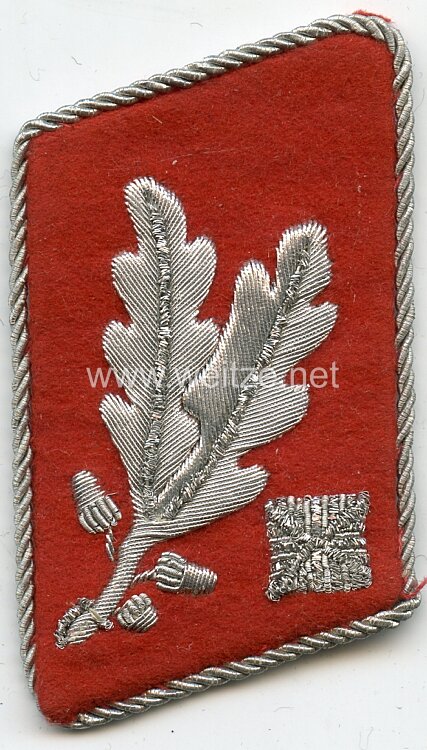
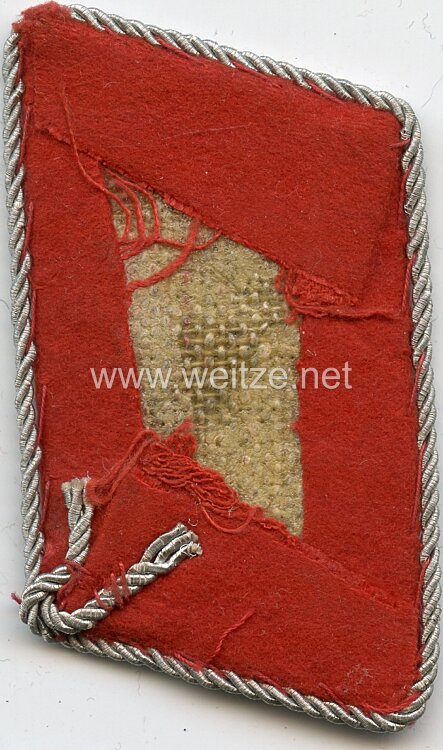
Single Collar Tab for an SA-Brigadeführer on the Staff of an SA-Gruppe

Hand-embroidered in metal thread on red wool, circa 1939. Lightly worn, condition 2.
281603
350,00

Single Collar Tab for an SA-Brigadeführer on the Staff of an SA-Gruppe

This single collar patch represents a significant rank insignia of the Sturmabteilung (SA) from the period of National Socialist Germany. This hand-embroidered specimen in metal thread on a red base was made for an SA-Brigadeführer serving on the staff of an SA-Gruppe and dates from around 1939, a period of significant organizational changes within the SA.

The Sturmabteilung was founded in 1920/21 as a paramilitary combat organization of the NSDAP. After the seizure of power in 1933, the SA experienced massive expansion and at times numbered over four million members. The organization was hierarchically structured into several levels: The largest unit was the SA-Gruppe, which usually corresponded to a military district. Below this were Brigades, Standarten, Sturmbanne, Stürme, and Scharen.

The rank of SA-Brigadeführer roughly corresponded to a Major General in the Wehrmacht and represented a high leadership position. A Brigadeführer typically commanded several SA-Standarten and was directly subordinate to the SA-Gruppenführer. Assignment to the staff of an SA-Gruppe indicates a special staff function, where the wearer did not directly command a brigade but served in an advisory or administrative capacity at the Gruppe level.

The SA's collar patches underwent several developmental stages. Originally, SA leaders wore various insignia that became standardized during the 1930s. The red base color of the collar patch was characteristic of staff members at the Gruppe level. The regular SA wore brown uniforms with differently colored collar patches depending on their assignment: red designated staff officers of the higher leadership levels.

The manufacturing technique of this piece is noteworthy. The hand embroidery in metal thread on red cloth base corresponds to the quality execution typical for higher leadership ranks. While ordinary SA men and lower-ranking leaders often wore machine-made or simpler insignia, higher leaders frequently had their rank badges made by specialized craftsmen. The metal threads used usually consisted of silver-plated or tinned copper wire embroidered onto the base material.

The year 1939 marks a watershed in SA history. After the so-called Röhm Crisis of June 30, 1934, when the SA leadership was largely eliminated, the organization lost considerable political significance. The Wehrmacht assumed the role as the regime's primary military force. Nevertheless, the SA remained as an organization and assumed various tasks in pre-military training, air raid protection training, and administration. With the outbreak of war in 1939, many SA men were conscripted into the Wehrmacht, while the organization itself increasingly took over homeland services.

The wearing method of collar patches was precisely regulated. They were worn in pairs on the uniform collar, with the right and left pieces arranged as mirror images. The exact position and orientation were specified in SA clothing regulations. Together with other rank insignia such as shoulder boards and sleeve stripes, the collar patches formed a clear identification system for rank and function within the SA hierarchy.

Preservation as a single piece is not unusual. Often the pairs were lost over time or separated. The stated condition of “lightly worn” indicates that this collar patch was actually in use but not worn excessively long or intensively. This could have various reasons: perhaps it was only worn on special occasions, or the wearer changed rank or function.

From a military-historical perspective, such objects are important testimonies to the organizational structure and visual culture of the Nazi regime. They document the elaborate hierarchy and the effort to represent rank and function representatively. At the same time, they are relics of an organization responsible for political violence and terror that played a central role in establishing the Nazi dictatorship.

The hand-embroidered quality and red coloring make this collar patch a typical example of the high-ranking insignia used within the SA staff structure. Such pieces were often produced by specialized firms that manufactured military insignia and decorations, including companies in Berlin, Munich, and other major German cities. The craftsmanship involved in creating these pieces required considerable skill in metalwork embroidery, a traditional technique adapted for military use.