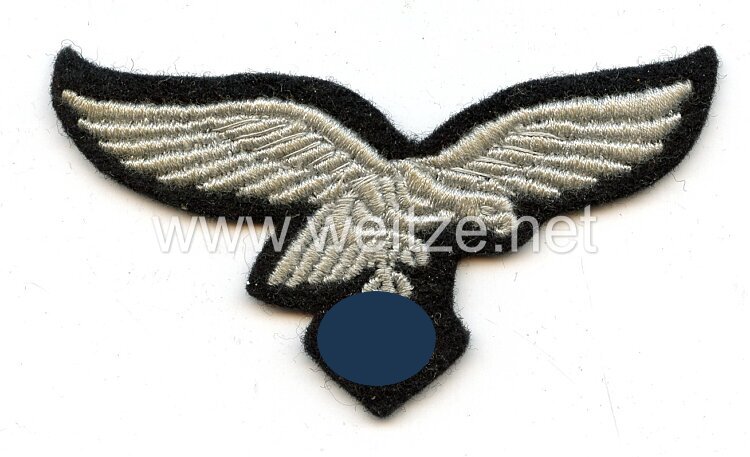
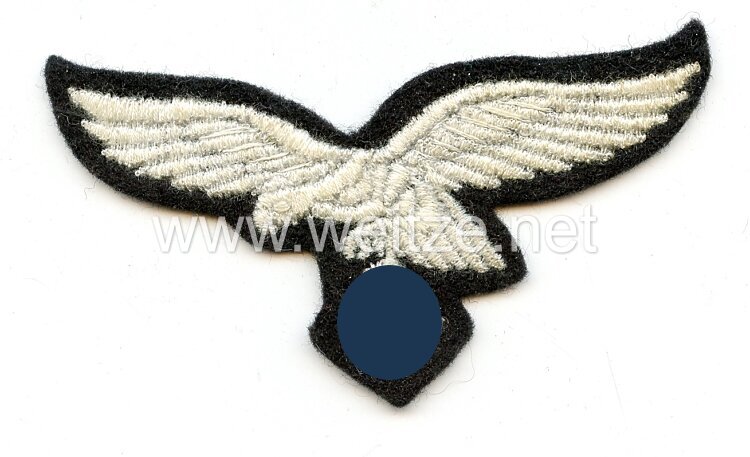
Luftwaffe Side Cap Eagle for Enlisted Men LW-Fallschirm-Panzerkorps “Hermann Göring”

Machine-embroidered version on black wool base. Unissued condition, condition grade 1.
462702
90,00

Luftwaffe Side Cap Eagle for Enlisted Men LW-Fallschirm-Panzerkorps “Hermann Göring”

The Luftwaffe Side Cap Eagle for Enlisted Men of the LW-Fallschirm-Panzerkorps Hermann Göring represents a significant example of military badges and uniform insignia of the German Luftwaffe during World War II. This machine-embroidered version on black backing embodies the special status of one of the Wehrmacht's most elite units.

The Fallschirm-Panzerkorps Hermann Göring evolved from the original Regiment General Göring, which was established in 1935 as a guard regiment of the Luftwaffe. Named after Reichsmarschall Hermann Göring, the Commander-in-Chief of the Luftwaffe, this formation grew throughout the war from a regiment to a division and finally to an armored corps. The unit uniquely combined paratrooper and armored forces under the Luftwaffe's command, which was an exceptional feature in German military organization.

The Schiffchenadler, also known as the side cap eagle, was a mandatory national emblem worn on the Schiffchen (flight cap). The design followed strict regulations of the Luftwaffe uniform specifications. The eagle, as a national symbol of the German Reich, was depicted in its characteristic pose with outstretched wings and a swastika clutched in its talons. This symbolism represented the power and authority of the National Socialist state.

The machine-embroidered execution differs significantly from hand-embroidered or woven variants. Machine-embroidered badges were increasingly used from approximately 1939, as they were more cost-effective and faster to produce than hand-embroidered examples. The embroidery was typically executed with gray or silver-colored artificial silk thread on a black base fabric, which was characteristic for enlisted men and non-commissioned officers of the Luftwaffe. Officers, in contrast, frequently wore eagles on light blue or white backing.

The black backing of the badge is of particular significance, as the Luftwaffe's paratrooper forces traditionally wore black uniform elements. This distinguished them from other Luftwaffe units and emphasized their elite status. The black color of the side caps was introduced for paratroopers in 1936 and remained throughout the entire war.

The Fallschirm-Panzerkorps Hermann Göring fought on various fronts during World War II. The division was deployed in North Africa, Sicily, Italy, and later on the Eastern Front as well as in the defense of the Reich. Despite its designation as a “Fallschirm” (parachute) unit, many soldiers after 1942 no longer conducted airborne operations but fought as regular infantry or armored forces. However, the unit retained its traditional paratrooper badges and the characteristic black uniform elements.

The production of such badges was carried out by various manufacturers throughout the German Reich. During the war, materials became increasingly scarce, which was reflected in the quality of later productions. Early war badges frequently show finer workmanship and better material quality than later examples. The machine-embroidered version described here in unworn condition suggests careful storage or non-use.

Regulations for wearing uniform badges were strictly controlled in the Luftwaffe. The Luftwaffe Service Regulation L.Dv. 410/1 and later supplements precisely specified where and how badges were to be worn. The side cap eagle had to be attached to the right side of the cap, with the eagle's head facing forward.

Today, such badges are important objects of study for military historians and collectors. They document not only uniform studies but also organizational history, production methods, and material culture of World War II. The condition and authenticity of such pieces are crucial for their historical significance. Unworn examples like the one described are particularly rare, as most badges were actually in use and show corresponding signs of wear.

The study of these insignia provides insights into the complex hierarchy and organizational structure of the German military forces. The distinction between enlisted men's and officers' badges, the use of different base colors, and the evolution of production methods all contribute to our understanding of wartime logistics, supply chains, and the priorities of the Nazi regime even as the war situation deteriorated.