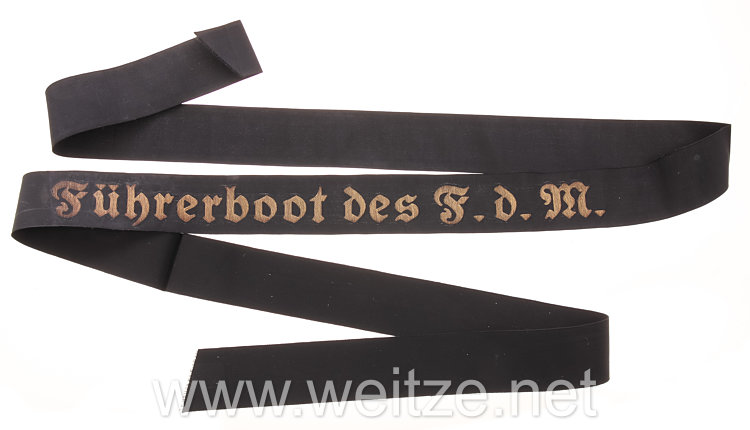
Kriegsmarine Cap Tally "Führerboot des F. d. M."
This Kriegsmarine cap tally bearing the inscription “Führerboot des F. d. M.” (Commander's Boat of the Leader of Minesweeper Units) represents a rare and historically significant relic of the German Kriegsmarine during World War II. The abbreviation F. d. M. stands for Führer der Minensuchverbände (Commander of Minesweeper Units), an important leadership position within maritime mine warfare operations.
The minesweeper units of the Kriegsmarine played a crucial role throughout the war in maintaining sea routes and securing coastal waters. Following the experiences of World War I, where mines had a devastating effect on shipping, particular attention was paid to mine warfare in the Kriegsmarine. The organization of minesweeper units was systematically built up during the 1930s and received its own command structures.
The cap tally itself is manufactured in the classic metal-thread woven execution, as prescribed for official naval service dress. This technique, in which metal threads were woven into the black base fabric, produced the characteristic gold or silver lettering on the band. Production was carried out by specialized textile companies that manufactured for the Kriegsmarine and were subject to strict quality standards.
Kriegsmarine cap tallies followed precise regulations regarding design, material, and inscription. The Dress Regulations for the Kriegsmarine (Anzugsordnung für die Kriegsmarine - A.O.K.) detailed which crews were to wear which cap tallies. While normal ship crews wore the name of their vessel, special units and staff boats were identified by corresponding inscriptions. The “Führerboot” designated the flagship or command vessel of a higher leadership staff.
The position of Commander of Minesweeper Units existed at various levels of the naval organization. There were F.d.M. for different sea areas such as the Baltic Sea, North Sea, or Norwegian waters. These officers, usually holding the rank of Captain or Commander, coordinated the operations of numerous minesweepers, clearance boats, and barrier breakers. Their duties included tactical leadership of clearance operations, training of crews, and coordination with other naval units.
The minesweepers (M-boats) of the Kriegsmarine were specially constructed vessels with wooden hulls or special degaussing to protect against magnetic mines. They often operated under the most dangerous conditions, having to clear enemy minefields or create safe passages for larger units. The loss rate among minesweeper crews was considerable, underscoring the importance of competent leadership.
The deployment of minesweeper units was particularly intensive during the final war years. After the war ended in 1945, minesweeping continued as German waters were contaminated with hundreds of thousands of mines – both German and Allied. German minesweeper units continued clearance operations under Allied supervision until 1949, one of the most dangerous post-war tasks.
The authenticity of such cap tallies can be verified by several characteristics: the quality of the metal-thread weaving, the correct typeface, the width of the band (typically 3.2 to 3.5 cm), and the overall length, which had to be sufficient to encircle the cap band. The full length of this band indicates that it was never shortened, which frequently occurred with worn pieces to adjust them to the respective cap size.
The stated condition as “lightly worn” is typical for equipment items that were actually used in service. Original pieces often show slight signs of use, while unworn bands are extremely rare. The metal threads may have partially lost their luster through oxidation and wear, which however underscores the historical authenticity.
For collectors and historians, such a cap tally represents not merely a piece of textile history, but testimony to the complex organization and specialized units of the Kriegsmarine. It documents the often-overlooked but war-critical role of mine warfare and commemorates the men who performed this service under the most dangerous conditions.