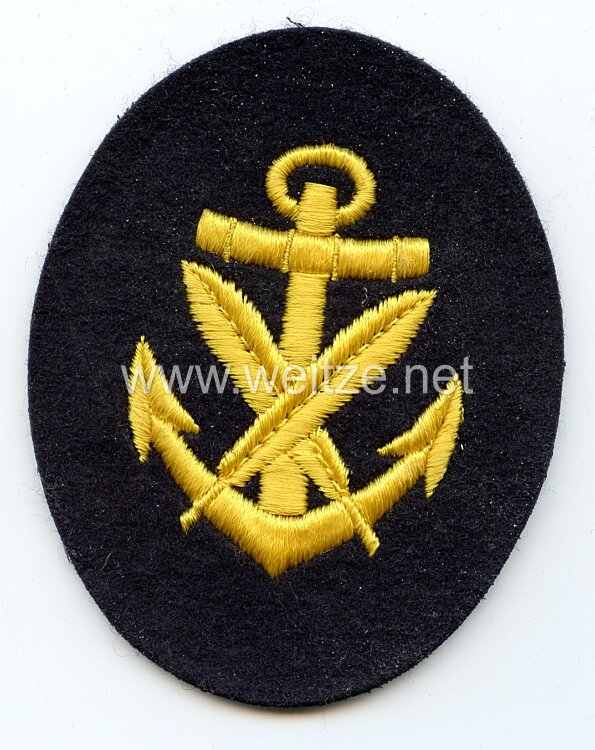
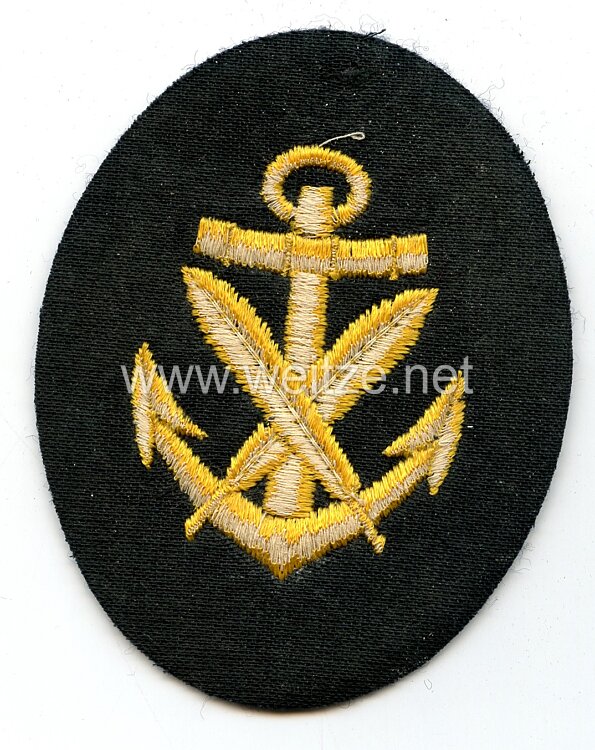
Kriegsmarine Sleeve Insignia Yeoman Petty Officer
The Kriegsmarine sleeve badge for Schreibermaat (Writer's Mate) represents a fascinating example of the complex rank identification systems employed in the German Navy during World War II. This machine-embroidered version for the blue blouse exemplifies the specialist badges that identified petty officers with particular technical skills.
The Kriegsmarine, the official designation for the German Navy from 1935 to 1945, developed a comprehensive system of rank insignia and specialist badges. Following Germany's rearmament under the National Socialist regime and the official abandonment of Versailles Treaty restrictions in 1935, the Reichsmarine was renamed Kriegsmarine. This reorganization brought with it a standardization of uniforms and insignia.
The Schreibermaat was a petty officer rank within the administrative career path of the Kriegsmarine. The term “Maat” traditionally designated a petty officer without sword-knot in the German Navy, comparable to the rank of Unteroffizier in the Army. Scribes were responsible for administrative duties, correspondence, personnel files, and other bureaucratic functions - indispensable activities for maintaining military organization aboard warships and at naval bases.
The sleeve badges of the Kriegsmarine were worn on the blue work blouse, which was part of the daily service uniform. These badges were typically affixed to the right upper arm and displayed the wearer's professional specialization. The machine-embroidered version was the standard type preferred during the war for practical and economic reasons. Unlike hand-embroidered versions, which were often of higher quality, machine-embroidered badges could be produced more quickly and cost-effectively.
The badge of a Schreibermaat typically consisted of a stylized representation symbolizing the administrative function. The color scheme followed the regulations laid down in the Dress Regulations for the Kriegsmarine (Anzugsordnung für die Kriegsmarine). These regulations were regularly updated and precisely governed which badges, in what form, and at which position on the uniform were to be worn.
The blue uniform of the Kriegsmarine had a long tradition in German naval history. The blue blouse was part of the working uniform and was worn during daily service aboard ship and ashore. It differed from parade uniforms and other ceremonial garments in its practical orientation. The blouse was made of durable blue wool fabric and was designed for the demands of naval service.
The organization of the Kriegsmarine into various specialist career paths was essential for operating a modern war fleet. Besides scribes, there were numerous other specializations: radio operators, mechanics, torpedo technicians, medical personnel, and many more. Each of these specializations had its own sleeve badges that allowed immediate recognition of the naval soldier's function.
The administrative career path, to which scribes belonged, was particularly important for maintaining military discipline and organization. Scribes maintained muster rolls, processed leave applications, managed pay books, and handled the extensive correspondence required by the operation of a warship or naval facility. Their work was often invisible but absolutely necessary for the functioning of the Kriegsmarine.
The production of these badges was carried out by specialized firms authorized by the Kriegsmarine. Machine embroidery enabled consistent quality and rapid production, which was of great importance given the large number of naval personnel conscripted during the war. The badges were manufactured on a fabric backing that was then sewn onto the uniform.
Today, such sleeve badges are important military-historical objects that provide insights into the organization and daily life of the Kriegsmarine. They document the specialized nature of modern naval warfare and the importance of administrative functions within the military hierarchy. For collectors and historians, they offer tangible connections to a significant, albeit dark, period of German and European history. These artifacts serve as reminders of the complex bureaucratic machinery that supported naval operations and the thousands of individuals who performed essential but often overlooked support roles in the wartime navy.