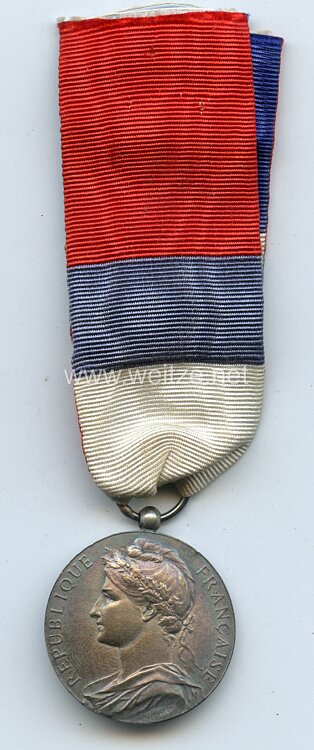
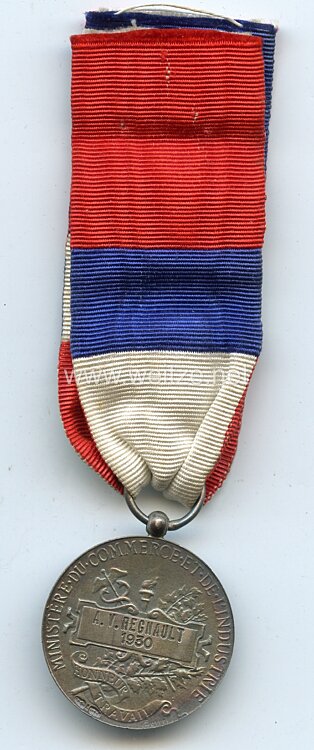
France “Médaille Travail Commerce Industrie”

silver-plated, on ribbon, engraved bearer's name “A.V.Regnault 1930”, condition 2
270302
25,00

France “Médaille Travail Commerce Industrie”

The Médaille du Travail, also known as the Médaille d'Honneur du Travail (Medal of Honor for Labor), represents one of France's most significant civil decorations, awarded since the 19th century. This medal recognizes long and faithful service by employees in commerce, industry, and trade, embodying the French tradition of officially acknowledging professional achievement and loyalty.

The historical roots of this decoration date back to 1848, when during the Second Republic, initial considerations were made to honor deserving workers. However, the actual establishment occurred through a decree dated December 1, 1948, which established the modern form of the medal. The present example from 1930 originates from the interwar period, an era of significant industrial and economic development in France.

The Médaille Travail Commerce Industrie was awarded in different grades, depending on the length of service. The bronze medal was awarded after 20 years of faithful service, the silver medal after 30 years, the silver-gilt medal after 35 years, and the gold medal after 40 years of uninterrupted employment. This graduated system of awards underscores the high value placed on continuity and loyalty in professional life, which has traditionally held an important place in French society.

The present silver-plated specimen bears the engraving “A.V.Regnault 1930,” indicating personal conferral to a specific recipient. Personalization through name engraving was customary for these awards and emphasized the individual recognition of achievement. The year 1930 falls during an economically challenging period, shortly after the onset of the Great Depression, which made the recognition of long-term company loyalty particularly significant.

The medal is worn on its original ribbon, typically rendered in the French national colors of blue, white, and red. The design of the medal itself usually features on the obverse a representation of the Republic or allegorical figures symbolizing work and industry, while the reverse frequently bears inscriptions honoring labor and merit.

During the Third Republic (1870-1940), when this specimen was awarded, France experienced a flourishing period of industrialization. The government increasingly recognized the importance of the working class for the country's economic development. The Médaille du Travail served as an instrument for promoting social stability and acknowledging the working class's contribution to national prosperity.

The condition grade 2 of the medal indicates very good preservation, which is remarkable for an object over 90 years old. This speaks to the quality of manufacture and careful preservation by subsequent generations. Such decorations were often passed down as family heirlooms and represented pride in professional achievement and social recognition.

The cultural significance of the Médaille du Travail extends far beyond its material value. It embodies the French philosophy of “dignité du travail” – the dignity of labor. In an era when social distinctions were strongly pronounced, this decoration offered workers the opportunity to receive state recognition, regardless of their social origin or position.

Today, these historical medals serve as important witnesses to France's social and economic history. They document not only individual careers but also the development of labor relations, industrialization, and the social values of different epochs. Collectors and historians value these objects as authentic sources for researching French labor and social history of the 20th century.

The medal's continued relevance demonstrates how France has maintained traditions of honoring civilian contributions to society. The practice of recognizing long service continues to this day, with modern versions of the award still being conferred, maintaining an unbroken link to the historical traditions represented by this 1930 example.

r