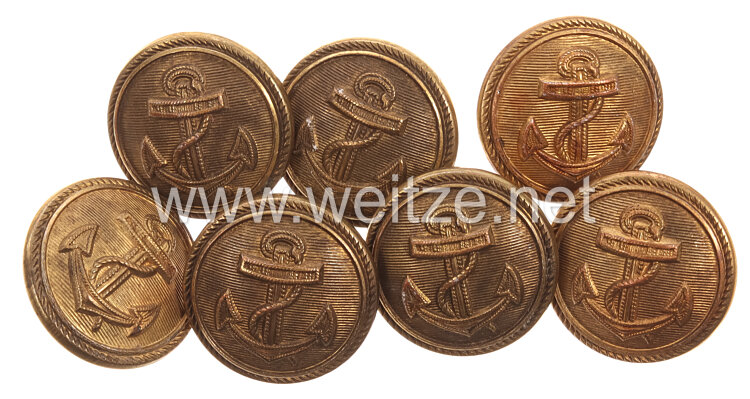
Reichsmarine / Kriegsmarine 4 Uniform Buttons

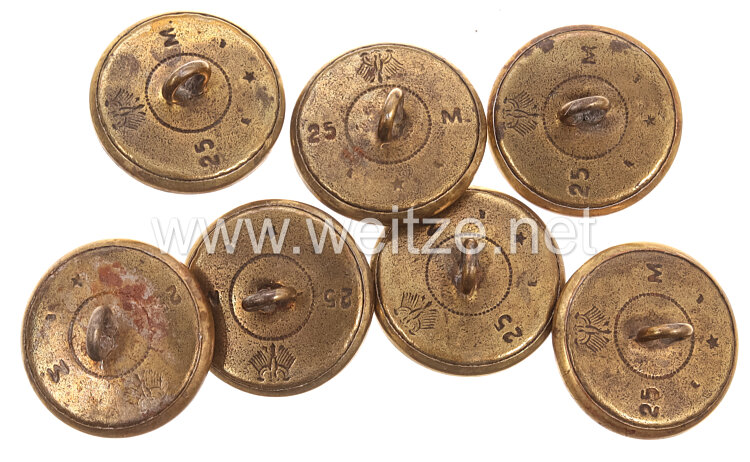
reverse side with Reichsmarine eagle, 25 mm, condition 2.
450101
35,00

Reichsmarine / Kriegsmarine 4 Uniform Buttons

These four uniform buttons with a diameter of 25 mm represent a significant testament to German naval history between the two world wars and during World War II. These buttons, marked on the reverse with the characteristic Reichsmarine eagle, embody the continuity and transformation of German naval forces from the Weimar Republic to National Socialist Germany.

The Reichsmarine was established in 1921 as the successor organization to the Imperial Navy, after the Treaty of Versailles imposed drastic restrictions on Germany. Peacetime strength was limited to 15,000 men, and the fleet could consist only of six battleships, six cruisers, twelve destroyers, and twelve torpedo boats. Despite these constraints, the Reichsmarine placed great emphasis on tradition, discipline, and uniform appearance among its personnel.

Reichsmarine uniform buttons followed strict standardization as specified in the navy's clothing regulations. The 25-mm button was typically used on uniform jackets, coats, and other outer garments. The reverse marking with the Reich eagle served not only as an identification feature but also as proof of quality and origin. These buttons were produced by various authorized manufacturers who had to meet specific quality standards.

The Reich eagle stamped on the reverse differed in its design from other military symbols. It showed the eagle with spread wings, head turned to the right (heraldically). This symbolism deliberately connected to the traditions of the German Empire and was meant to represent the continuity of German naval power. The technical execution of these stampings required specialized manufacturing techniques, typically using brass or other non-ferrous alloy metals that were subsequently gold-plated, silver-plated, or lacquered.

With the Nazi seizure of power in 1933, a gradual transformation of the German armed forces began. The Reichsmarine was officially renamed the Kriegsmarine on June 1, 1935, as part of the general rearmament and introduction of universal conscription. Nevertheless, many uniform elements, including buttons, initially remained unchanged or were only gradually modified. This explains why buttons with Reichsmarine markings were still used during the early Kriegsmarine period.

The Kriegsmarine expanded dramatically in the years before World War II. The Z-Plan, an ambitious fleet construction program, was intended to create a fleet by the mid-1940s that could compete with the Royal Navy. Personnel strength grew from approximately 15,000 men in 1933 to over 800,000 by 1945. This massive expansion required corresponding quantities of uniforms and equipment, including millions of uniform buttons.

The quality and execution of uniform buttons varied considerably during the course of the war. Early productions were characterized by high-quality materials and precise workmanship. As the war progressed and material shortages increased, however, inferior materials were often used, and manufacturing was simplified. The stated condition 2 of these buttons indicates good preservation, with possibly slight signs of wear but without severe damage or corrosion.

Uniform buttons were not merely functional elements but also important components of military hierarchy and identity. The naval uniform traditionally enjoyed high prestige in Germany, and every detail was imbued with meaning. The buttons contributed to the immediate visual recognition of naval personnel and distinguished them from other Wehrmacht branches.

From a collector's perspective, such uniform buttons are today important military-historical artifacts. They document not only the material culture of the German Navy but also production techniques, supply chains, and the gradual transformation of military symbols under different political systems. The reverse markings often enable more precise dating and attribution to specific manufacturers or production periods.

These four buttons thus represent a small but eloquent fragment of German naval history between 1921 and 1945, an era of dramatic political upheavals, military expansion, and ultimately catastrophic defeat. They serve as reminders of the hundreds of thousands of men who wore these uniforms and of the complex history of German naval forces in the twentieth century.

r