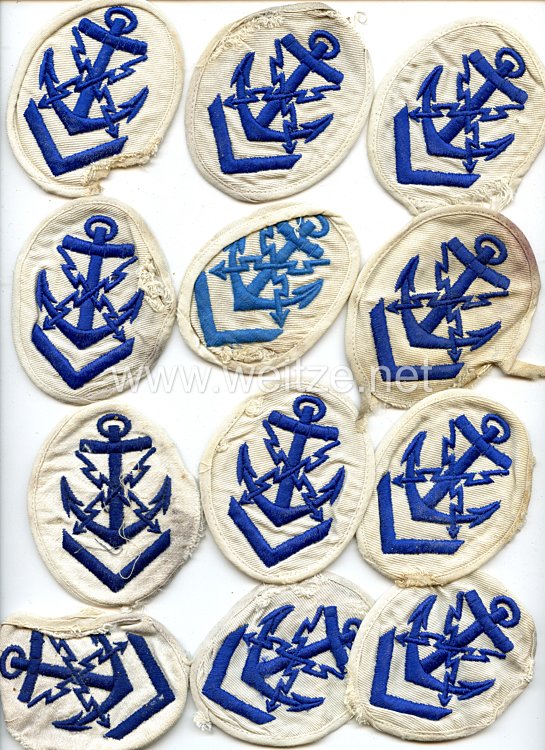
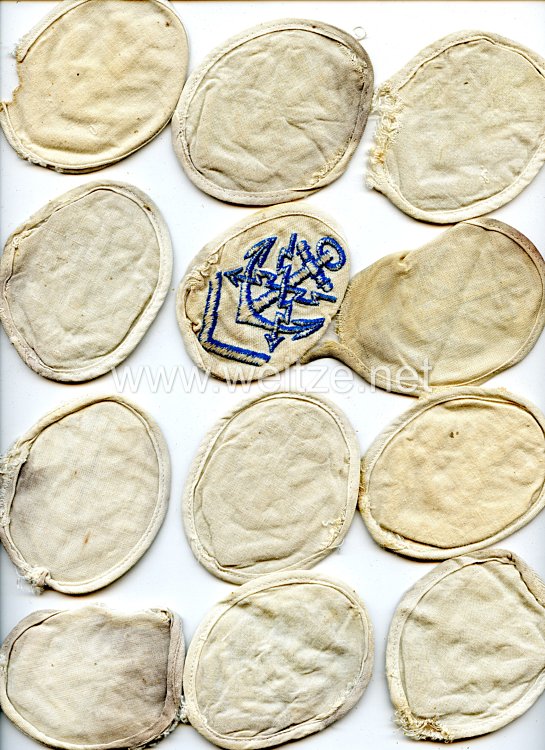
Kriegsmarine Sleeve Insignia Senior Teletype Petty Officer (Oberfernschreibmaat)

12 pieces, for the white summer blouse, condition 2-3.
440901
80,00

Kriegsmarine Sleeve Insignia Senior Teletype Petty Officer (Oberfernschreibmaat)

Kriegsmarine Sleeve Insignia for Oberfernschreibmaat - Historical Context

The presented sleeve insignia for the rank of Oberfernschreibmaat (Senior Teleprinter Mate) of the German Kriegsmarine represent a specialized technical rank within the maritime communications forces of the Second World War. These twelve insignia, manufactured for the white summer tunic, document the highly developed rank structure and the importance of telecommunications technology in German naval warfare between 1935 and 1945.

The Kriegsmarine was officially established on June 1, 1935, thereby replacing the Reichsmarine, which had been severely restricted by the Treaty of Versailles. With the Anglo-German Naval Agreement of June 18, 1935, the systematic construction of a modern naval fleet began. The organizational structure encompassed not only combat units but also highly specialized technical services, which included teleprinter specialists.

The rank of Oberfernschreibmaat was integrated into the complex rank system of the Kriegsmarine. A “Maat” corresponded roughly to a non-commissioned officer in the Army, with the prefix “Ober-” indicating a higher qualification level. The teleprinter mates formed part of the communications services of the Navy, responsible for secure and rapid communication between ships, submarines, and land stations. In an era when radio reconnaissance and direction-finding were war-decisive factors, these specialists held particular importance.

Teleprinter technology had developed rapidly during the 1920s and 1930s. In the military sphere, it offered considerable advantages over Morse telegraphy: higher transmission speed, lower error rates, and the possibility of direct text output without laborious decoding. The Kriegsmarine employed various teleprinter systems, including the famous Enigma encryption machine, which was frequently used in conjunction with teleprinters. Senior teleprinter mates had to master not only the technical operation of these complex devices but also possess knowledge of encryption procedures and message protocols.

The sleeve insignia themselves followed the precise regulations of the Dress Regulations for the Kriegsmarine. These meticulously governed the appearance of all uniform components. Insignia for petty officers and mates were worn on the left upper arm and indicated the exact rank and specialty through various combinations of chevrons, stars, and special symbols. The specific symbol for teleprinters typically consisted of a stylized representation marking the technical specialization.

The production for the white summer tunic is noteworthy as it indicates deployment in warmer climates or during summer months. The Kriegsmarine strictly distinguished between different uniform types: the blue service uniform for daily wear, the white uniform for tropical deployments or summer periods, and various walking-out uniform variants. Each uniform type required correspondingly adapted insignia, coordinated in color and material with the carrier fabric. White uniforms were particularly used by the Mediterranean Fleet, in North Africa, or during operations in the Black Sea.

The presence of twelve such insignia suggests a production batch or procurement for multiple uniform pieces of one wearer or a unit. Uniform insignia were subject to wear and had to be regularly replaced. Additionally, naval personnel typically owned several uniforms, all of which had to be appropriately equipped.

The stated condition 2-3 according to the usual collector's scale means that the insignia represent used but well-preserved original pieces. They likely show slight traces of wear, possibly discoloration or minimal damage, but retain their essential characteristics and historical integrity. This state of preservation is quite typical and valued for textile militaria from World War II, as it documents authentic use.

Following the unconditional surrender on May 8, 1945, the Kriegsmarine was dissolved. Uniforms and insignia were largely destroyed or confiscated by occupation forces. The survival of such objects is often owed to veterans who preserved uniform parts as personal mementos, or to collectors who began acquiring military-historical objects in the immediate post-war period.

Today, such sleeve insignia possess primarily historical and documentary value. They enable researchers and museums to reconstruct and understand the complex rank structure and organizational form of the Kriegsmarine. Simultaneously, they serve as reminders of a time when technical skill and military duty were placed in the service of a criminal regime.