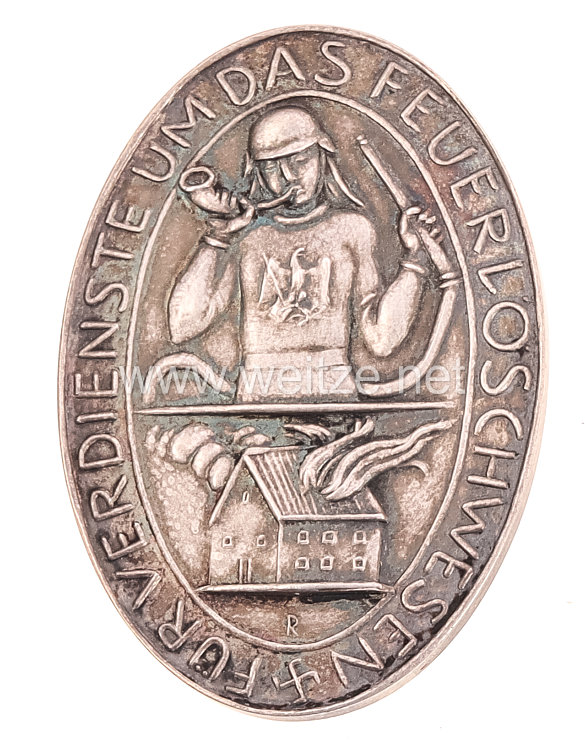
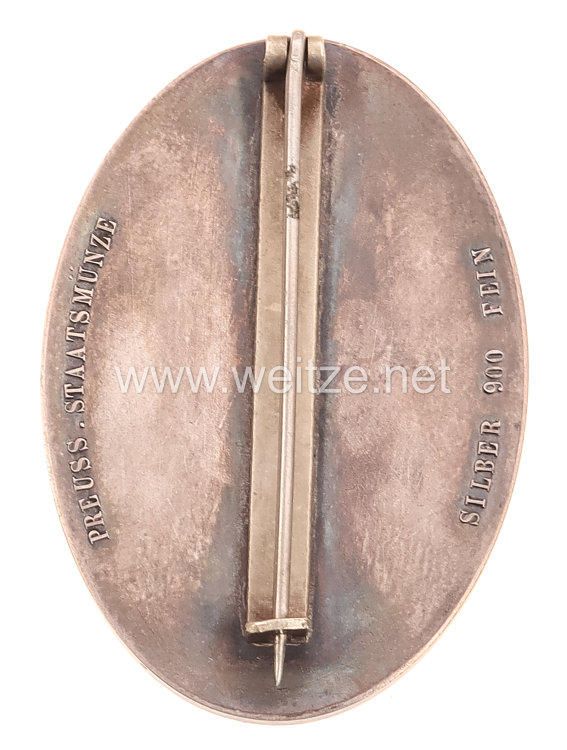
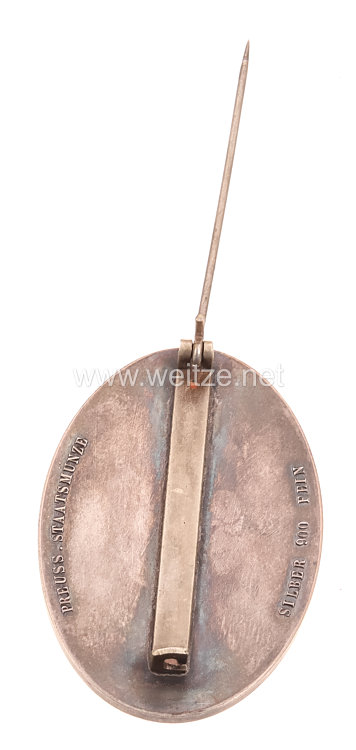
Free State of Prussia/Third Reich Fire Brigade Honor Badge until 1936
The Fire Brigade Honor Badge of the Free State of Prussia and the Third Reich represents a significant testament to German firefighting history during the transition period between the Weimar Republic and Nazi rule. This highly oval pin badge with the inscription “For Services to Firefighting” documents both the continuity and simultaneous transformation of state decoration practices during one of the most turbulent periods in German history.
The Prussian fire brigade decoration was originally established on November 22, 1928 by Prussian Minister President Otto Braun. In the Weimar Republic, it was intended to honor volunteer firefighters for their long-standing service. The badge was awarded in three grades: after 25, 40, and 50 years of service. The execution in 900 silver, manufactured by the Prussian State Mint in Berlin, testifies to the high craftsmanship quality of state decorations of this era.
After the Nazi seizure of power in 1933, the entire German fire service underwent comprehensive reorganization according to the National Socialist policy of Gleichschaltung (coordination). The Prussian Ministry of the Interior, now under NSDAP control, initially retained existing honor badges but added the swastika as the central symbol of the new regime. This practice was typical of Nazi policy, which on one hand instrumentalized traditions while forcing an ideological reorientation through its symbolism.
The inscription “For Services to Firefighting” remained unchanged, emphasizing the professional component of the decoration. Firefighting had a long tradition of communal self-organization in Germany, which formally continued to exist during the Nazi period. However, a parallel strict central organization developed under the leadership of SS-Reichsführer Heinrich Himmler, who from 1936 also held command authority over the German fire service.
The year 1936 marks a decisive turning point: With the Law on Firefighting of November 23, 1938 (prepared from 1936), the fire service was reorganized into the “Fire Protection Police” and fully integrated into the police apparatus of the Nazi state. This ended the era of Prussian fire brigade honor badges in their previous form. New Reich-wide decorations took their place, which now explicitly bore National Socialist symbolism and no longer referred to Prussian traditions.
The striking by the Prussian State Mint took place in the traditional Berlin institution on Unter den Linden, which had existed since 1750 and was responsible for the production of coins, medals, and state decorations. The marking “900 Fine Silver” corresponds to a silver content of 90 percent and was the standard for high-quality state honors. This material specification guaranteed value and was intended to prevent counterfeiting.
The highly oval shape of the badge was characteristic of Prussian decorations and differed from the round or cross-shaped honors of other German states. Designed as a pin badge, it could be worn on uniform or civilian clothing, with wearing regulations precisely governing at which position and on which occasions the honor was to be worn.
From today's perspective, such decorations are important contemporary historical documents. They exemplify how the Nazi regime adopted existing institutions and traditions and transformed them for its purposes. The fire brigade honor badge with swastika is testimony both to the continuity of communal structures and to their ideological appropriation. Collectors and historians evaluate such objects not according to their original function as decorations, but as material sources for researching the Nazi era and its mechanisms of securing power.
Preservation in condition 2 means that the piece shows only minor signs of wear and thus represents a well-preserved example of this decoration group, documenting both the craftsmanship quality and the historical peculiarities of the transition period between 1933 and 1936.