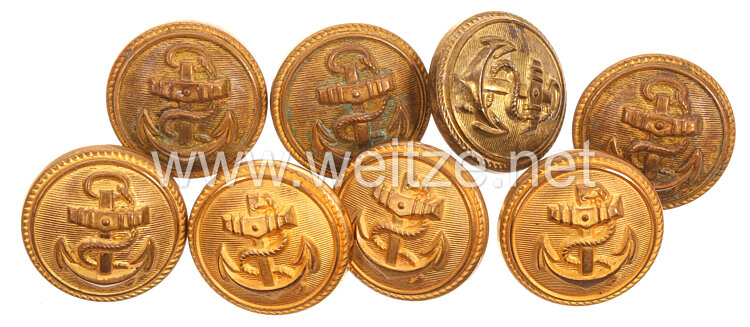
Reichsmarine / Kriegsmarine 8 Uniform Buttons
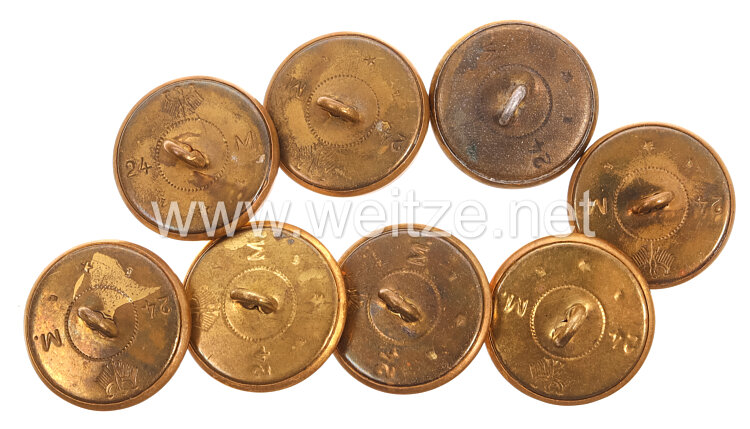
These eight uniform buttons from the Reichsmarine and Kriegsmarine, measuring 24 mm in diameter, represent significant artifacts from German naval history between 1921 and 1945. These buttons, bearing the characteristic Reichsmarine eagle on the reverse, were integral components of naval uniforms and subject to strict military dress regulations.
The Reichsmarine was established in 1921 as the successor organization to the Imperial German Navy following World War I. The Treaty of Versailles had imposed severe restrictions on the German Navy, both regarding fleet size and personnel strength. Despite these limitations, the Reichsmarine placed great emphasis on tradition and uniform standards. The uniform buttons from this era displayed the characteristic Reichsadler (Imperial Eagle) on the reverse, representing the state emblem of the Weimar Republic.
Buttons with a diameter of 24 mm were typically used on various uniform pieces, particularly on jackets, coats, and service tunics of enlisted men and non-commissioned officers. The dress regulations of the Reichsmarine precisely specified where different button sizes were to be used. Larger buttons were used on uniform jackets, while smaller examples were designated for sleeve patches or other details.
With the Nazi seizure of power in 1933, a gradual transformation of the German armed forces began. On June 1, 1935, the Reichsmarine was officially renamed the Kriegsmarine, reflecting the increasingly militaristic course of the regime. This renaming was accompanied by massive naval rearmament that directly contradicted the provisions of the Treaty of Versailles.
The uniform buttons underwent various modifications during this transitional period. The eagle on the reverse was partially adapted to the new National Socialist symbolism, with the Hoheitsadler (sovereignty eagle) bearing the swastika becoming the dominant emblem. Interestingly, many older Reichsmarine buttons continued to be used after 1935, as the complete conversion of all uniform equipment took time and could not occur immediately for logistical and economic reasons.
The manufacture of uniform buttons was subject to strict quality controls. They were usually made from aluminum, brass, or other alloys and often provided with a protective surface coating. The reverse side frequently showed not only the eagle but also manufacturer markings that provided information about the producer. Various companies were contracted to manufacture uniform accessories, including established manufacturers of military equipment.
The condition of these buttons is rated as 2, which according to common collector grading indicates good to very good preservation. This suggests that while the buttons may show signs of use, they are fundamentally well-preserved with recognizable details and without significant damage.
For collectors and historians, such uniform buttons are of particular interest as they represent authentic testimonies to the material culture of the German Navy in the 20th century. They allow conclusions about manufacturing techniques, logistics, and the everyday reality of naval service. Uniformology as a subfield of military history is devoted to such seemingly insignificant details, which in their totality provide a comprehensive picture of military organization.
The Kriegsmarine developed between 1935 and 1945 into a significant naval force, with the submarine warfare in the Atlantic gaining particular notoriety. The wearers of these buttons served in all naval theaters of war, from the Baltic Sea to the North Atlantic, from the Mediterranean to Arctic waters.
After 1945, many of these uniform parts and accessories were destroyed or lost. Preserved examples like these buttons are therefore sought-after collector's items today, possessing not only material but above all historical and documentary value. They serve as reminders of a complex and difficult era in German history and function as objects of study for military historical research.
The study of such artifacts contributes to our understanding of naval organization, industrial production during wartime, and the daily life of servicemen. These buttons, though small and seemingly mundane, connect us tangibly to the individuals who wore them and the historical events they witnessed. They represent an important category of militaria that helps historians and collectors preserve and interpret this significant period of naval history.