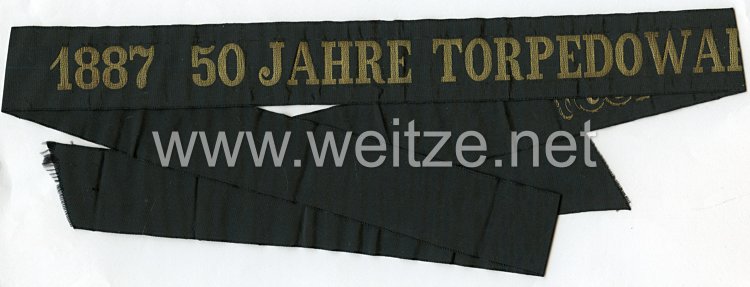
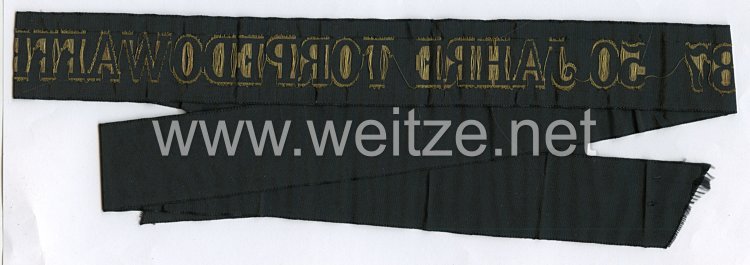
Kriegsmarine Commemorative Cap Tally "1887 50 Jahre Torpedowaffe 1937"

in the old Latin script, metal thread execution, worn condition, length 112 cm.
311400
60,00

Kriegsmarine Commemorative Cap Tally "1887 50 Jahre Torpedowaffe 1937"

Kriegsmarine Commemorative Cap Tally “1887 50 Jahre Torpedowaffe 1937”

This cap tally of the Kriegsmarine represents a significant commemorative piece marking half a century of German torpedo boat tradition. The inscription “1887 50 Jahre Torpedowaffe 1937” (50 Years of Torpedo Weapons) in old Latin script and the elaborate metal thread execution make this tally a remarkable testament to German maritime history.

Historical Background of the Torpedo Weapon

The torpedo weapon fundamentally revolutionized naval warfare in the late 19th century. In 1887, Germany began the systematic construction of a torpedo boat fleet, which would establish itself as a decisive weapon branch of the Imperial Navy. The first German torpedo boats were small, fast vessels equipped with self-propelled torpedoes, revolutionizing the power of smaller naval units against large battleships.

By the 50th anniversary in 1937, the torpedo weapon had long since established itself as an indispensable component of German naval forces. The Kriegsmarine, under the supreme command of the National Socialist leadership, was at this time in a phase of intensive expansion as part of the rearmament program.

Cap Tallies in the Kriegsmarine

Cap tallies were an essential component of German naval personnel uniforms since the Imperial era. They were worn on the peaked cap or the round sailor's cap and served to identify the unit or ship to which a sailor belonged. The tradition of cap tallies dates back to the 19th century and was continued by the Kriegsmarine after 1935.

Regular cap tallies typically bore the name of a ship or unit. Commemorative tallies like this jubilee band, however, were issued and worn on special occasions. They documented historical events, anniversaries, or special traditions of individual weapon branches.

The Metal Thread Execution

The metal thread execution was a high-quality manufacturing technique in which gold or silver-colored metal threads were woven into the black base fabric. This elaborate production method was typical for commemorative tallies and bands for special occasions. Unlike simple printed or embroidered versions, metal thread tallies demonstrated higher quality and were often worn on ceremonial occasions or by members of specific units.

The old Latin script, also known as Fraktur, was the common typeface in the German Reich until the late 1930s. It gave the cap tally a traditional and official character that emphasized the connection to the Imperial past.

The Anniversary Year 1937

The year 1937 was of considerable significance for the Kriegsmarine. Germany was in the midst of its fleet rearmament program, and the navy was expanding rapidly. The emphasis on traditions and the cultivation of historical continuities served to create identity and motivation among crews. Anniversaries such as the 50th anniversary of the torpedo weapon were celebrated accordingly through special events, parades, and indeed through special uniform items such as commemorative cap tallies.

The torpedo weapon had developed considerably since 1887. From the early torpedo boats of the Imperial era to the modern destroyers and fast attack craft of the 1930s, as well as the U-boats that carried the torpedo as their main weapon, the technology had improved dramatically. The range, accuracy, and destructive power of torpedoes had increased many times over.

Wearing and Use

A cap tally of this type was worn around the cap, being fastened with a closure at the back of the head. The length of approximately 112 cm was standardized and allowed wearing around various cap constructions. The worn condition of this specimen indicates that it was actually used in service and not merely kept as a souvenir.

Significance as Historical Document

Such commemorative cap tallies are today important testimonies of naval history. They document not only the technical and organizational development of naval forces but also the self-perception and tradition formation within the navy. The anniversary band of 1937 stands symbolically for the continuity between the Imperial Navy and the Kriegsmarine, which was deliberately maintained despite the political regime change.

At the same time, the band must be seen in the context of its time of origin: the Kriegsmarine was an instrument of National Socialist Germany and would march into the devastating Second World War a few years later. The torpedo weapon would play a central and controversial role in this conflict, particularly through submarine warfare.