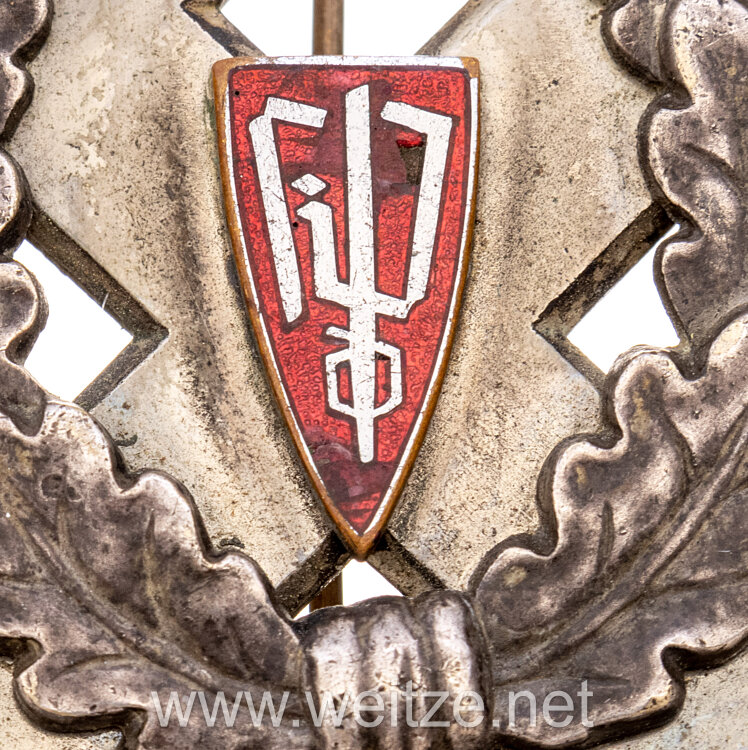
The Badge of Honor of the Carpathian German Party from 1938 represents a significant chapter in the history of German minorities in Central Europe during the interwar period and the dramatic political upheavals on the eve of World War II.
The Carpathian Germans formed a historic German minority primarily residing in Slovakia. Their roots extended back to the Middle Ages, when German settlers arrived in the region in several waves. After the collapse of the Austro-Hungarian Monarchy in 1918 and the establishment of the Czechoslovak Republic, the Carpathian Germans became a national minority in the new multinational state. Czechoslovakia granted German minorities extensive cultural rights, including the right to their own schools, associations, and press organs.
In 1929, the Carpathian German Party (Karpatendeutsche Partei, KP) was founded to politically represent the interests of the German population in Slovakia. Initially, the party developed as a conservative, ethnically-oriented organization advocating for the preservation of German language and culture. However, in the early 1930s, the party increasingly found itself caught between democratic traditions and the radical political currents emanating from National Socialist Germany.
A decisive turning point came in 1935, when the Carpathian German Party entered into an electoral alliance with the Sudeten German Party (SdP) under Konrad Henlein. This cooperation marked the beginning of a stronger orientation toward National Socialist Germany. The Sudeten German Party had already developed into a mass movement that openly sympathized with the NS regime and adopted its ideological concepts.
The year 1938 brought dramatic changes to the entire region. Following the Munich Agreement of September 29, 1938, Czechoslovakia was forced to cede the Sudeten German territories to the German Reich. In this climate of political upheaval, the transformation of the Carpathian German Party into the German Party (Deutsche Partei, DP) took place in October 1938. This transformation occurred in close alignment with the NSDAP in the German Reich and signified complete coordination with National Socialist ideology.
The badge of honor described here dates from precisely this transitional phase of 1938. Measuring approximately 58 millimeters in diameter, it is a silver-plated pin badge whose design reflects the ideological reorientation. The central motif shows an upright swastika surrounded by an oak leaf wreath—both characteristic elements of National Socialist symbolic language. At the center is the enameled badge of the Carpathian German Party, symbolizing historical continuity with the original organization.
The combination of these symbolic elements is historically revealing: The oak leaf wreath had embodied strength, permanence, and national identity in German tradition since the 19th century. The swastika had been the official symbol of the NSDAP since 1920 and became the universal emblem of National Socialism. The integration of the original party badge into this new symbolic order demonstrates an attempt to connect the historical legitimacy of the Carpathian German movement with the new National Socialist orientation.
Such badges of honor were typically awarded to deserving party members, functionaries, and supporters. They served both as recognition for special achievements and as visible signs of belonging to the political movement. The rarity of this badge can be explained by several factors: The Carpathian German Party was a relatively small organization comprising only a few thousand members. Moreover, the period of its existence in its transformed form was very brief, as the region's political landscape underwent rapid changes after 1938.
After the destruction of the remainder of Czechoslovakia in March 1939, Slovakia became a nominally independent but actually German-dependent state under Jozef Tiso. The German Party functioned as the political representation of the German minority in the Slovak state and was closely connected with the NS regime. After the end of World War II in 1945, most Carpathian Germans were expelled or resettled from Czechoslovakia, bringing the history of this political organization to an end.
From a historical perspective, this badge of honor documents the process of political radicalization of German minorities in Central Europe under the influence of National Socialism. It stands exemplarily for the transformation of originally ethnically-oriented, conservative organizations into coordinated instruments of NS foreign policy. Today, such objects are important witnesses for research into the complex relationships between German minorities, their host states, and National Socialist Germany in the period before and during World War II.