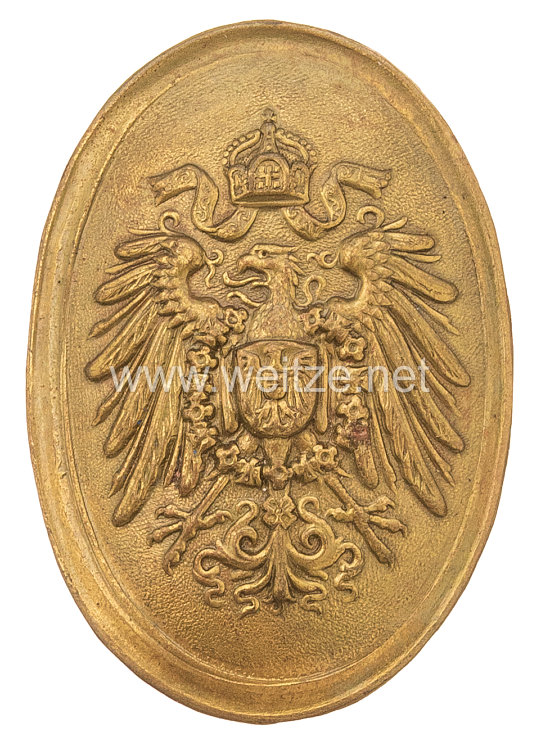
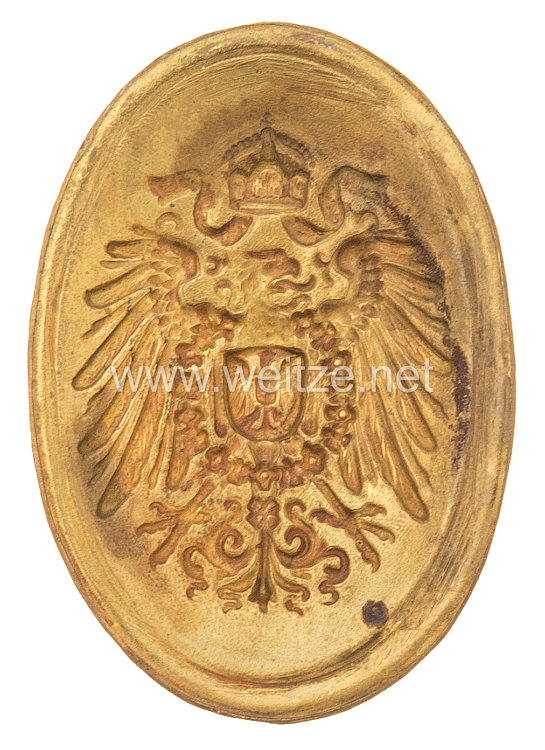
German Reich Small Fitting with Imperial Eagle for Mounted Gendarmerie Bandolier

Circa 1910. Brass, dimensions approximately 3.25 x 5.4 cm, reverse side still without split pins. Unworn, condition 2.
431500
120,00

German Reich Small Fitting with Imperial Eagle for Mounted Gendarmerie Bandolier

This Imperial Eagle fitting for the bandolier of the mounted gendarmerie of the German Empire represents a significant testament to Prussian-German police history around 1910. This brass equipment piece, measuring 3.25 x 5.4 cm, embodies the organizational and symbolic connection between military tradition and state law enforcement authority in the Imperial era.

The mounted gendarmerie held a special position in the German Empire. It evolved from Prussian military traditions and increasingly assumed police duties in rural areas and smaller towns from the mid-19th century onward. Gendarmes were typically stationed in the countryside, where they maintained peace and order, monitored transportation routes, and served as the extended arm of state authority. Their military character was evident not only in their organizational structure but also in their uniforms and equipment.

The bandolier, also called shoulder belt or baldric, was an essential component of mounted units' uniforms. It ran diagonally across the wearer's chest and served both practical and representative purposes. Various pieces of equipment were attached to it, and it emphasized the military appearance of the gendarmes. The fittings that adorned the bandolier were not merely functional connecting elements but also symbols of state authority.

The Imperial Eagle depicted on this fitting was the central sovereign emblem of the German Empire since its founding in 1871. It symbolized national unity under Prussian leadership and continuity with the medieval tradition of the Holy Roman Empire. In the uniforming of state organs, the Imperial Eagle played a central role as a sign of legitimation. Its use on gendarmerie equipment underscored their function as representatives of Imperial authority.

The manufacture from brass was typical for such fittings around 1910. Brass offered several advantages: it was relatively inexpensive, easy to work and cast, corroded less than iron, and retained its gold-like luster that corresponded to military aesthetics. The craftsmanship quality of such fittings varied by manufacturer, but they were generally produced by specialized firms that focused on military effects.

Particularly noteworthy is the condition of this specimen: reverse side still without split pins and unworn. This indicates that it is a never-used piece, possibly warehouse stock or an unissued example. The split pins, small metal pins for attachment to the leather strap, were normally affixed during issue or equipment fitting. The absence of these fastening elements makes this piece a rare example of a manufacturing state.

The gendarmerie in the German Empire was organizationally subordinate to the War Ministry but was employed for police purposes. Gendarmes were recruited predominantly from former army non-commissioned officers who transferred to gendarmerie service after their military service. This explains the strong military influence in training, uniform, and bearing. Mounted units were particularly indispensable in extensive rural areas where they had to monitor large districts.

Around 1910, the German Empire was in a phase of relative internal stability but also increasing social tensions. The gendarmerie played an important role in maintaining public order, monitoring assemblies, and enforcing state ordinances. The representative appearance, to which such fittings contributed, was meant to embody authority and state power.

After World War I and the end of the Empire in 1918, such Imperial Eagle fittings lost their official use. The newly founded Weimar Republic introduced new sovereign symbols, and the gendarmerie was reorganized. Many Imperial equipment pieces were stored, sold, or privately kept, which explains why unworn examples still exist today.

For collectors and historians, such fittings are valuable testimonies to the material culture of the Imperial era. They document not only the craftsmanship of the time but also the symbolic communication of state power. The unworn condition makes this example particularly interesting for researching manufacturing techniques and the original appearance of such objects.