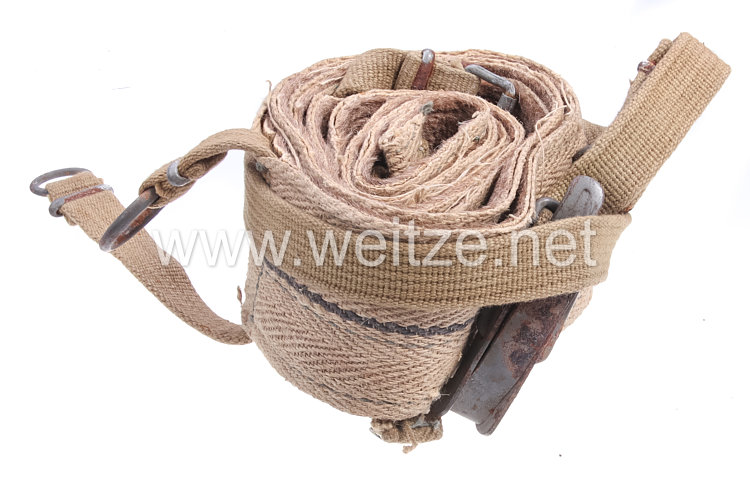
Wehrmacht Gebirgsjäger Single Climbing Skin for Skis

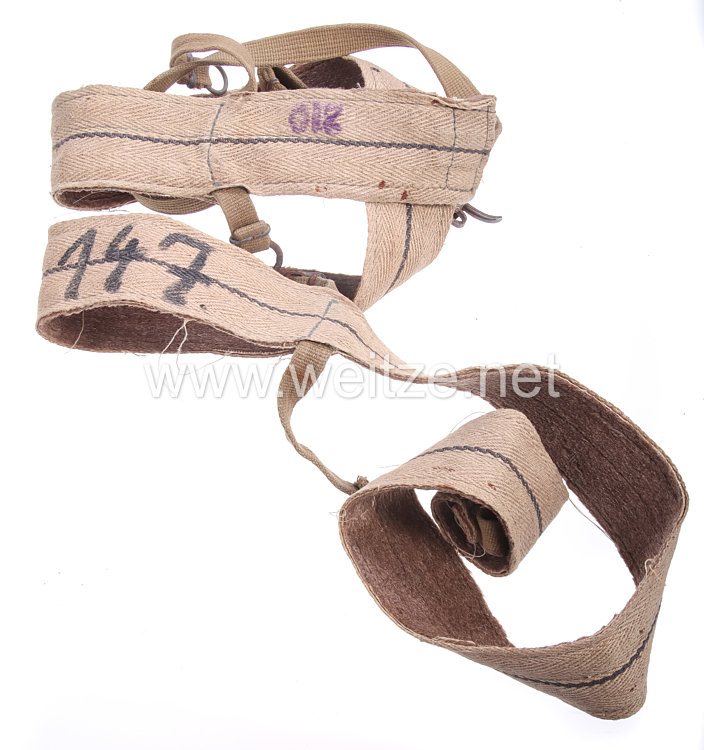
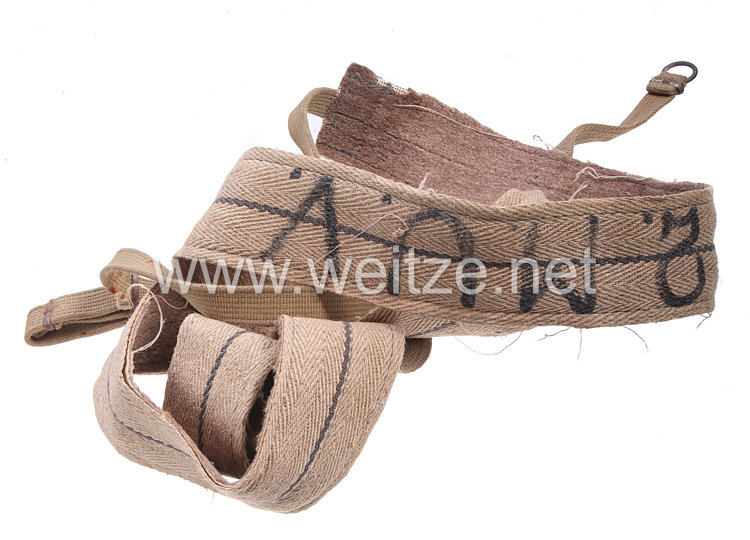
Underside with fur, upper side of linen, front with loop for attachment, underside marked with "210" as well as "147" and "2. M.U.V". Length without straps approx. 168 cm, heavily used, condition 3-
399999
175,00

Wehrmacht Gebirgsjäger Single Climbing Skin for Skis

The climbing skin (German: Steigfell or Skifell) was an indispensable piece of equipment for German Gebirgsjäger (mountain troops) during World War II. This individual ski climbing skin represents the specialized equipment developed for winter warfare in alpine and Nordic regions.

Technical Construction and Design

This climbing skin displays the typical construction of such equipment: the underside is covered with genuine fur, while the upper side is made from robust linen fabric. With a length of approximately 168 cm without straps, this corresponds to the standardized measurements for Wehrmacht climbing skins. The front loop served to attach the skin to the ski, with various fastening systems being employed. The markings “210,” “147,” and “2. M.U.V” (Musterungsverwaltung - inspection administration) on the underside indicate military origin and administrative tracking.

Function and Application

Climbing skins were attached under the running surface of skis and enabled soldiers to ascend even steep slopes. The principle was based on the natural structure of the fur: in the forward direction, the hairs lay flat allowing gliding, while when sliding backward they stood up providing grip. This technique had been known in alpine regions for centuries and was adapted for military purposes. For mountain warfare in Norway, Finland, the Alps, and later in the Caucasus, this equipment was of crucial importance.

The Gebirgsjäger and Winter Operations

German mountain troops were systematically trained for combat in mountainous and winter regions from the 1930s onward. Following the establishment of the first mountain divisions in 1935 and 1938, this branch expanded considerably. During Operation Weserübung (the invasion of Norway in 1940) and particularly during the war against the Soviet Union from 1941 onward, winter and alpine combat conditions were routine.

The training of Gebirgsjäger included intensive ski instruction. Soldiers had to master not only skiing with full equipment but also the maintenance and proper application of specialized gear such as climbing skins. Mastery of these techniques could mean the difference between life and death, especially during operations in Finland and northern Norway, where temperatures below -40°C were common.

Material Procurement and Production

The manufacture of climbing skins required considerable quantities of animal pelts, typically from seals, cattle, or other animals with suitable fur structure. As the war progressed, material shortages led to quality problems and substitutions. The marking “M.U.V” (Musterungsverwaltung) indicates the military quality control and inventory management practiced in the German army supply system.

Theaters of Operation and Historical Context

Climbing skins were deployed in all winter warfare theaters. They were particularly significant during:

The campaigns in Norway (1940-1945), where mountain troops were deployed to secure occupied territory. Operations in Finland (1941-1944), especially during Operation Silver Fox and fighting in the Arctic Circle. The winter battles on the Eastern Front, where inadequate winter equipment led to catastrophic losses. Mountain troops were better equipped than regular infantry units. The fighting in the Italian Alps (1943-1945) during the Italian campaign.

Condition and Collector Value

The stated heavy use condition (condition 3-) of this climbing skin is typical for equipment actually deployed in the field. Many such objects were used under extreme conditions and show corresponding wear. The preservation of markings and the completeness of the object are valuable for historical studies, as they provide insights into production standards, logistics, and actual usage.

Historical Significance

Climbing skins such as this are silent witnesses to the adaptation of military equipment to extreme environmental conditions. They represent the Wehrmacht's specialization for different theaters of war and the importance placed on proper equipment for survival in winter mountain regions. At the same time, they remind us of human suffering in these inhospitable deployment areas, where besides enemy fire, nature itself was often the deadliest adversary.

These artifacts serve as tangible connections to the experiences of soldiers who fought in some of the most challenging environments of World War II, where technical proficiency with equipment like climbing skins was as essential as combat training itself.