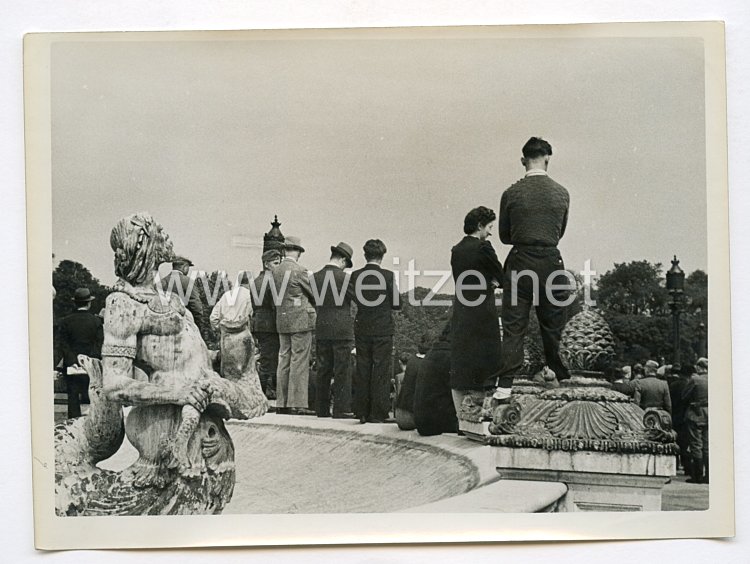
Press Photograph, Occupation of France 1940:
Press Photography from the Occupation of France 1940
German press photographs from the Western Campaign of 1940 represent significant historical documents that reflect both the military warfare and propagandistic staging of the Third Reich. These photographs were produced as part of war reporting and served to deliberately influence public opinion both domestically and abroad.
The Western Campaign, which began on May 10, 1940, led within a few weeks to the occupation of the Netherlands, Belgium, Luxembourg, and large parts of France. The German Wehrmacht employed for the first time on a large scale the tactic of Blitzkrieg, which relied on rapid armored advances and close air support. On June 14, 1940, German troops marched into Paris, and on June 22, the armistice was signed in the forest of Compiègne – symbolically in the same railway car where Germany had accepted defeat in 1918.
The Wehrmacht's Propaganda Companies (Propaganda-Kompanien or PK) played a central role in documenting these events. These units were created in 1938 at the suggestion of Propaganda Minister Joseph Goebbels and placed under the High Command of the Wehrmacht (OKW). The PK personnel were trained journalists, photographers, and cameramen who were simultaneously soldiers and advanced with the fighting troops. Their task was to provide material for the newsreels, newspapers, and magazines.
The technical equipment of the war correspondents included modern cameras such as the Leica or Contax, which were particularly suitable for front-line deployment due to their compactness and reliability. The standard formats of press photos were typically 13 x 18 cm or 9 x 12 cm, corresponding to the described object. These prints were usually made on baryta paper and often bore stamps from the propaganda departments, captions, and censorship marks on the reverse.
The motifs of the French photographs were diverse: they showed marching troops, tank columns, conquered cities, capitulated French soldiers, but also staged shots of German soldiers in front of famous landmarks such as the Eiffel Tower or the Arc de Triomphe. Particularly popular were images demonstrating the supposed superiority of the German Wehrmacht and the discipline of the troops. The photographs were intended to strengthen the will to victory at home and emphasize Germany's military might abroad.
Control over the photographic material was strictly regulated. All photographs had to pass the censorship of the propaganda departments before they could be published. The Reich Press Chamber and the Reich Ministry for Public Enlightenment and Propaganda supervised distribution. Images showing fallen German soldiers, destroyed German vehicles, or other negative aspects were generally not approved for publication.
For collectors and historians today, these press photographs are important sources for researching the warfare and propaganda work of World War II. The condition of such photographs is usually rated on a scale from 1 (excellent) to 5 (poor), with condition 2 corresponding to very good preservation with possibly minor signs of use.
The authenticity of historical press photographs can be verified through various characteristics: the paper quality and texture of the period, possible reverse stamps, inscriptions in contemporary handwriting, as well as photographic technique and image composition. Original prints from the period differ markedly from later reproductions.
After the war, large quantities of German press photographs were confiscated and archived by the Allies. Many are now held in state archives such as the Bundesarchiv in Koblenz, the National Archives in Washington, or the Imperial War Museum in London. Private collections supplement these public holdings and contribute to preserving this visual heritage.
Scholarly engagement with these photographs requires a critical eye, as they were primarily created as propaganda instruments and often distorted the reality of war. Nevertheless, they offer invaluable insights into the era and serve as memorials against war and totalitarian systems.