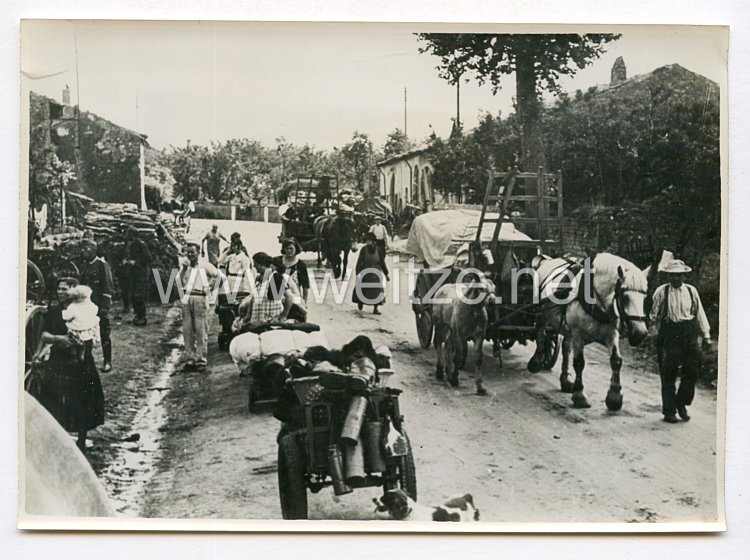
Third Reich Press Photo. French Refugees Returning Home. July 5, 1940.
This Third Reich press photograph dated July 5, 1940, documents a significant moment in the early phase of World War II – the return of French refugees to their homes following the German occupation of France. This document serves as testimony to the extensive Nazi propaganda machinery, which employed photography as an important medium for controlling public opinion.
In the spring of 1940, the German Reich launched its Western Campaign, beginning on May 10, 1940, with the invasion of the neutral countries of Belgium, the Netherlands, and Luxembourg. The German Wehrmacht broke through French defensive lines at Sedan and reached the Channel coast by May 20. This rapid military success led to one of the largest refugee movements in European history. An estimated six to ten million people fled southward before the advancing German troops – this exodus became known as “L'Exode”.
On June 22, 1940, the Armistice of Compiègne was signed in the Forest of Compiègne, dividing France into different zones: an occupied zone in the north and west, and an initially unoccupied zone in the south under the Vichy government of Marshal Philippe Pétain. Following the armistice, the difficult return of refugees began, many of whom had left behind all their possessions and now found destroyed or looted homes.
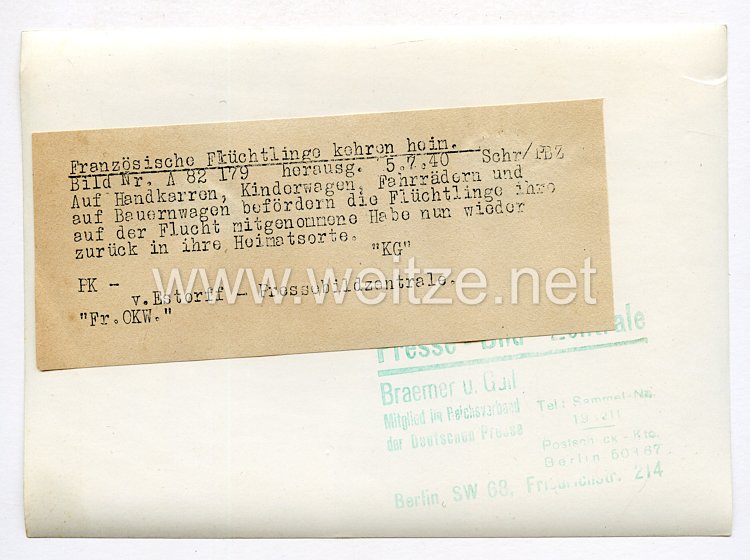
The Reich Ministry of Public Enlightenment and Propaganda under Joseph Goebbels strictly controlled the visual reporting of the war. Press photographs like this were taken by authorized war correspondents and photographers assigned to military units. Images underwent a multi-stage censorship and approval process before being released for publication. The reverse of such photographs typically bore stamps from propaganda companies, captions, and instructions for editorial use.
The depiction of returning French refugees served several propaganda purposes: it was meant to suggest “normality” under German occupation, demonstrate the alleged generosity and orderliness of German administration, and simultaneously contrast the weakness and chaos of the French government before the armistice. Such images were used both in German publications and in the controlled press of occupied territories.
The Wehrmacht's Propaganda Companies (PK) were specialized units founded in 1938. They consisted of journalists, photographers, cameramen, and radio reporters who documented military operations and shaped public perception of the war. By 1944, approximately 15,000 men served in these units. The materials they produced were forwarded to the German News Bureau (DNB) and other media channels.
The format of approximately 13 x 18 cm corresponds to the standard for press photographs of that era. This size was practical for archiving and could easily be reproduced for various print formats. The reverse notation typically included the date, a caption, information about the photographer or PK unit, and publication instructions. Such annotations are important sources for historians today to understand the origin and context of the images.
The situation of the French civilian population in the summer of 1940 was precarious. Many refugees returned to destroyed towns and villages, finding their homes looted or occupied by German troops. Infrastructure was heavily damaged, bridges destroyed, and transportation routes disrupted. The German occupation authorities established a strict control system with curfews, travel permits, and rationing.
Today, such press photographs from the Third Reich are important historical documents that record both the events themselves and the manner in which these events were presented by Nazi propaganda. They require critical analysis that considers the propagandistic intent behind the image composition and distribution. Collectors and researchers preserve these materials as testimonies of a dark period in history, serving as warnings and prompting engagement with totalitarian manipulation.
These photographs provide insight into the sophisticated visual propaganda strategies employed by the Nazi regime. The careful staging, selection, and distribution of images were integral to maintaining control over both domestic and international perception of German military actions. Understanding this context is essential for interpreting such historical artifacts properly and recognizing the power of visual media in shaping historical narratives.