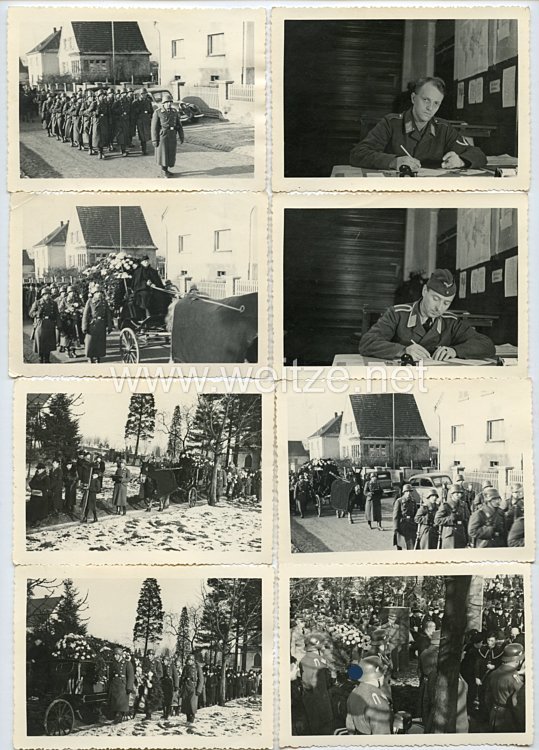
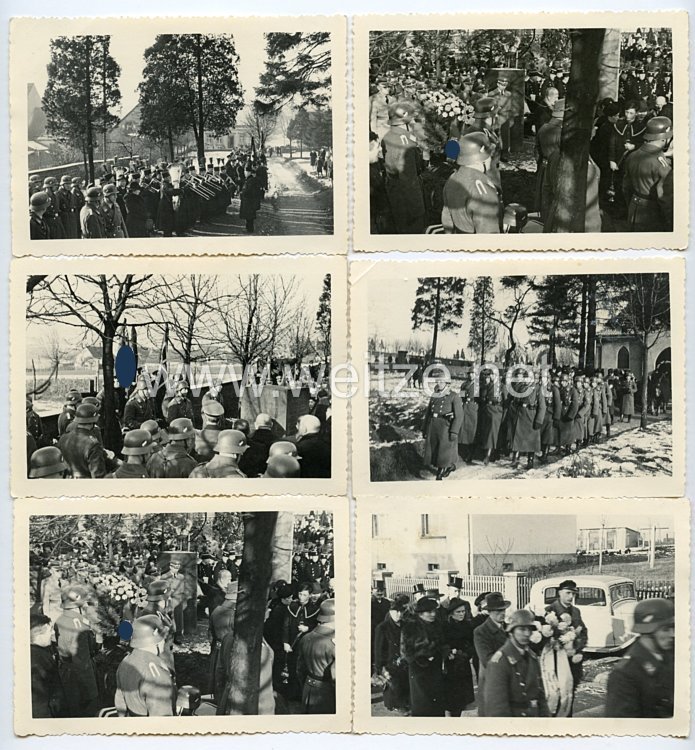
Third Reich Photo Group, Soldier's Funeral
This Third Reich photograph collection documenting the funeral of a soldier represents a significant aspect of military mourning culture and memorial practices during World War II. Such photo collections from the period between 1933 and 1945 are important historical testimonies that provide insights into burial rituals, military ceremonies, and the handling of fallen soldiers in the Wehrmacht.
During World War II, a standardized practice for military funerals developed that combined both traditional Prussian-German military traditions and specifically National Socialist elements. The Heeresdienstvorschrift (HDv) and other military regulations prescribed in detail how soldiers' funerals were to be conducted. These ceremonies were intended both to honor the fallen and to serve propagandistic purposes, strengthening comradeship and the concept of sacrifice.
Military burials in the Third Reich typically included several formalized elements: The coffin was often covered with the Reich War Flag or a swastika flag, an honor guard of the deceased's comrades formed ranks, and officers delivered memorial speeches. Depending on the rank of the deceased and local circumstances, salute shots might be fired. Photographic documentation of such events was widespread, both through official war correspondents and private photographs taken by comrades.
The significance of photography in the military context of the Third Reich cannot be underestimated. The Oberkommando der Wehrmacht (OKW) and the Propaganda Companies (PK) deliberately employed photography as a means of documentation and propaganda. Simultaneously, technical advances and the increasing availability of small-format cameras made it possible for ordinary soldiers to take private photographs. Such personal photo collections served as memories and were often sent to relatives or preserved after the war.
The condition rating of 2 for this photograph collection indicates relatively good preservation, which is remarkable for photographs from this period. Many photographs from World War II have suffered from improper storage, moisture, or mechanical damage. The 14 photographs in this collection likely offer a coherent documentation of a single burial ceremony, from the laying out of the body through the religious or secular memorial service to the interment.
Historical research uses such photo collections as important sources for various aspects: They provide information about uniforms, rank insignia, military equipment, and the specific procedures of ceremonies. They also enable insights into the emotional dimension of war and show how death and mourning were dealt with. The fact that such photographs were taken and preserved speaks to the importance attached to individual commemoration even within the military mass organization.
In the broader context of National Socialist commemoration of the fallen, photographic documents played an important role. The Nazi state developed a comprehensive cult practice around the “heroes” of war, which found expression in monuments, memorial ceremonies, and not least in visual media. At the same time, these practices served ideological penetration and were meant to prepare the population for further sacrifices.
After the war, such photographs acquired new significance as historical documents. Today they are preserved in archives, museums, and private collections and serve historical research, memorial culture, and sometimes the identification of fallen soldiers or the location of graves. The scholarly handling of such materials requires critical contextualization that considers both propagandistic aspects and human dimensions.