Third Reich - “Fight Against Hardship - Protect Mother and Child”
Porcelain Badges "Fight Against Hardship - Protect Mother and Child" from the Third Reich
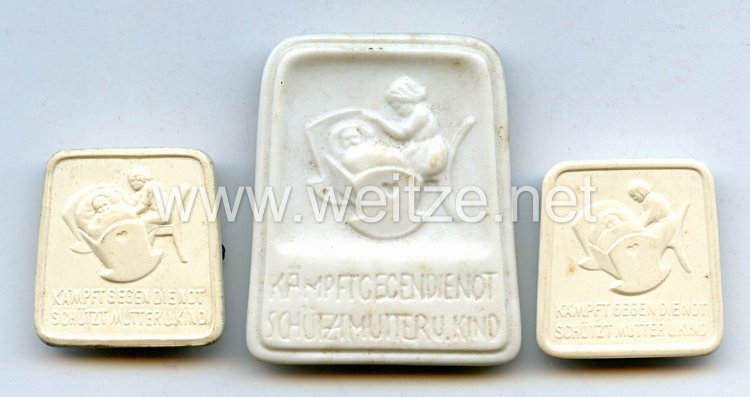
These three porcelain badges bearing the inscription "Kämpft gegen die Not - Schützt Mutter und Kind" (Fight Against Hardship - Protect Mother and Child) represent a significant chapter in National Socialist social propaganda between 1933 and 1945. These badges were issued as part of the Winterhilfswerk des Deutschen Volkes (WHW) or Winter Relief Organization, one of the largest propagandistic charitable organizations of the Nazi regime.
The Winter Relief Organization was founded in September 1933 under the patronage of Reich Propaganda Minister Joseph Goebbels and was officially intended to support needy Germans during the winter months. In reality, it primarily served as an instrument of Volksgemeinschaft (people's community) propaganda and financial strengthening of the NSDAP. The organization collected millions of Reichsmarks annually through street collections, workplace collections, and the sale of badges.
The production of porcelain badges for the WHW began in the mid-1930s and represented a special category within the diverse badge production. Renowned German porcelain manufacturers such as Allach, Meissen, Rosenthal, and others participated in producing these collectibles. The use of porcelain gave the badges a higher perceived value and was intended to increase willingness to donate.
The motto "Fight Against Hardship - Protect Mother and Child" reflects National Socialist family and population policy. Nazi ideology propagated a traditional image of women, in which women were primarily portrayed as mothers and guardians of the family. The protection of mother and child was a central theme of Nazi propaganda, closely linked to the regime's racial policies. Programs such as Lebensborn and the promotion of large "Aryan" families were part of this policy.
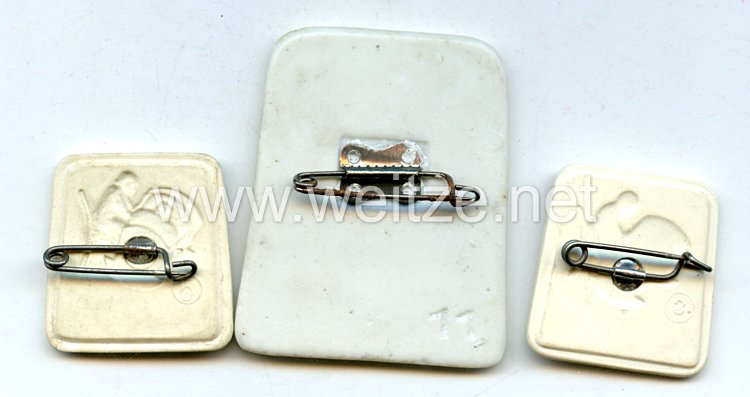
The technical execution of these badges as pin-on porcelain pieces required specialized craftsmanship. The porcelain elements were fired, painted or decorated with overglaze colors, and then fitted with a metal pin. The quality of execution varied considerably depending on the manufacturer and year of production. The stated condition 2 indicates well-preserved examples with minimal signs of wear, which is remarkable given the fragile nature of porcelain.
Wearing these badges was socially strongly desired and practically obligatory during the Nazi era. Those who did not wear a WHW badge exposed themselves to suspicion of not belonging to the Volksgemeinschaft or rejecting National Socialist ideology. This led to considerable social pressure that made the collections extraordinarily successful. Between 1933 and 1945, an estimated 8.7 billion Reichsmarks were collected through the WHW.
The artistic design of WHW badges was diverse, ranging from regional costumes to historical motifs and ideological representations. Badges featuring mother-and-child motifs were among the most common themes and were produced in various series and versions. The porcelain variants were particularly sought after by collectors.
After 1945, these badges became historical documents of a dark epoch in German history. Their collection and scientific documentation is now part of coming to terms with the Nazi period. While some of these objects had a purely decorative character, they all served a propagandistic purpose and financed the Nazi regime. The preserved examples in museums and private collections are important witnesses to the everyday culture and propaganda of the Third Reich.
For collectors and historians, these porcelain badges offer insights into production techniques, iconography, and propaganda methods of the Nazi era. They document how the regime instrumentalized even seemingly harmless themes such as mother and child for its ideological purposes and integrated the entire society into its propaganda system.